Categories
Startups

Tech company or X company?

Simple was one of the original app-first banks with a focus on transparency and user experience. It announced recently that it would be shutting down.

I think it’s unfortunate. Simple was the model for the startup I’m at today, which had set out to build what is now called a “neo-bank”. Its 2014 sale to the European bank BBVA was a big inspiration.

I found this most notable about Simple’s demise:

The Portland company faltered as it tried to resolve a central tension over whether it was foremost a bank or a tech company.

That paragraph linked to a Jan 2019 article that explored this further:

Simple has long struggled with the central question of whether its priorities lay in banking or technology. A bank must be dependable, steady and unfailingly reliable. It’s holding people’s money, after all.

A tech company is a different beast, nimble and imaginative, revolutionary and willing to accept failure so long as it innovates.

To Reich [the founding CEO], there was no question about Simple’s identity: It was, and would always be, a tech company. Last year’s overhaul was engineered to make that plain, sacrificing a measure of growth to focus on developing and introducing new banking services.

Over a decade ago the Internet legend Yahoo! famously tackled the same question – was it a tech company or a media company? As it spent years navel-gazing attempting to answer what should never have been a question, it found itself becoming increasingly irrelevant, ultimately being sold for parts.

In my experience there is such a thing as company DNA. When a startup’s founded as a tech company, I don’t think it can ‘become’ anything else.

If you find yourself asking if you’re a tech company or you’re X, you’re in big trouble.

Categories
Data Custody Privacy and Anonymity Products and Design The Dark Forest of the Internet Wellness when Always-On

Why you shouldn’t delete Whatsapp and move to Signal

The Ars Technica website has a solid explanation of Whatsapp’s new privacy policy changes, which involve sharing extensive data about your Whatsapp usage with Facebook, Whatsapp’s parent company.

Whatsapp has been sharing data with Facebook since 2016, but earlier you had one chance to opt out of it. With the prompt you saw last week, it’s now mandatory – if you didn’t opt in this time, you won’t be able to use the app after 8 Feb 2021.

Now. Whatsapp claims it cannot read the actual contents of your chats – the company says those are encrypted end to end, in a way that even Whatsapp/Facebook can’t unscramble, in fact using technology from the privacy-focused app Signal.

But metadata – “data about data” – is not encrypted. This is your activity in the app:

  • Who you chat with
  • When and how often you chat with them
  • Whether you send multimedia,
  • Whose profiles you search and look at,
  • Whose statuses you check,
  • who you call on the app, when and for how long

All of this is sent as one long, continuous stream of data. The plan is almost certainly to match this with similar data collected by the Facebook and Instagram apps, and the thousands of other apps that use the Facebook ‘SDK’ for ads/tracking, to build a detailed picture of you.

So. Now that you know this, should you move off Whatsapp to Signal, as Elon Musk suggested on Twitter?

In general, no. You shouldn’t move off Whatsapp and move to Signal.

Is this you?

  • You have a Facebook account
  • You stay logged into it on one tab while you browse other sites on the web
  • You run the Facebook app on your phone
  • You have an Instagram account
  • You’ve given either or both FB and Instagram access to your contacts when they asked you at signup
  • You’ve used Log In With Facebook to sign into other apps
  • You hadn’t opted out of sharing Whatsapp data with Facebook when asked a few earlier

If you’ve answered Yes or even I’m not sure to some of these questions,, the Whatsapp policy change really doesn’t make much difference. You’re already sharing data – lots of it – with the Facebook family. Deleting WhatsApp is plugging a few squares in a sieve.

I’m not judging you. Our relationship with technology, especially social media, is highly asymmetric. It isn’t practical for you and me to understand the average privacy policy fully, leave alone that the onus of tracking frequent changes to it is on us. Repeat for each app that we use, and the tracking code from different other companies that that app uses.

Even if you’ve wisened up, even if you’re now uncomfortable with the amount of data the Facebook family of apps collects about you, chances are your friends, family, professional groups don’t care as much – they’ll still happily use them, and they’ll expect you to ‘be’ on these apps too.

Quitting Whatsapp is most effective when you quit the rest of Facebook too. It’ll take time. It’ll take some convincing, it’ll take some re-evaluation of relationships. But you can make it work.

It’s taken even Facebook a few years to hook you enough to get the sheer amount of data it has on you. Give yourself time to rid yourself of it too.

Update: A friend asked me if Facebook was able to collect any less data if one used Instagram in a browser as opposed to the app:

“I signed up [on Instagram] using an email address I created specifically for IG, but it doesn’t take Zuck to figure out that the overlap between the people I talk to on Whatsapp and those that this IG account interacts with means that we’re the same person.”

“Your interaction on Instagram the service reveals more about you than the specific devices you use it on. Sure, the IG app can tell your location more accurately than IG in a browser window can, because the former uses GPS and the latter looks up your IP in a database. But IG in the browser still knows when you log in and for how long, whose profiles you lurk on, what your friend network is and suchlike.”

“When you upload a photo, IG can tell a lot from the photo’s EXIF data: the precise model of the camera you used, phone or otherwise, where you were when you took it, when you took it, among other things. IG can run facial recognition algorithms on them to draw an even more detailed picture of your network. But both of these have little to do with whether you use the app or the browser.”

“If someone spots you at a cafe, you aren’t better hidden if you pulled up to the cafe in an uber as opposed to drove there. The fact remains that you were there and someone saw you. (I am rather bad at analogies but I think this one might actually work)”


(Featured Image Photo Credit: Markus Spiske/Unsplash)

Categories
Discovery and Curation

A short thread on an alternative to big tech’s control over online conversation

Categories
The Next Computer

Mid-2012 unibody Macbook Pro SSD, the three-year update

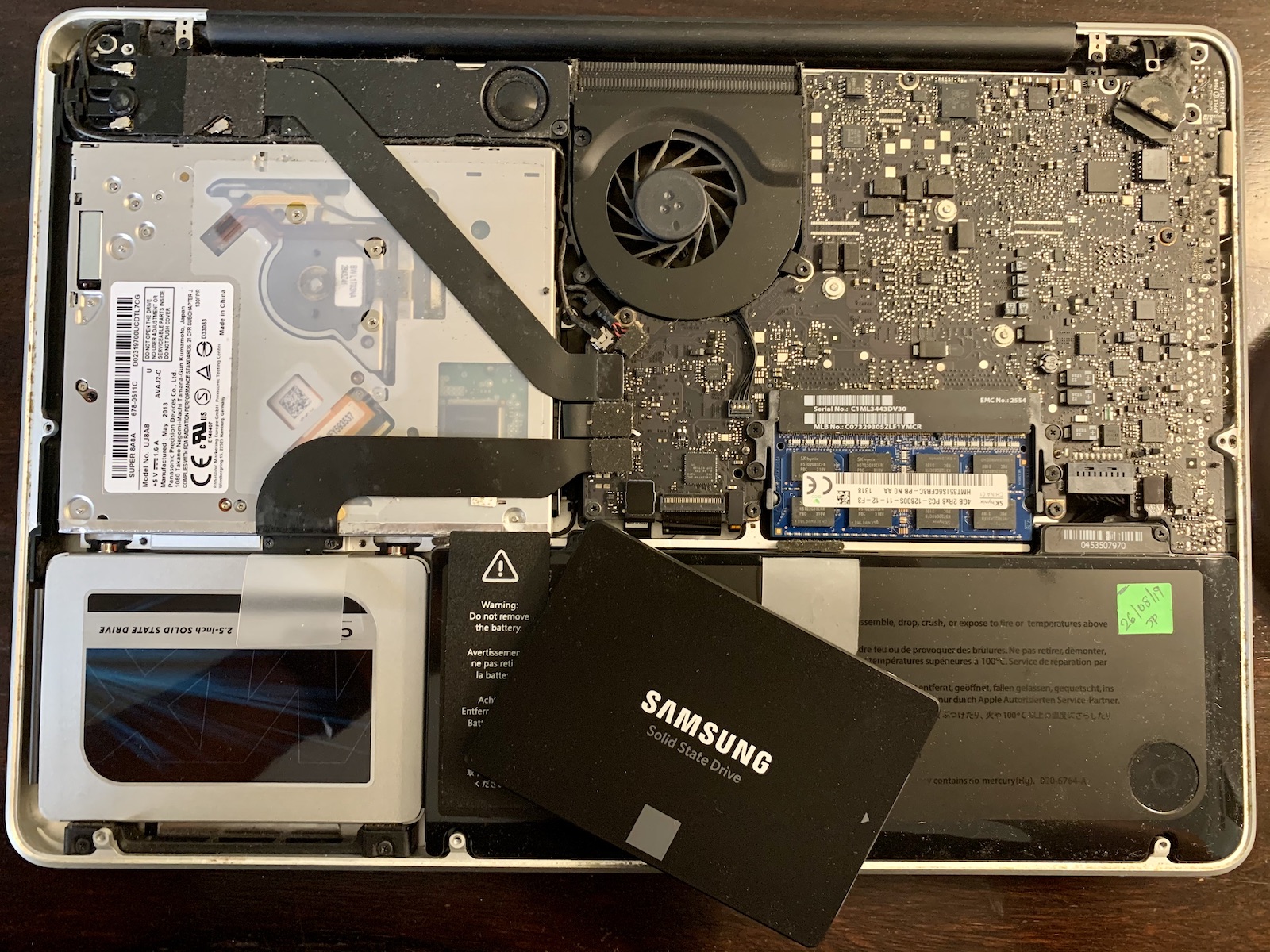
In the middle of 2017, I replaced the spinning hard disk drive in a relative’s unibody pre-retina Macbook Pro with a 250GB SSD. It gave the machine a new lease of life. The machine had a 2.5GHz i5 processor and 8 GB RAM, plenty for back then – the drive was the bottleneck.

As luck would have it, I inherited this machine a couple of years ago and replaced the battery. It’s still plenty fast, and I hook it up to a 2560x1440px 25″ monitor and use it as my main Mac.

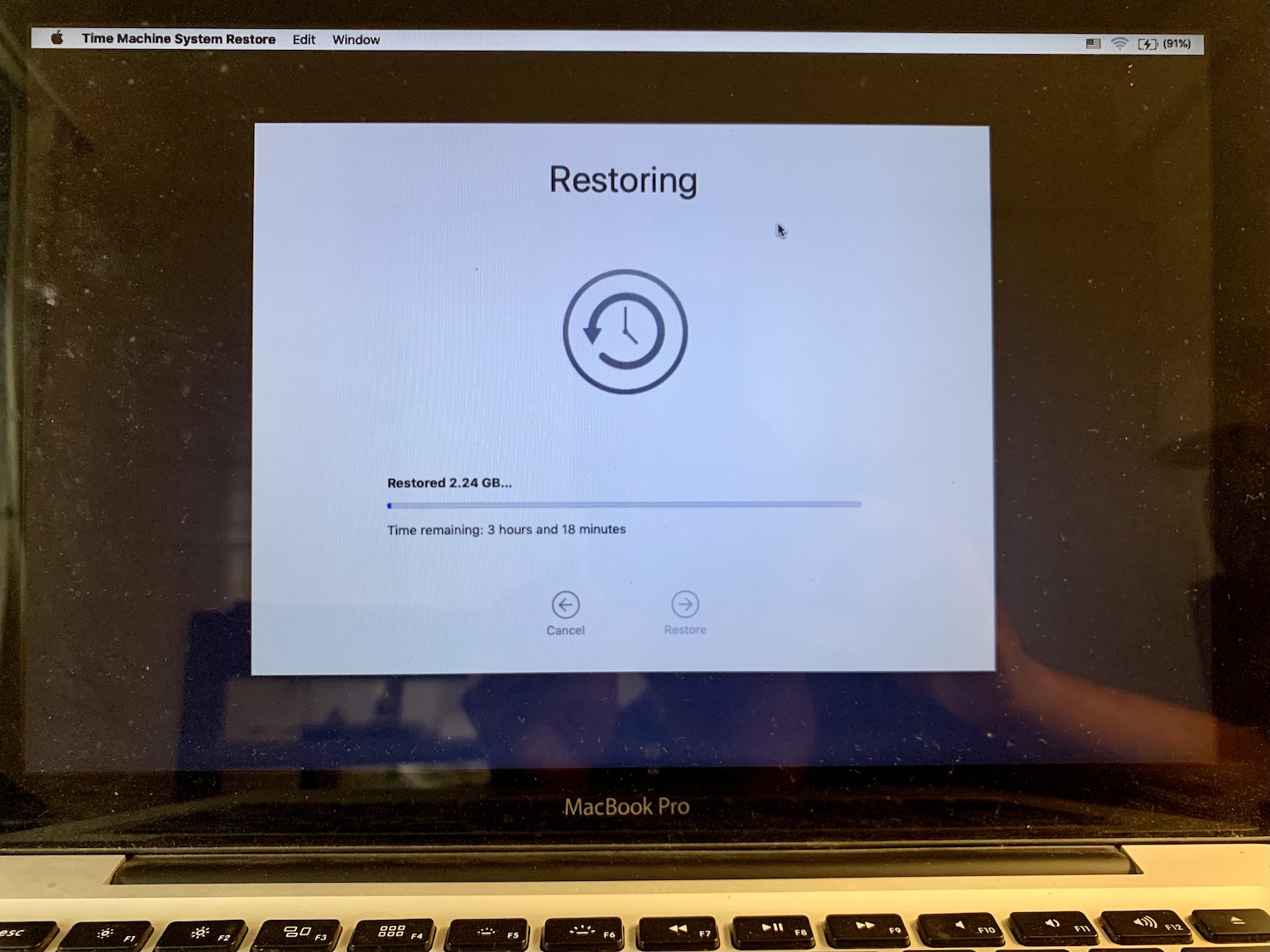
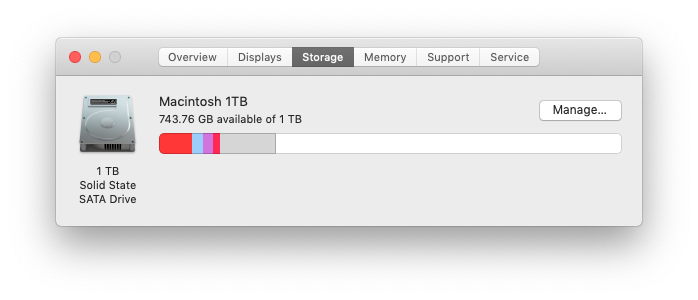
I decided to upgrade the 250 GB SSD when I began to run out of space – I store all my documents, email and music locally even if they are synced online. So I bought a 1TB Crucial SSD that came highly recommended. I followed my own guide from 2017; it only took a couple of hours because I had Time Machine backups handy. I also spent ten minutes of that time gently cleaning away accumulated dust from the internal fan.

In parallel, I bought a case for the old 250GB SSD, which I now use as a USB 3.0 external disk both with this Mac and my iPad Pro. It’s super-light and has no moving parts and I have no concerns tossing it into a bag.

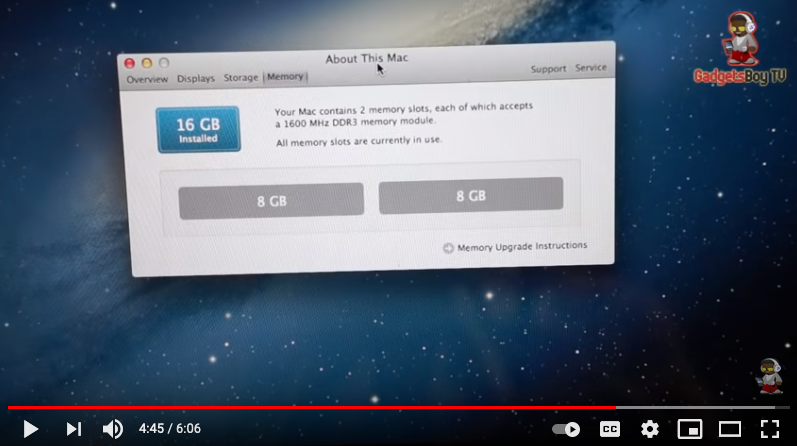
Now I’m considering doubling the RAM. The model officially supports the current installed 8GB, but it’s been commonly upgraded to 16GB.

This sort of upgradability is remarkable because you can no longer do this with newer Macbooks or most laptops. Since upgradability and repairability are two sides of the same coin, it’s also a question of how effectively affordable your machine is.

Categories
Audience as Capital Decentralisation and Neutrality Discovery and Curation The Dark Forest of the Internet

Where will the Trump community congregate after the Twitter and Facebook ban?

From the viewpoint of Twitter, Facebook, Shopify and potential other social media/commerce services, banning and suspending Trump’s account makes sense. It is pretty straightforward for these services to make the case that his posts/tweets violate their terms of service [1].

I’m stuck by how quickly and totally Trump’s influence has been curtailed. His options are now
(a) White House press releases, which he has until the week after next
(b) the group chat app Parler that is popular with the fringe right, but which was also banned by Google Play and has been given notice by Apple’s App Store,
(c) various subreddits, but Reddit has already suspended most of the popular ones
(d) other potential social networks (including, say, the group messaging app Telegram)
(e) his email lists
(f) his own website

Only with his email lists and his own website is Trump fully in control. [2] Perhaps he could set up his own Twitter-like social network on his site with Mastodon. He could set up discussion forums on his site with Vanilla Forums or Discourse. All of this over and above built-in comments on his blog. It is likely that sooner or later Trump or an organisation linked closely to him will set up this sort of infrastructure.

But what he gets back in terms of control he loses in terms of distribution. Anyone who engages with Trump and his community on this website and forums is someone who has joined for that specific reason. No one other than news reporters covering Trump and his network will join.

With an account on broad-based social networks like Twitter, your ‘viral’ messages find their way into the feeds of people who have nothing to do with you. In this way, at least, Twitter works for you, distributing your message in a way that optimises for discovery of your account. You don’t need to pull people in; the platform pushes them to you.

This optimisation is one the most common criticisms of social networks – with an algorithmically picked feed, at its best, you discover new interests, make new friends, understand things better. But at its worst, your feed makes you more anxious, causes more outrage, causes you to be more polarised than you otherwise would be. This is how polemical figures like Trump gain both followers and detractors.

What’s important is that both sides are equally important to his popularity. And there’s an inherent danger in having only supporters on a platform.

On Twitter (and Reddit/Facebook), there have probably been hundreds of thousands of online fights between supporters and detractors of Trump. However ugly they may have been, they have served as an outlet for rage and hatred, a valve for emotional steam stirred up by Trump and TV channels.

For a while, I imagine these online squabbles will continue. But if and when Trump or an entity aligned with him sets up their own online infra like we discussed above, it’s going to be an echo chamber that surpasses subreddits like /r/the_donald or on the chat app Parler. Some of the frenzy may be let out on social media, but the risk is that the majority will play out in the real world.

This is the main second-order risk I see with a ban on Trump’s social media presence. I’m not sure we’ve understood this, leave alone acknowledged it.

[1] Whether it was too late, or whether they enforce these rules arbitrarily or selectively is another debate, and not this site’s focus.

[2] That is, as long as he uses his own infrastructure for them, as opposed to something like Substack for email and a wordpress.com site, which could both be turned off.


(Featured Image Photo Credit: Nareeta Martin/Unsplash)

Categories
Life Design Personal Finance

Five steps to building a positive investing habit – the video

Back in August 2020 I described “five steps to building a positive investing habit” that described how to efficiently set up and automate monthly investments for yourself. Recently, in December 2020, I spoke about it in a thirty minute talk.

Categories
Discovery and Curation Startups

Time, not capital, is an early stage company’s most valuable resource

This somewhat short post lists the software that a small three-member startup says that it happily pays for. There are eight services that total up to USD 171 a month, or a little over two thousand dollars a year.

When you’re an early-stage company, your biggest cost is your opportunity cost of time. Above all else. You can buy yourself that time quite profitably with well designed, highly available software.

I’ve seen – and experienced – a lot of startups that look to conserve money in their early days by either looking to build out software that they use internally, or by repurposing one tool for another use case, or by sticking with the limitations of a free version of an otherwise paid service that was designed to save time.

These companies typically think that their capital on hand is their most precious resource. In trying to be good stewards of that money, they end up working inefficiently with suboptimal tools, creating quite unnecessary overhead for themselves and in many cases incurring early technical debt.

When time is your most valuable resource, evaluate software carefully, then find a way to pay for it.

Categories
Investing Personal Finance

What explains the gap between the roaring US stock market and its indifferent economy?

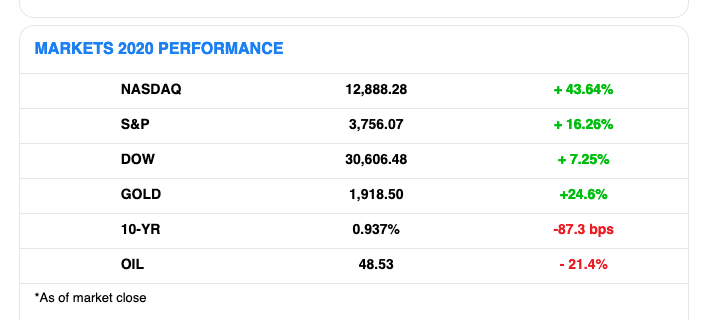
US financial markets had a remarkable year even as the economy struggled with business shutdowns, layoffs and unprecedented jobless claims in the wake of the pandemic.

This screenshot is from the 4 January issue of the excellent Morning Brew newsletter:

The New York Times tried to explain this disparity by looking at income and spending:

The millions of people no longer working because of the pandemic were disproportionately in lower-paying service jobs. Higher-paying professional jobs were more likely to be unaffected, and a handful of other sectors have been booming, such as warehousing and grocery stores, leading to higher incomes for those workers.

and

The obvious part was a decline in spending on services: All those restaurant reservations never made, flights not taken, sports and concert tickets not bought added up to serious money. Services spending fell by $575 billion, or nearly 8 percent.

– “Why Markets Boomed in a Year of Human Misery”

However, to me this isn’t the full picture. The article makes little attempt to show that the net savings were invested:

… for those a little more comfortable with risk, there was investing in stocks, which helps explain the 16 percent rise in the S&P 500 for the year. For those comfortable with a lot of risk — and with taking advantage of the market’s momentum — there was buying a market darling stock like Tesla or trading options.

In any case, retail investors – people like you and me – make up a small part of the markets, according to this Bloomberg TV video quoted by Business Insider:

Retail investors now account for roughly 20% of stock-market activity on average and nearly one-quarter of trades on peak days, Joe Mecane, the head of execution services at Citadel Securities, said… Individual investors made up just 10% of the market’s trades in 2019. That share then crept to 15% as popular brokerages including E-Trade, TDAmeritrade, and Charles Schwab erased their commission fees…

80% of the investment in the financial markets is institutional money. Those sort of people didn’t have their lifestyles affected in the same way as retail investors did. Institutional investors may have been spooked by the pandemic, withdrawing money in February and March, but they dove right back.

So what drove the markets’ performance this year?

Tech did.

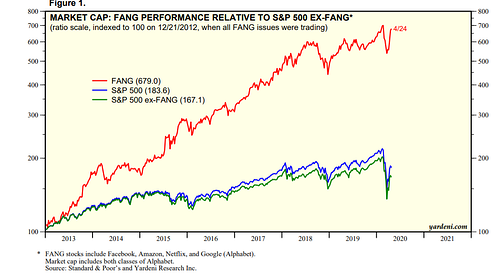
See this chart of the performance of the S&P 500 index with and without FANG: Facebook, Amazon, Netflix and Google.

This isn’t just a 2020 phenomenon. As the chart shows, a few tech stocks have both outperformed the rest of the market and have ballooned in market cap enough to have an outsize impact on the overall S&P 500 index performance.

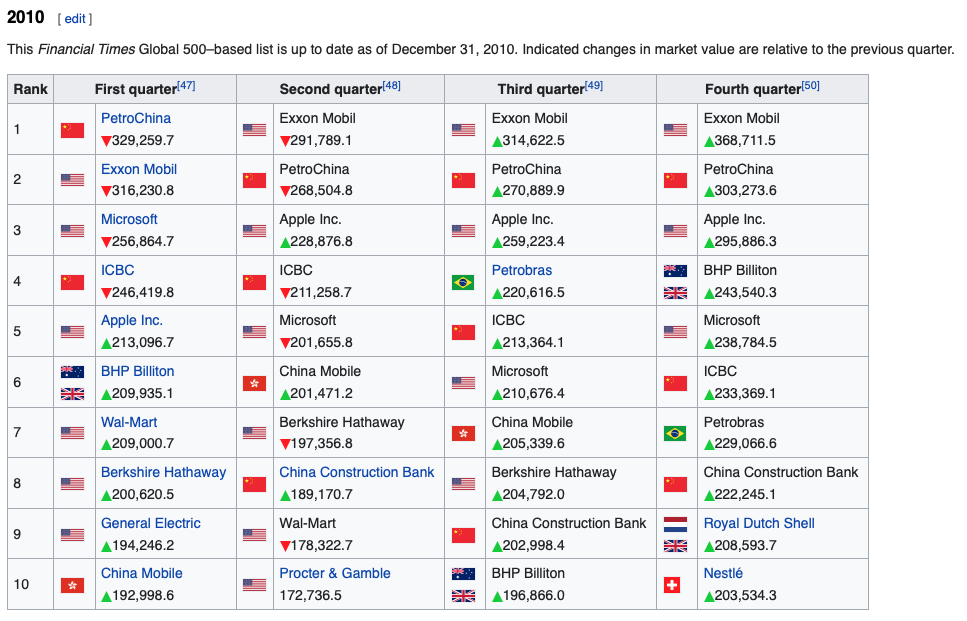
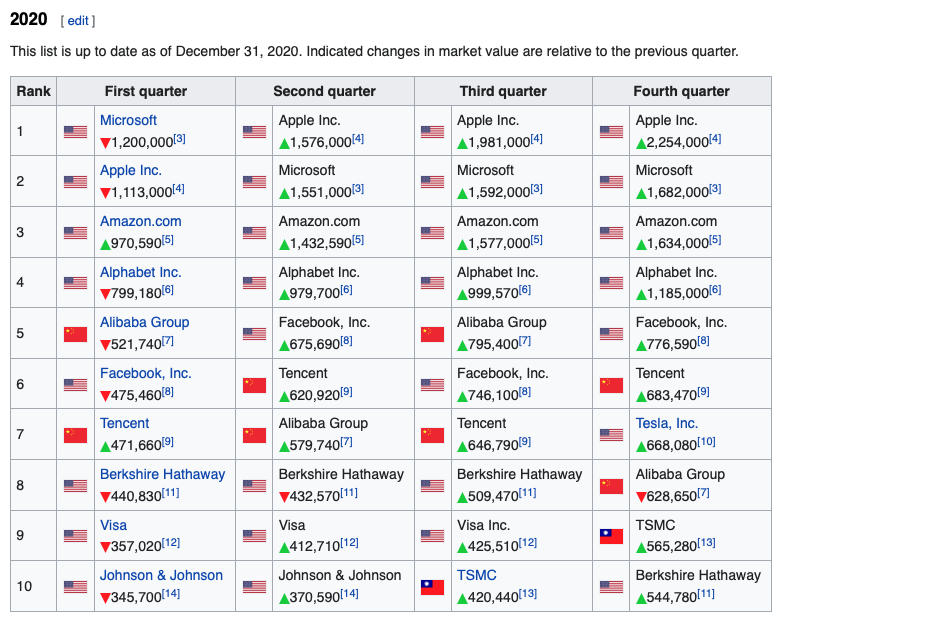
This past decade is when tech giants overtook energy and manufacturing companies as the US’ largest corporations. A comparison of the world’s top ten largest companies by market cap in 2010 and 2020 makes this clear:

Of the 2010 top ten, five were in energy, two in finance, two in tech, and Nestle, the food/beverages multinational.

In 2020, nine out of ten were tech companies. One was the Berkshire Hathaway holding company. The only two tech companies in the 2010 list, Apple and Microsoft, are, in 2020, the world’s two largest companies.

The companies that have posted some of the highest gains in 2020 are all those tech companies that have directly or indirectly enabled our shelter-in-place pandemic-suffused lives – Zoom (up 425%), Peloton (439%), Shopify (166%), Spotify (111%), Twilio (220%), among others. And of course the FANG stocks above + Apple.

In 2021, as the US opens up after mass vaccinations, not everything will go back to how it was. There have been irrevocable lifestyle changes. There will be other, newer companies that capture the spends from these changes – Airbnb, perhaps, as the normalization of remote work means that people choose to work from, well, remote places a few weeks at a time. Potentially Zillow and Opendoor as property owners shift their holdings from large cities to smaller ones that are more likely to attract such short-term relocations.

End note: The stock market isn’t the economy and vice versa. Anyone who conflates them is uninformed at best and disingenuous at worst. However, it’s clearer than ever that the gap between the markets and the economy will likely remain: there are only a few companies that are likely to disproportionately shape our lives over the next few years. As these companies do well, their stock – having attracted ever more money – will do well too. And since these companies are also among the largest on the stock markets, the overall market will perform well too.

(I am not a registered investment advisor in the US. None of this constitutes investment advice. I own several of the stocks I’ve mentioned in this post.)

Categories
The Next Computer

iPhone home screen, January 2021 – widgets only

(Previously:August, September, October, November, December home screens)

In December, I described how I’d gotten rid of all home screens other than the one minimum that iOS requires – the new App Library and the Siri suggestions dropdown are all you need to locate your app quickly. I’d described it as a post-home-screen world

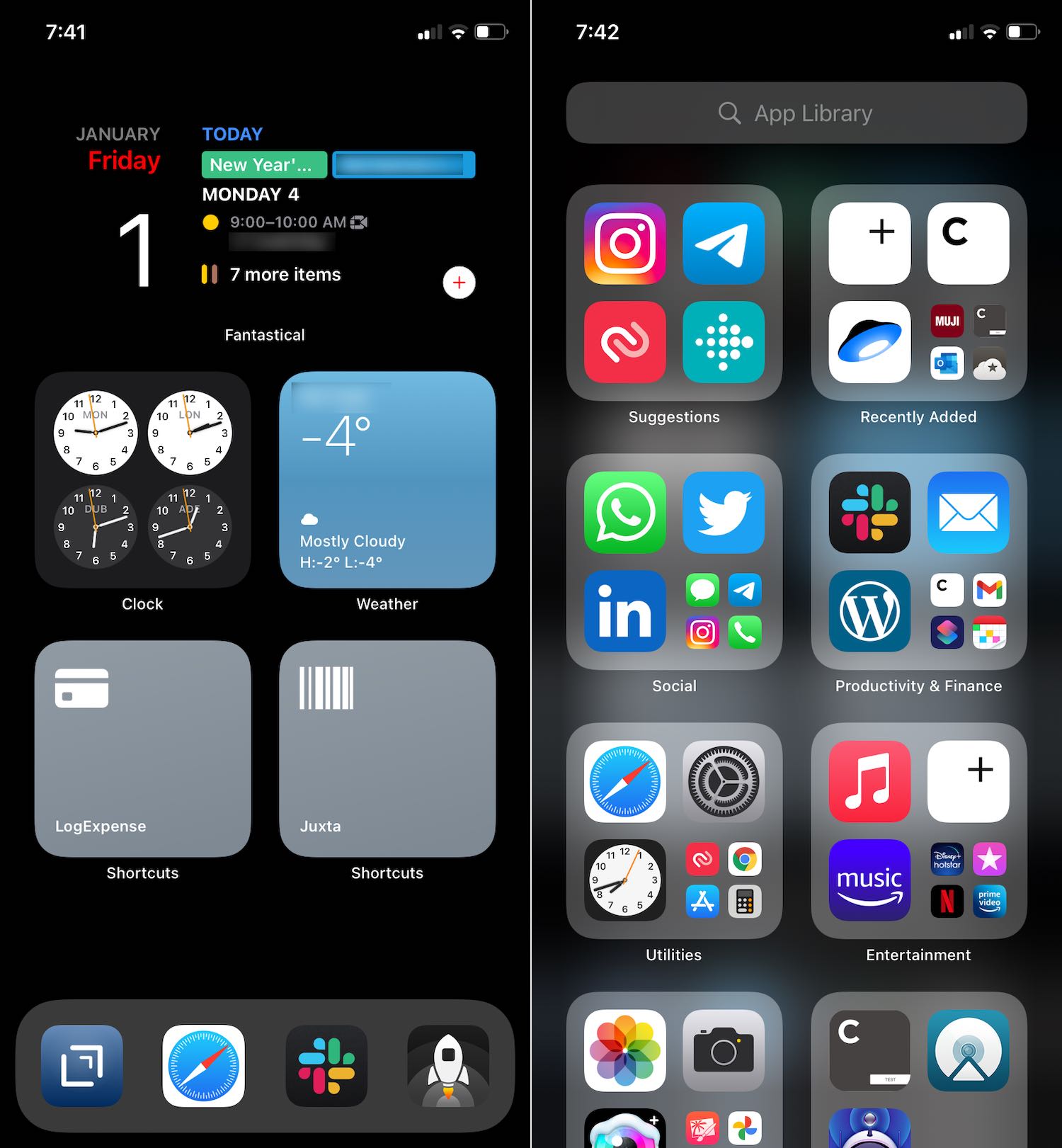
I found that this worked well for me so I doubled down on it. Here’s what my iPhone looks like today:

Since I don’t need any app icons on the lone home screen, I’ve decided to simply use it for widgets, new in iOS.

Some of the widgets are from December: the excellent Fantastical full-width widget, the multi-city clock one, the weather widget. And I’ve now added widgets for shortcuts – the two that I use the most. They’re unnecessarily large tap targets, but faster than tapping Launch Center Pro (bottom right in the Dock) and then selecting the Shortcut, which is how I have invoked them for years.

I also like that the icons in the App Library adjust as you use them, both the ‘Suggested’ group at the top left and the category-wise ones. It’s intelligence at work, but silently.

The app icon grid has been an iOS staple since the original iPhone OS. That’s completely changed for me – let’s see how long I stick with this.

Categories
Audience as Capital The Dark Forest of the Internet

The hijacking of subcultures

A subculture at this stage is ripe for exploitation. The creators generate cultural capital, i.e. cool. The fanatics generate social capital: a network of relationships—strong ones among the geeks, and weaker but numerous ones with mops. The mops, when properly squeezed, produce liquid capital, i.e. money. None of those groups have any clue about how to extract and manipulate any of those forms of capital.

The sociopaths [when they show up in a subculture] quickly become best friends with selected creators. They dress just like the creators—only better. They talk just like the creators—only smoother. They may even do some creating—competently, if not creatively. Geeks may not be completely fooled, but they also are clueless about what the sociopaths are up to.

Mops [members of the public; passive consumers of a subculture] are fooled. They don’t care so much about details, and the sociopaths look to them like creators, only better. Sociopaths become the coolest kids in the room, demoting the creators. At this stage, they take their pick of the best-looking mops to sleep with. They’ve extracted the cultural capital.

The sociopaths also work out how to monetize mops—which the fanatics were never good at. With better publicity materials, the addition of a light show, and new, more crowd-friendly product, admission fees go up tenfold, and mops are willing to pay. Somehow, not much of the money goes to creators. However, more of them do get enough to go full-time, which means there’s more product to sell.

– Geeks, MOPs, and sociopaths in subculture evolution, Meaningness.com