Categories
The Next Computer

The release treadmill as a weakness

The question is not how we can evolve towards a circular economy, but instead why we continue to evolve away from it.

– “How and why I stopped buying new laptops

The writer makes several solid points about using old, used machines. I’m am no stranger to this way of thinking. I use a nine year old Macbook Pro and a ten year old Macbook Air as my main laptops. Both, especially the Pro, have had several components upgraded and work more than well for my needs.

The most important part is the writer’s reflection on why his behaviour is the exception, not the rule

Although capitalism could provide us with used laptops for decades to come, the strategy outlined above should be considered a hack, not an economical model. It’s a way to deal with or escape from an economic system that tries to force you and me to consume as much as possible. It’s an attempt to break that system, but it’s not a solution in itself. We need another economical model, in which we build all laptops like pre-2011 Thinkpads. As a consequence, laptop sales would go down, but that’s precisely what we need. Furthermore, with today’s computing efficiency, we could significantly reduce the operational and embodied energy use of a laptop if we reversed the trend towards ever higher functionality.

Significantly, hardware and software changes drive the fast obsolescence of computers, but the latter has now become the most crucial factor. A computer of 15 years old has all the hardware you need, but it’s not compatible with the newest (commercial) software. This is true for operating systems and every type of software, from games to office applications to websites. Consequently, to make laptop use more sustainable, the software industry would need to start making every new version of its products lighter instead of heavier. The lighter the software, the longer our laptops will last, and we will need less energy to use and produce them.

These are all sensible points. The tech industry’s incentives have evolved to a point where this sort of thinking is quaint, even naive. New machines – phones, tablets, smart watches, headphones – are expected to have annual refreshes, and companies will be punished by the ‘market’ if they don’t abide.

I’d like to see a company shift their business model to one where they only released a phone every three years, but had such a strong, sticky subscription model around it for annual revenue.

Subscriptions are hard to pull off but not terribly difficult to imagine. Apple and Google both have successful subscription models around their devices. That their scale is such that they have to release new phones and increase sales every year could arguably be their weakness, not always a strength.

Apple and Google and other gadget giants are on a treadmill; an upstart need not.

End note: I think there was a point in 2013-14 when Xiaomi came close – at least outside of China they had a large yet closely-knit community, a small set of excellent phones and accessories, and their innovative, well-designed (although in many cases copied) software. They’ve since become like every other phone manufacturer.

Categories
Audience as Capital Discovery and Curation Making Money Online Products and Design Startups

Rewarding affinity, not transactions

We’ve discussed before the increasing population of what I call CoCoCo – content → community → commerce, and what’s also been termed Linear Commerce.

Now, a recent Harvard Business Review article touches on this in the context of loyalty programs: “Want More Loyal Customers? Offer a Community, Not Rewards

True loyalty is emotional and irrational and leads to customers feeling like they’re part of an exclusive membership group which then leads them to become loyal subscribers or consumer network participants.

as opposed to

some companies allow you to earn points for following them or writing a product review. This sort of bribery usually attracts the least loyal and least valuable audience — people mostly interested in claiming the reward not invested in the brand… [things like this] have more to do with an economic transaction than with true affinity for a brand.

I have been part of great communities, and they are everything that the first quote talks about. I’ve also seen such communities decline as the company behind the brand failed to convert this loyalty into commercial success. And I’ve seen referral rewards dressed up as loyalty programmes that ultimately attracted the sort of people the second quote describes.

At its core, the most influential customer-facing person at a brand need to be genuinely interested in engaging with customers and understanding what they want, in the context of the brand. Creating products and solutions does not automatically beget a community.

Categories
Investing Real-World Crypto

Bet against the ruling class

About five months ago, the VC Chamath Palihapitiya made the case for Bitcoin as the ultimate insurance:

If the government itself just continues to make a string of bad decisions that then have rising consequences… Bitcoin to me is the only think that I’ve seen so far that is really fundamentally uncorrelated to that decision making process and to that decision making body. Because at the end of the day, any other asset class – equities debt, real estate, commodities, they’re all tightly, tightly coupled to a legislative framework and an interconnectedness in the financial markets that brings together many of the governments that are… behaving in this way.

So [Bitcoin] is almost like a bet against the ruling class in some ways and making sure you have a small amount of insurance because… insurance is not something that pays off 50 cents to the dollar, insurance is something that pays off… 1000 bucks to a buck. You want these massive, massive asymmetric payoffs because you want to be sure that a small amount of insurance can basically make you whole…

that’s why I just think that… you should take 1% of your portfolio, put it in Bitcoin, never look at it. Don’t look at the price. Don’t look at anything and hope that that 1% goes to zero. Then you have the 99%. But in the case where that 99% goes to zero, that 1% will probably be worth 120%. And you’ll feel like a genius.

Categories
Data Custody

Open source means you don’t need to worry about your data

The arguments for open source software and free software are many and well articulated.

In addition to those, open source software is also important in the context of what we discussed yesterday: the risks of having your data stored in the Cloud, often in proprietary data formats, with your access to it subject to the terms and conditions of a small set of increasingly dominant tech companies.

Open source software inherently deals with open source formats. It’s difficult to imagine an open source (or free software) project with its own proprietary data format. Perhaps such software may be able to work with data formats from other proprietary software, but that’s a plus. For instance, LibreOffice being able to read and edit Microsoft Office files and GIMP being able to work with Adobe Photoshop files.

Open source and free software projects may offer to host your data in the Cloud, usually for a fee. But there’s almost always the ability for you to host the software on your own server. Bitwarden offers a hosted version, which I use. But I can always host it myself. Likewise, you can either download and self-host Wallabag, the open source read-it-later service, or you can use the Wallabag.it service run by the developers. The choice is yours.

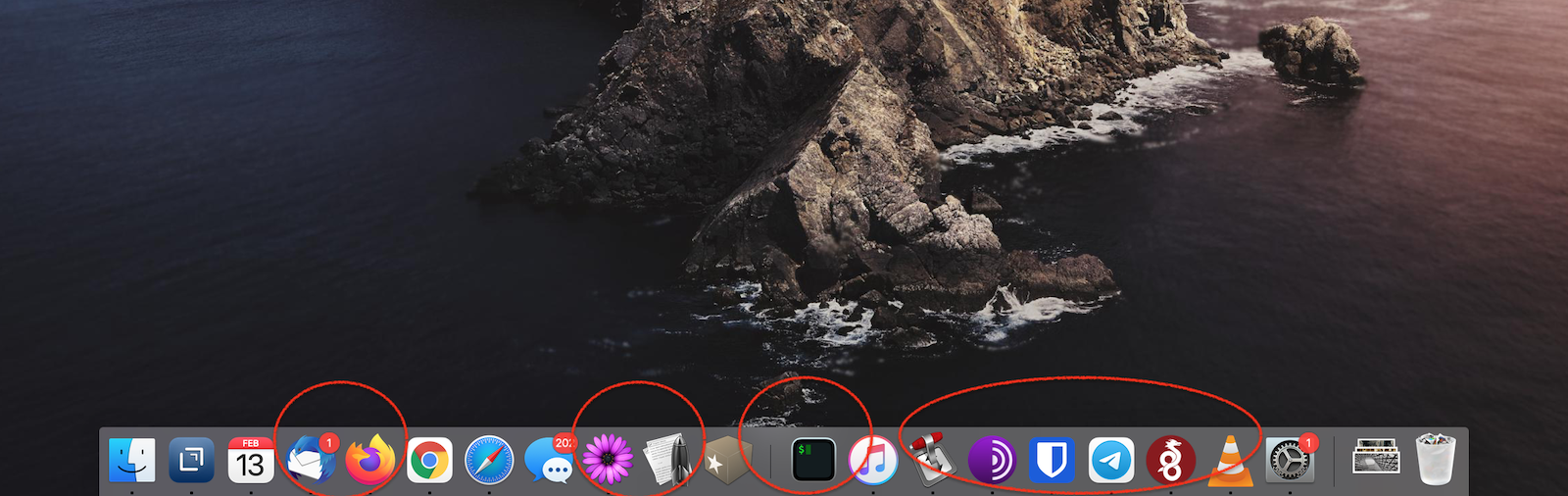
On Mac OS, I try to use open source software unless it’s inconvenient. Over time, I expect to move most of my everyday software to its open source equivalents. For now, here’s a subset.

From left to right, the highlighted ones are

  • In addition, in my menubar are
  • Flux to ‘warm’ my screen colour to mitigate the ill effects of blue light
  • Caffeine for when I want to keep the computer from sleeping
  • Shiftit for window management

None of these is a compromise versus a proprietary equivalent. All of them use open formats natively. With them, I’m confident of my access to data.

Categories
Data Custody Decentralisation and Neutrality The Next Computer

Cloud islands

A lot of what I write is about data custody. It’s a topic that we’re inevitably going to have to debate in the mainstream sometime this decade – I mean prime time conversations on TV. That’ll happen when enough people experience the downsides of having their data reside with just a few large tech companies.

There are many ways things could go wrong with your data in the Cloud.

People could be locked out of their account for some violation of terms of service they weren’t even aware of, or being hacked via social engineering. If it’s their Google account, they lose access to their email, their photos, contacts. This has happened several times. We only rarely hear of it when it happens to someone with a large online following.

One of these companies may have a problem with their data centers. Even though people have access to their accounts, they could find their emails, documents, chats lost.

Companies could suffer an outage. This happens fairly regularly, most recently just a few days ago with the data organisation company Notion. If you can’t access your information at a critical moment – if you need to pull up a receipt number or a scan of a medical prescription – you lose trust in the company you stored your data with.

There are others still:

Governments could ban companies overnight, leaving you unable to access your data – India’s upcoming cryptocurrency law could do just that.

Companies could readjust free limits, leaving you with no choice but to begin paying them to hold your data – the upcoming changes to Google Photos’ free tier is an example.

You could find that there’s no easy way to export your data – if you move from an iPhone to an Android, it’s really hard to transfer the notes from your Notes app to an equivalent Android app.

The ‘cloud’ as the default for our life’s information and documents and photos – this is all very new. Email was probably the first to move to the cloud with Gmail, but even that was just fifteen years ago. That’s barely half a generation.

Each of us needs to spend at least some time thinking about how we’re going to deal with our data when we’re ten, twenty, thirty years older than today. How likely is it we’ll continue use iPhones or whatever they evolve to, to have several terabytes of info in our iCloud Drive or its successor(s), that we’ll keep buying Apple TVs to project our photos on? Ditto with Google. Or {giant trillion dollar corporation}.

We have collectively been exposed to billions of dollars of marketing to keep us from thinking about this, to believe that our data’s safe in the Cloud for now and forever.

To add to that, most of us aren’t ‘tech-savvy’ enough to even know what alternatives exist, much less be able to move to them and use them on an every day basis – why, even if you change your default browser, you’ll be asked if you want to switch back by the browser your computer shipped with (try it – change your default browser to Firefox on Mac OS; Safari will ask you right away if you want to switch back. Microsoft is even worse with Edge)

Finally, neither independent software makers nor open source projects been able to create software that, for the most part, can replace the entire gamut of Cloud-like software that the dominant tech companies provide. For instance, it’s not straightforward to organise your photos using something that’s not Apple Photos or Google Photos or Adobe Lightroom Classic – alternatives exist but they’re not great.

So. It’s not easy and it’s not a solved problem by any means.

Until the Cloud becomes a safe, reliable commodity like the electricity grid or the Internet itself, we’re going to have multiple independent Cloud islands. Apple’s. Google’s. Amazon’s. Microsoft’s. Yandex’s. Dropbox’s. Adobe’s. And a dozen more.

Each are closed worlds, but worlds that hold your life’s work and loves. And your only key, your username and password, isn’t guaranteed to always work.

It’s not sustainable.


(Featured Image Photo Credit: Pearse O’Halloran/Unsplash)

Categories
Making Money Online Products and Design Startups

No-code gives founders superpowers

I’m working with a few founders, mostly first-timers, who are going about building the initial experience for their very first customers in an interesting way. Two short tweets:

https://twitter.com/rahulgaitonde/status/1361333493767303172?s=21

When it comes to raising capital, being able to demonstrate traction with a few hundred or a few thousand customers quickly is extremely valuable. Ditto when hiring a team or even a technical co-founder.

When it comes to actually going ‘live’, the founder leapfrogs the usual build phase → market phase transition. The founder is both building and marketing simultaneously. It’s a much quicker road to product-market fit.

Finally, when it comes to the actual tech that the founder’s using, a no-code set of tools is typically built by startups building for other small startups. They’re well-thought-out: they make it easy to build visually compelling, data-heavy pages (Notion), they make it easy to ‘glue’ together disparate elements (Zapier, IFTTT), they make it easy to build and engage with an audience (Convertkit), they even make it easy to collect money from that audience (Gumroad, Memberful) – all are things that would otherwise require complicated signup forms, KYC, licensing/commitments, and complicated technical integration.

This tweet captures this dynamic well:

https://twitter.com/tmrohan/status/1361385954649415680?s=21
Categories
Privacy and Anonymity Wellness when Always-On

Privacy and the imbalance of power

We explored this in a lot of detail in our three-part series on Alternate Realities, where we dive into how the Internet has made it possible to express safely who we are – often multiple selves – and find others like us.

Privacy, closely related to anonymity, works just like this. We need privacy not necessarily because we are up to something that is criminal or something that causes harm. It is because people differ about what is considered acceptable. The norm for this is always set by those in power. Privacy is the only thing that lets people act in ways considered unacceptable, without incurring censure, ridicule, ostracisation, even harm. Whether by themselves or with people like them.

Categories
Products and Design The Next Computer Wellness when Always-On

Stress and pressure

In my opinion, this is mostly true. In fact, acknowledging this distinction reveals something important:

The distraction and attention suck that’s skillfully designed into social media, games and other apps is hard to shake because it blurs the line between pressure and stress.

On the surface, this addiction seems to be in our control – we got into it, it’s self-inflicted. Most advice advocates deleting apps, turning off notifications, locking our devices away temporarily, setting our screens to black-and-white, turning off 4G, deliberately downgrading our phone – actions that we’re supposed to take and then maintain. Any subsequent failure is personal because the original responsibility was ostensibly ours, and therefore there’s deserved pressure to stick to our de-addiction goal.

But it isn’t really like that is it? Social media and notification addition cause stress that is inflicted upon us by apps, apps that have been designed by companies with enormous resources and incentives to keep us engaged for as long as possible. The battle is unequal and the onus should be as much on these apps to encourage good, healthy behaviour as it is on you and me to reduce screen time.

Categories
Decentralisation and Neutrality Privacy and Anonymity The Dark Forest of the Internet

Decentralisation and criminal activity

A few days ago we discussed how end to end encryption and decentralisation were an inherently political matter.

We saw how Signal’s end to end encryption meant that security agencies can’t simply compel the Signal nonprofit to unscramble users’ messages or monitor them. With Bitcoin, there is no central authority to target, and no easily traceable identities, unless you’re a beginner who’s left their cryptocurrency in an exchange’s account. But it’s because they’re inherently secure, they’re attractive to criminals and terrorists. That in turn attracts the attention – and ire – of law enforcement agencies. And turns it into a political issue.

This article in fact describes the use of Jabber-based messaging apps by criminals in Russia:

Jabber’s federation means that anyone can open a server and run it as they see fit. That’s enormously attractive to criminals worried about companies cooperating closely with governments, especially in the United States. And some Jabber servers are set up specifically to cater to criminals.

– Why Jabber reigns across the Russian cybercrime underground

This isn’t a matter of forcing wiretapping phones, or compelling Apple to unlock iPhones, or forcing a bank to turn over account statements. If traffic on this server is tunneled through a VPN, even locating what Jabber chat server criminals use is a huge problem for security agencies. And unlike Parler or Facebook groups, one can simply set up another Jabber server.

It’s the same reason that sites on the Tor network that sell and list torrents and other contraband are so resilient to being taken down.


(Featured Image Photo Credit: Ricardo Gomez Angel/Unsplash)

Categories
Life Design Making Money Online Products and Design Wellness when Always-On

The Precariat and today’s tech age

The precariat is a neologism for a social class formed by people suffering from precarity, which means existing without predictability or security, affecting material or psychological welfare. The term is a portmanteau merging precarious with proletariat.

Unlike the proletariat class of industrial workers in the 20th century who lacked their own means of production and hence sold their labour to live, members of the precariat are only partially involved in labour and must undertake extensive unremunerated activities that are essential if they are to retain access to jobs and to decent earnings. Classic examples of such unpaid activities include continually having to search for work (including preparing for and attending job interviews), as well as being expected to be perpetually responsive to calls for “gig” work (yet without being paid an actual wage for being “on call”).

The hallmark of the precariat class is the condition of lack of job security, including intermittent employment or underemployment and the resultant precarious existence.

– Precariat, Wikipedia.

We usually ascribe the ability of technology-first companies to disrupt existing industries to the fact that tech brings the marginal costs to service customers down to nearly zero. Tech-first companies can ‘scale’, get things done more efficiently: cheaper, faster, with fewer errors and people.

Another, darker side of many types of technology companies is that they externalise costs that were usually absorbed by more traditional companies.

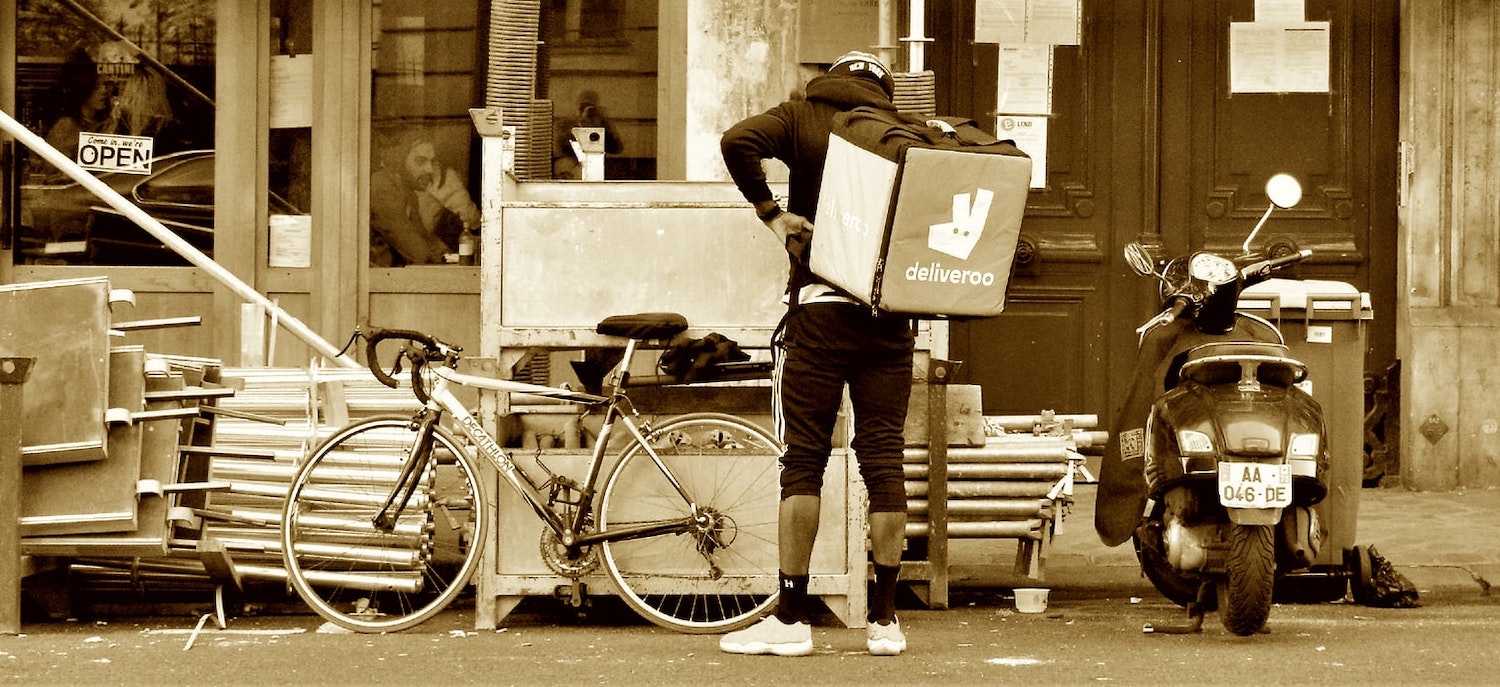
These costs are often borne by employees themselves. This is more obvious in the ‘gig’ economy, where companies have fought hard to have their drivers, delivery persons and other roles classified as contractors so they wouldn’t be required by law to receive all the benefits employees were due. But this is also evident at several other tech companies, especially those that have moved to remote work (or were remote-first to begin with). Many companies have employees pay for their own computers, phone and equipment, internet, power, and their own home office while saving on rent, IT and utilities.

The precariat isn’t a consequence of the Tech age or tech companies. Its emergence and persistence are more than anything the symptoms of an inadequate welfare system which itself, as Wikipedia article suggests, is a result of “neoliberal capitalism”.

But it is also true that the very things that make some types of technology companies efficient and innovative are those that create precarious employment.


(Featured Image Photo Credit: Carl Campbell/Unsplash)