
Categories
Real-World Crypto

Not That Fiat

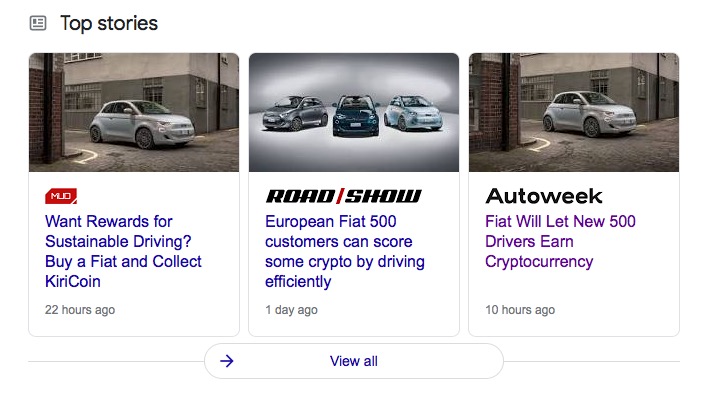
Last week, a friend sent me a link that claimed the car company Fiat would reward buyers of its upcoming 500e electric vehicle with cryptocurrency for every mile they drove.

It sounded strange, so I looked into it. There were many articles in tech and auto publications saying the same thing:
The press release from Fiat’s parent company Stellantis also made a reference to the cryptocurrency, Kiricoin:

The partnership with Kiri enables Stellantis to achieve three world firsts in the automotive industry. First, the ability to collect a cryptocurrency simply by driving; second, giving access to an exclusive marketplace; finally, providing extra rewards for the highest eco:Scores.

Driving data, such as distance and speed, is uploaded to the Kiri cloud and automatically converted into KiriCoins, using an algorithm devised by Kiri. The result is downloaded directly to the user’s smartphone and the KiriCoins can then be used to purchase products and services in the Kiri marketplace.”

Stellantis press release

That sounds highly limiting.

Now I couldn’t find Kiricoin on any major crypto exchange.

Nor could I find any reference to it being listed anywhere. So I read through Kiricoin’s own website:
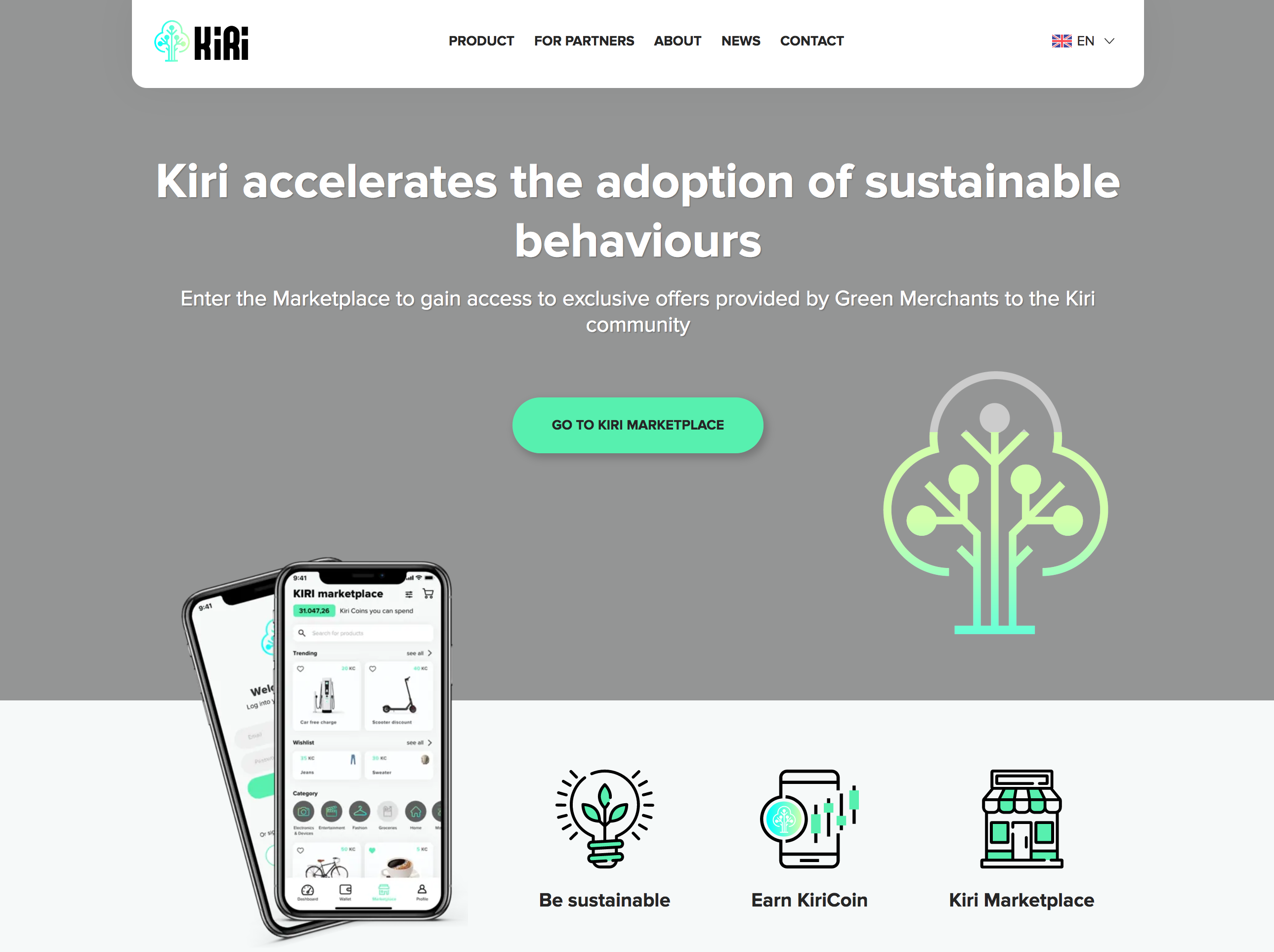
It turns out that Kiri itself doesn’t make any reference to itself as a cryptocurrency.

It’s a simple, light website that describes a private currency for ‘ green merchants’ to provide ‘exclusive offers’ to the ‘Kiri community’ – in other words, a private currency closed wallet.

Kiri is being honest here.

It’s amusing, if a little disappointing to see how every reporter on single news article about Fiat and the 500e simply parroted the ‘cryptocurrency’ angle without actually verifying it.

Or questioned why a cryptocurrency’s even needed for something so centralised.

The next decade will be fun as we see more brands riding on the crypto wave in name only.
Categories
Audience as Capital Discovery and Curation Life Design Making Money Online Wellness when Always-On

When you pay attention to one thing, you ignore something else

A wonderful longform article by the New York Times writer Charlie Warzel about the perils of the attention economy. The article itself is centered on his conversation with the writer Michael Goldhaber, who predicted this over thirty years ago, before even the infancy of the web.

The need to reclaim our attention is a topic dear to me, and naturally so was this article.

It’s hard to quote one or two essential sentences by Goldhaber, so I’ve had to go beyond in order to do him justice. I think it’s worth your attention to read on:

Understanding attention scarcity

He was obsessed at the time [in the 1980s] with what he felt was an information glut — that there was simply more access to news, opinion and forms of entertainment than one could handle. His epiphany was this: One of the most finite resources in the world is human attention.

This is a zero-sum proposition, he realized. When you pay attention to one thing, you ignore something else.

Understanding attention hijacking

“When you have attention, you have power, and some people will try and succeed in getting huge amounts of attention, and they would not use it in equal or positive ways.”

[In 1997] He outlined the demands of living in an attention economy, describing an ennui that didn’t yet exist but now feels familiar to anyone who makes a living online. “The Net also ups the ante, increasing the relentless pressure to get some fraction of this limited resource,” he wrote. “At the same time, it generates ever greater demands on each of us to pay what scarce attention we can to others.”

“Our abilities to pay attention are limited. Not so our abilities to receive it,” he wrote in the journal First Monday. “The value of true modesty or humility is hard to sustain in an attention economy.”

Politics and Attention

Most obviously, he saw Mr. Trump — and the tweets, rallies and cable news dominance that defined his presidency — as a near-perfect product of an attention economy, a truth that disturbed him greatly…

Living in a rural area, he suggested, means being farther from cultural centers and may result in feeling alienated by the attention that cities generate in the news and in pop culture. He said that almost by accident, Mr. Trump tapped into this frustration by at least pretending to pay attention to them.

he was deeply concerned about whether the attention economy and a healthy democracy can coexist. Nuanced policy discussions, he said, will almost certainly get simplified into “meaningless slogans” in order to travel farther online,

“We struggle to attune ourselves to groups of people who feel they’re not getting the attention they deserve, and we ought to get better at sensing that feeling earlier,” he said. “Because it’s a powerful, dangerous feeling.”

Categories
Life Design Product Management Startups

Authenticity

Mundane as it sounds, that’s the most powerful motivator of all, not just in startups, but in most ambitious undertakings: to be genuinely interested in what you’re building. This is what really drives billionaires, or at least the ones who become billionaires from starting companies. The company is their project.

One thing few people realize about billionaires is that all of them could have stopped sooner. They could have gotten acquired, or found someone else to run the company. Many founders do. The ones who become really rich are the ones who keep working. And what makes them keep working is not just money. What keeps them working is the same thing that keeps anyone else working when they could stop if they wanted to: that there’s nothing else they’d rather do.

That, not exploiting people, is the defining quality of people who become billionaires from starting companies. So that’s what YC looks for in founders: authenticity. 

Paul Graham, “Billionaires Build”

This is actually harder than it sounds. Authenticity is rare. If we could assume that everyone we met was authentic, navigating personal, professional and other spheres would be a lot less stressful for most of us.

But it is also because authenticity is so rare that it is such a powerful signalling mechanism with go-to-market, customer engagement, and especially hiring. I have seen each of these first-hand.

Categories
Decentralisation and Neutrality Real-World Crypto

Of bitcoin and asset bubbles

In an efficient financial market, high volatility is correlated with high expected returns. This is one of the most basic principles of finance. Volatility is the cost that investors pay to hold an asset that is likelier to yield them bigger rewards. Risk is the pain, expected return is the gain…

 Many people over the years have argued that Bitcoin is this type of trash asset. … But let’s assume it’s not. Suppose Bitcoin’s value is slowly rising to some long-term equilibrium. The existence of semi-regular bubbles and crashes every few years will tend to slow that process, because it keeps some people scared and keeps them out of the Bitcoin market. That depresses the price today. But then as the bubbles keep happening and the skeptics realize that this is just how Bitcoin works, they eventually lose their fear and jump into the market, and Bitcoin’s price rises.

– Triumph of the HODLers

The article goes on to make the point about bitcoin as a hedge not just against equities or bonds or a specific asset class, but against “system failure”:

 The system of governments, banks, financial regulations, etc. etc. that currently runs the world is not infinitely robust. In the places and times and future conditions in which that system fails, peer-to-peer financial solutions like Bitcoin are inherently very valuable. That gives Bitcoin fundamental value.

and then ultimately hazards a guess at what makes Bitcoin so political.

All around, an excellent read.


Related post:

Categories
Life Design

Extreme negative incentives

If I did drink any alcohol between the beginning of October and October 28th, which was my wife’s birthday, I would have to donate $100 to the Trump campaign for every drink, and post a screenshot of the donation on Twitter. Since I didn’t really want to do that, and I knew it would not be particularly popular socially, it became a good motivator for the whole month and I was able to stick to my goal.

– The Health Stack – with Nat Eliason
Categories
Life Design

At some level, the details are not transmissible

We ask Warren Buffet why he invested in a company and he can try and create a mental construct as to how he thinks and how he invests in a company. But there are just as many details to Buffett’s activities, when he decides what to invest in and how he lives his life and how he thinks, as there are to Roger Federer’s body running around a tennis court, hitting a ball. At some level, the details are not transmissible. They’re not copyable.

[co-interviewer/ee] The things that you do greatest are the things that you know not how you do.

Conquering the Mind, podcast with NavalR and KapilG

Engineers like myself value first-principles thinking. Following the path from observations back to first principles is useful. When it comes to building something back up from those principles, you’re best on your own.

Categories
Decentralisation and Neutrality Real-World Crypto

Single point of failure of imagination

I’ve been thinking about India’s will-they-won’t-they reckoning with the legality of cryptocurrency. Even a year after the Supreme Court ordered the RBI to rescind its ban on banks dealing with cryptocurrency-linked exchanges and directing the government to formulate a law instead, there isn’t one. Instead, there’s a bill that has wound its way through committee and is now awaiting tabling in the ongoing session of Parliament.

The one-line description of the bill makes a reference to the banning of “private cryptocurrencies”. As a consequence, the sword of damocles that has hung above India’s collective cryptocurrency ecosystem since the RBI ban in 2018 has gotten a little wobblier. Every week, for weeks, people in the ecosystem have parsed the odd statement by the minister of finance, and the governor of the RBI and other bureaucrats to glean some indication of which way the wind is blowing.

One day – no one knows when – everyone’ll refresh their feed and discover whether India’s entire industry lives free or dies or is condemned to a highly circumscribed life. That decision determines the access of one-sixth of humanity to something as transformative as decentralised ledger technology – someone in the industry draws comparisons with India’s mid-1990s decision to allow (extremely constrained) access to the Internet itself.

This is a terrible way to live.

Finally, what’s worse is that it’ll eventually be one person – whether an influential bureaucrat or an elected official – who’ll make the difference.

This isn’t unique to India. While in India the eventual lynchpin might be faceless, policy making in the US is transparently but routinely held hostage to a small handful of elected officials.

These are single points of failure. Failures of imagination. Failures that can and often do set entire populations and economies back by a generation.

Corporations make similar decisions at different levels in their hierarchy. The difference for people like you and me is one of choice. We can usually switch to another product, another provider, another subscription. There are switching costs, of course. But the costs of switching countries are many orders of magnitude higher.

Finally, corporations reverse decisions quickly as well. The feedback mechanism is tighter. Decision making is more agile than countries to begin with. It’s a lot harder to rescind an executive order and reverse a law: citizens have only the judiciary and the ballot box.

In the coming face-off between corporation-states and nation-states, this agility will be a big competitive advantage.

Categories
Investing Real-World Crypto

Another 100+ year old institution adopts cryptocurrency

Less than a week after Christie’s sold a digital collage to an investor who paid $69 million in cryptocurrency, rival auction house Sotheby’s said it was considering an option to eventually let bidders use digital currencies to pay for physical artworks—from prints to Pablo Picassos—as well as digital works.

Sotheby’s Enters NFT Digital Art Market, Considers Broader Cryptocurrency Options

Sotheby’s is 276 years old. Christie’s is 254.

We saw last year how other century-old institutions had begun investing in, parking money in and/or getting into the business of cryptocurrency. That list included Mass Mutual, State Street and the SEC:

That’s why its hard to witness the finance ministries and central banks of young countries – China, India, Nigeria – take a hard stand against it.

These countries are roughly sixty and seventy years old, but China was reborn economically just forty years ago; India ten years later.

Their institutions should be among the least protective, most imaginative and most welcoming of new technology.

Categories
Uncategorized

Apple / Taiwan / China / India

In the context of Apple lobbying the Indian government to improve incentives for moving some manufacturing there:

Apple assembles a bulk of its iPads in China, but is fast diversifying production to markets such as India and Vietnam to minimise the impact of the U.S.-China trade war and the coronavirus crisis…

It was not immediately clear which of Apple’s three contractors in India – Foxconn, Wistron and Pegatron – would assemble iPads.

– Apple lobbies for India incentives as it plans iPad assembly: sources

It’s interesting that each of these three companies is an Indian subsidiary of a Taiwanese manufacturer. And that each of these companies has had factories in China for a long time now. And that China and Taiwan have a strained relationship, to put it mildly.

It’s going to be interesting watching corporation-states and nation-states interact this century.

Categories
Products and Design Real-World Crypto

“Crypto can’t contribute anything further” and the failure of imagination

This article in The Ken newsletter isn’t very hopeful about crypto’s ability to make much of a difference to India. There are a couple of strong downsides to allowing unfettered access to crypto, but the article doesn’t make those. I think I’ll write about them on this site in a future post.

This article, unfortunately, makes claims like this regarding the “tens of billions of dollars coming to the country from remittances and remote work”

the contention that crypto will serve as a catalyst is moot. India already has a robust banking system to support inward foreign remittances and crypto can’t contribute anything further.

I wish the writer had chosen a different hill to make a stand on. I really do.

Cross border remittances are infamous for few options, very high processing fees and currency markups. Here’s the World Bank lamenting the state of remittances [PDF report].

Providers of remittance services in the formal sector typically charge a fee of 10–15 percent of the principal amount to handle the small remittances typically made by poor migrants.

For every INR 100 a migrant ends back, if their family receives just INR 85, that’s INR 15 worth of that migrant’s labour wasted. Lost. In moving electronic records from a computer system to another. In 20201.

This is unconscionable.

And as regard the robust banking system, look no further than this:

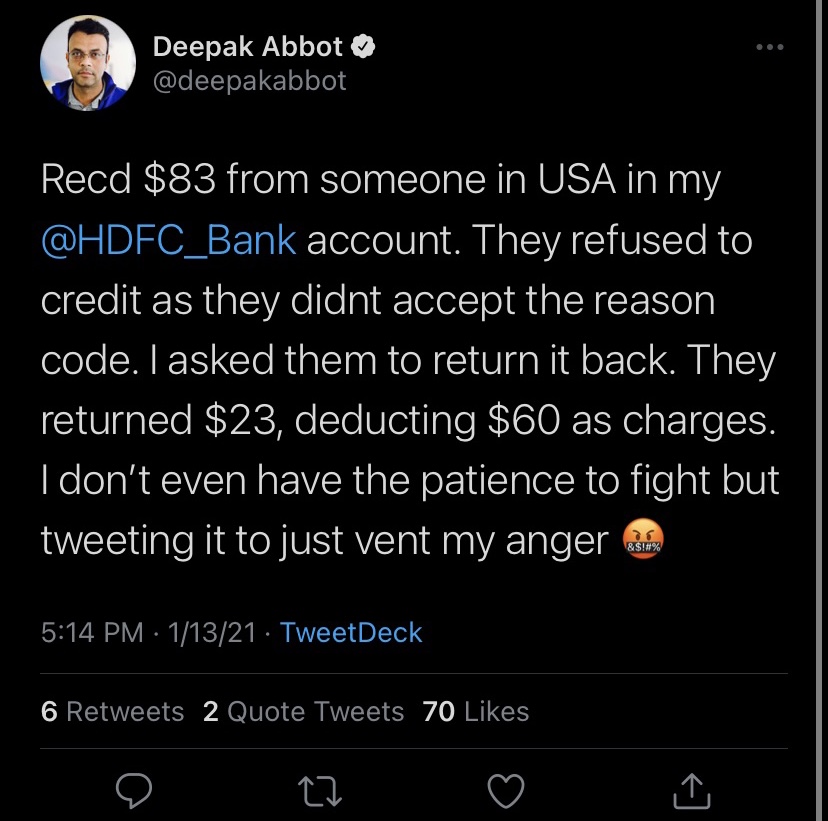
I am myself, as of Monday, waiting for an overseas payment that was made to me on Thursday. I have no idea where it is in my bank’s systems. When I wanted to remit money overseas late last year, my bank had me pull records from 2014 to prove that the money I was sending was in fact mine.

There exist many startups, both Indian and otherwise – Remitl.y, Remit2India, RemitGuru, Azimo, Xoom, Transferwise – that choose to tackle the problem of remittance in India.

Remittances is broken.

To say ‘crypto can’t contribute anything further’ is to accept the current state of finance: payments, investments, even inflationary money.

This is an example of failure of imagination –the worst sort of failure.