Categories
Audience as Capital Data Custody Decentralisation and Neutrality Discovery and Curation Making Money Online Privacy and Anonymity Real-World Crypto RG.org The Dark Forest of the Internet The Next Computer Wellness when Always-On

300

7th October marks three hundred days since I began writing daily on this website.

While I have written on and off on the site from late 2002, this is the longest publishing streak the site has had. The streak began in December 2019 as something I wanted to do for myself at a time I felt low. It has now become a habit. If I remember correctly, Seth Godin had said on Tim Ferriss’ podcast that at some point after he started writing regularly on his blog, his thinking changed from ‘should I write tomorrow?’ to ‘what should I write about tomorrow?’.

I’ve gotten somewhat comfortable with drafting, writing and scheduling posts for the week ahead. Now I plan to build a healthy information consumption habit. My reading is too scattered, both in subject and in time. It doesn’t leave me with enough time to absorb things and think them through. I plan to trim my reading sources and structure my week so there are distinct chunks for reading, thinking and writing.

Community
This site has always explored questions about how you and I deal with technology in our lives. Those questions are so much more important in 2020 than they were eighteen years ago. My framework to understand this are the Five Megatrends and Five Big Questions.

Ultimately I’d love for the readers of this site to be a community that discusses and helps each other navigate opportunities that tech brings to our lives, and the challenges we face to our mental and physical health and to our relationships: by being conscious that tech serves us instead of us serving tech, or serving those that control tech. About Living Well in the Always-On.

Interested in being an early community member? Get in touch: Email or Twitter.

(Featured image photo credit: Jeff Golenski)

Categories
Products and Design The Next Computer

More USB-C standards confusion

We have seen before how confusing USB-C can be: what cables and device support what capabilities. This article has more examples of confusion about the standard:

If you buy a USB-C charger that doesn’t support Power Delivery and try to use it with a Microsoft Surface, for example, the laptop will complain that it’s “not charging” despite receiving some power. Fixing this requires figuring out whether or not it’s the cable or wall charger that doesn’t support Power Delivery, and replacing it with something that does support it. There would be no way for a layperson to hold two USB-C chargers and know the difference between one that supports Power Delivery and one that doesn’t.

Furthering the confusion, some devices actually can’t be charged with chargers supporting Power Delivery, despite sporting a USB-C port — because they weren’t designed to negotiate the higher wattage being delivered by the Power Delivery standard. A pair of cheap Anker headphones I own, for example, refuse to charge when plugged into a MacBook charger. Other devices, like the Nintendo Switch, only partially support the standard, and some unsupported chargers have bricked devices, reportedly due to the Switch’s maximum voltage being exceeded.

If you need to use different ‘supported’ chargers and cables with different devices, how is that any better than a proprietary standard?

Categories
Audience as Capital Discovery and Curation Making Money Online Wellness when Always-On

What’s something that’s easy for me to do but hard for others?

This newsletter, available on the web, about building ‘personal moats’:

The post as a whole is a great read. Here are three standout pieces, in addition to the title, which came from the post:

1 . If you were magically given 10,000 hours to be amazing at something, what would it be? The more clarity you have on this response, the better off you’ll be.

2. … it’s easy to lie to yourself & say that you’re a generalist when in reality you’ve tried a bunch of things and you’ve flaked out when things got hard and then tried something else. You want to be at least great at one thing, and then apply that lens or skill to other categories.

3. We talk a lot about “passive income,” but not as much about “passive social capital” or “passive knowledge gaining” — that’s what you gain if you build an asset that grows over time without intensive constant effort to sustain i

One of the five megatrends we explore on this site is that of Audience as Capital.

The benefits of having a large humber of people who have consciously decided to listen to what you have to say have so far been limited to people with political power, or who ran large economic or social institutions. Today it is available to everyone – perhaps the Internet’s greatest dividend.

Having something of value to offer people, a personal moat, is a prerequisite to amassing this following, which is a prerequisite for building audience capital.

Featured image: Lake Palace, Lake Pichola, Udaipur, taken in 2011

Categories
Decentralisation and Neutrality Discovery and Curation Making Money Online

Play Store and Fair Play

Google has recently begun enforcing its policy about using Google Play’s in-app billing for apps that sell virtual goods. The problem is the 30% cut that Google, like Apple, charges on such transactions.

This Economic Times article has reactions from some app makers in India, including references to new-age colonialism via a foreign player imposing lagaan.

In my view, Google’s policies on which goods need to use in-app billing and which don’t is pretty clear. It’s also not different from Apple’s App Store policies, which have always been enforced strictly. It only applies to digital goods (with some exceptions even there), so statements like this don’t hold water:

“How can a company survive after paying 30% Google tax and Apple tax… Most businesses don’t have such margins. If enforced, this will spell an end to the startup dreams of a lot of Indian entrepreneurs.”

But there are new restrictions on communicating the existence of alternative payment methods, similar to Apple’s. I think these are onerous:

Apps other than those described in 2(b) may not lead users to a payment method other than Google Play’s billing system. This prohibition includes, but is not limited to, leading users to other payment methods via:

  • An app’s listing in Google Play;
  • In-app promotions related to purchasable content;
  • In-app webviews, buttons, links, messaging, advertisements or other calls to action; and
  • In-app user interface flows, including account creation or sign-up flows, that lead users from an app to a payment method other than Google Play’s billing system as part of those flows.

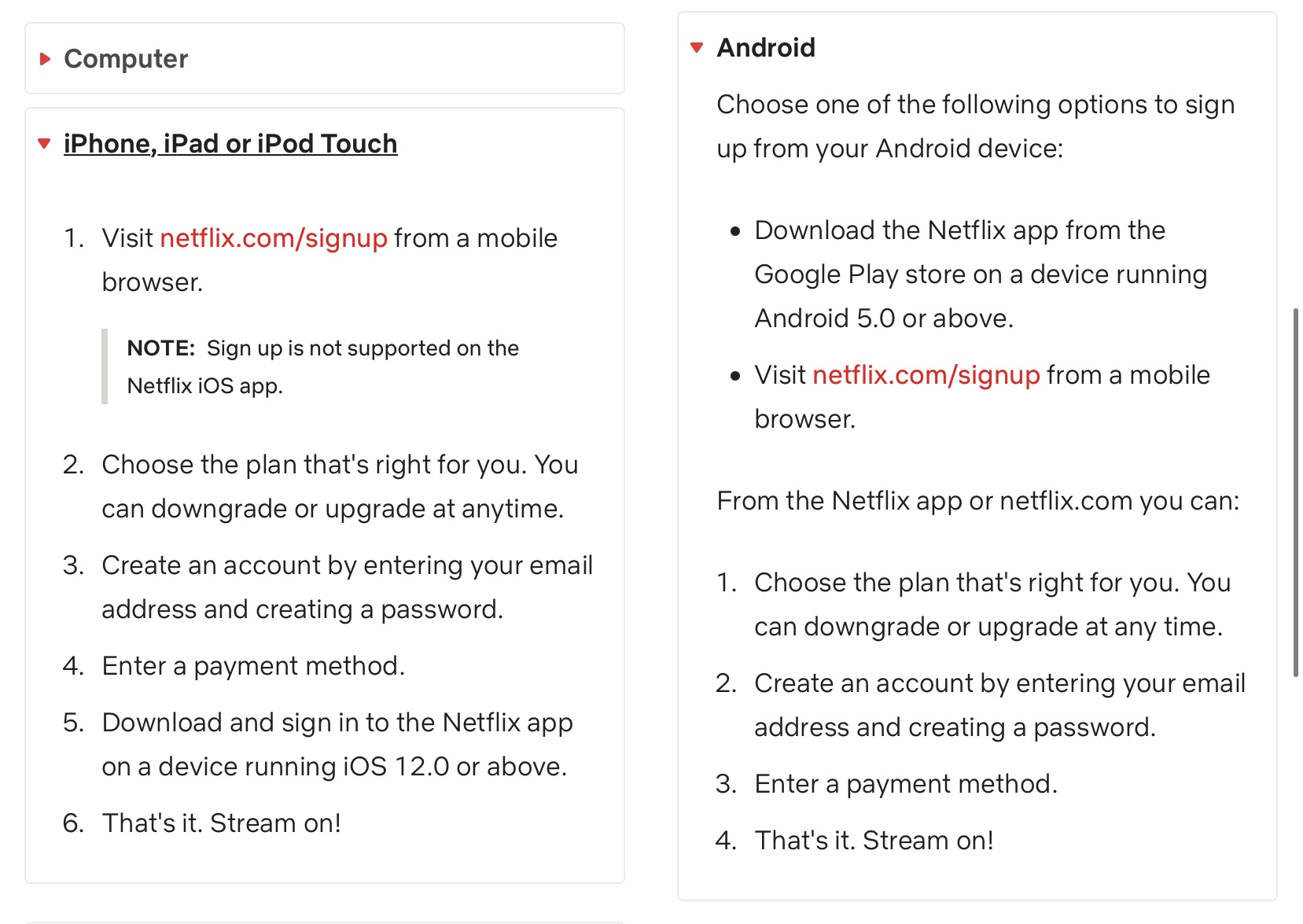
Because Apple enforces this policy, you can see the difference in Netflix’s signup instructions on iOS and Android. Once Google’s new policy comes into effect, I expect these to look similar:

What if the Play Store billing was completely optional in India, but a much better experience than any other method? The opportunity cost is low: an estimate of Google’s Play Store revenue in India for this year so far is USD 50 million. Its global 2nd quarter revenue was over USD 38 billion. The India business is a drop in terms of revenue, but led to 17 billion downloads.

In other words, the question Google should discuss is when app makers start designing workarounds for your policy, do you start plugging loopholes, putting you at odds with app makers, or so you change your policy, perhaps radically, so app makers welcome it?

Categories
Products and Design The Next Computer Wellness when Always-On

Sustainability and the ‘joy of fixing things’

From this short, beautiful piece on the joy of fixing things:

Watch a story about the owner of a priceless collectible car or wristwatch, and you’ll notice that they often state that they aren’t the owner of that object, but instead the steward who is keeping it till it moves on to the next owner.

It’s that same feeling that I have about all the objects in my possession. Whether it’s a vacuum cleaner, a knife, or tape measure, when I look at it, I think about the people that brought it to fruition. I think of the people who designed it, assembled it, shipped it across continents, and placed it on a store shelf. When it breaks, I think of its possible future in a landfill somewhere, all of that effort then forgotten. No object deserves that future.

As readers of this site know, I feel strongly about this.

And using well-constructed hand-me-downs has also forced me to become at least somewhat proficient at repair and maintenance, meaning I get to know these things better, which in turn teaches me what about them makes them great in the first place.

Finally, adopting a mindset of being okay using such tools has over time helped me get better at identifying new items that are likely to last long, perpetuating the cycle.

Categories
Uncategorized

The opportunity for tech in agriculture

In the context of the new agriculture reform bills recently passed by India’s parliament, I came across this article on the need and opportunity for technology in Indian agriculture. The whole article, end to end, is a gold-mine. For anyone with any interest in building a business in the agricultural space after these reforms, this is a great read.

[A farmer looks for] answers to three basic questions—what crop to sow, how to grow it, and where to sell it… To be specific, there are three infirmities in the current agriculture extension system—insufficient knowledge creation, poor delivery of information, and an absent grassroots capability. We need to reimagine the agricultural R&D and the extension system by creating knowledge, disseminating personalized information through technology, and decentralizing knowledge delivery by empowering local channels.

On knowledge creation:

An extension officer visiting Kamlakant’s farm is often swiftly surrounded by a crowd of farmers waiting to get their query answered. To really address farmers’ knowledge gap, we have to create a knowledge bonanza… agriculture universities and institutes need to create open access online agriculture courses (like courses on Udemy, a popular online learning platform) on horticulture, soil science, nutrient management, crop protection, greenhouse cultivation, post-harvest management and cold supply chain.

This is an enormous opportunity because

Currently, over 94% of India’s 138 million farm landholdings do not receive information through the agriculture extension system due to which smallholder farmers continue to be far less productive than what’s possible.

On information delivery:

Smartphone for all can be a real gamechanger as it would solve for all the three questions that Kamlakant and his ilk usually have at the beginning of every cropping season…. Recently, during the lockdown, tomato prices plunged, causing tomato cultivation to decline. If Kamlakant can find out that there are fewer tomato growers in the same way Google Maps informs us about the route which has less traffic (past trends would indicate that less cultivation could result in a price rise 2 months down the line), he would plant tomatoes. Data can help farmers make safer bets and get better prices.

On grassroots capability:

With cheaply available online courses, young graduates and even progressive farmers can self-train as extension officers and fuel on-farm innovation… When every farmer uses a smartphone, it becomes easy to develop mass contact farmer-to-farmer data sharing as well as individual contact with farmers. Armed with individualized information, farmers make independent data-driven decisions and mitigate harmful herd behaviour. Smartphones help gather large amounts of data quickly, contributing to better policymaking.

Hugely inspirational. At the same time, I balance excitement with experience of how slowly things move. Back in 2006, I had written a guest post on a website I cannot remember, on the (Indian) state’s excessive interfering in business – a subset of that ended up becoming a post on this site. I remember that guest post had references to what could be possible with information delivered over SMS and focused radio stations accessed via phone calls, all over hardy Nokia dumbphones. A decade and a half later, after the mobile revolution we’re talking about smartphones for all farmers, but the information gap remains.

Categories
Audience as Capital Data Custody Discovery and Curation Making Money Online Privacy and Anonymity Real-World Crypto

On legal cover for independent journalists, censorship and self-hosting

I just discovered this – “legal support for Substack writers

Important writing holds the powerful to account – and quite often, that’s an arrangement that the powerful would rather not support. In some cases, antagonists use threats of legal action in an attempt to stop the work that makes them uncomfortable. Recently, for instance, a high-powered lawyer representing a politician threatened a Substack writer for his coverage of the lawmaker’s questionable business ties. The threats disappeared when the writer, backed by our support program’s lawyers, stood his ground. At Substack, we want to make it crystal clear that anyone who uses such intimidation tactics will also have to reckon with us. We will use our financial and legal resources to vigorously oppose any bad-faith efforts to dissuade Substack writers from doing their work. 

Substack will make the ultimate choice on who is accepted into the [Defender] program and which cases to support. Once a case has been taken on by the program’s lawyers, Substack, at our discretion, will cover fees up to $1 million (in exceptional cases, we may cover even more). 

This is a bold, brave move by the company, and I would definitely rather this program exist than not. There are several major journalists (one, two, three are just highlights) moving to Substack, and they will need this sort of institutional cover to form 21st Century Media.

However, it puts Substack in the position of determining what opinions and positions should be defended and what not. Specifically, it puts Substack’s founders in that position. While the scale is very different today, the situation is little different from the Facebook leader being ultimately in the position of what is censored and what is promoted on the service and what isn’t.

In fact in Facebook’s case, we are taking about censorship of content. The Substack legal support program is not just about censorship but about the personal, potentially physical freedom of the writer – that is what writers are choosing to outsource, for lack of an alternative.


End-note: independent of legal protection, journalists should also invest time and effort in figuring out how to be uncensorable. We examined it a few months ago: Part 1, Part 2. If you publish on your own site and encourage your readers to read you over the open web, or subscribe to your writing via RSS, and pay you in cryptocurrency, you become a lot more difficult to shut down. You can of course continue to publish that content over Substack, and share it on Twitter and engage wit your followers there. Ultimately the truly censorship-resistance platform is the one you host.

Categories
Discovery and Curation Privacy and Anonymity Products and Design The Next Computer Wellness when Always-On

Work, tools and agency

From the writer Anne Helen Petersen, on “How Work Became An Inescapable Hellhole”:

 Like email, Slack allowed work to spread into the crevices of life where until that point it couldn’t fit. In a more efficient, instantaneous manner than email, it brings the entire office into your phone, which is to say, into your bed, when you land on the plane, when you walk down the street, as you stand in line at the grocery store, or as you wait, half naked, on the exam table for your doctor.

 It didn’t just accelerate communication; it standardized a new, far more addictive form of communication, with a casualness that cloaked its destructiveness. When you “shoot off a few emails” on a Sunday afternoon, for example, you might convince yourself you’re just getting on top of things for the week ahead—which might feeltrue. But what you’re really doing is giving work access to be everywhere you are. 

… the technology writer John Herrman… predicted the ways in which Slack would screw with our conception of work: “Slack is where people make jokes and register their presence; it is where stories and editing and administrating are discussed as much for self-justification as for the completion of actual goals. Working in an active Slack … is a productivity nightmare, especially if you don’t hate your coworkers. Anyone who suggests otherwise is either rationalizing or delusional.”

While I fully agree with tools like Slack breaking down of boundaries between your work sphere and your other spheres, the state of mind that the writer describes is one of a poor pre-existing relationship with work.

It’s important to recognise that the normalisation of remote work and the ubiquity of work tools that are model led on addictive hyper-communicative social media have made this relationship worse, not caused it. Unless you are a bottom-of-the-rung worker drone with no flexibility and no voice, you have the ability, however little, to push back against a 24×7 work culture, a culture that causes enough anxiety that people need to show off their input instead of their output. As the writer herself says,

Many of us still navigate the workplace as if getting paid to produce knowledge means we’re getting away with something, and have to do everything possible to make sure no one realizes they’ve made a massive mistake. No wonder we spend so much time trying to communicate how hard we work.

If it weren’t for these tools, distributed work would have been much more difficult – in many cases impossible. For those companies that have been distributed for a while, it’s given employees the opportunity to optimise their location and time for their other interests and constraints. It’s lowered the overhead of building and scaling an organisation of people. It’s reduced the friction of communication – just five years ago your only option as a smallish company was email, with long chains, lost contexts and renamed file attachments as some form of version control. Today you’re split for choice with Slack, Google Docs, Trello, Notion, Airtable, Zapier and thousands more tools, free and paid.

But no matter how good they get, they are tools meant to serve us. Never the other way around. Regardless of whether you’re a founder or CEO, part of the leadership, or in some position of authority in the company. Be aware of your relationship to work. Make it easier for the ones whose work time your control to immerse themselves in their other sphere. Push back when people above you intrude into your non-work spheres. It’s not always going to result in you getting fired.


Categories
Audience as Capital

Permaculture and influencers

From an in-depth, heartwarming two-part article on permaculture projects in India:

 we travelled south to the city of seven forts, Satara, to visit some of the spectacular work of the Paani Foundation.

There’s a lot of background to this story.

It begins with a super famous Bollywood movie star, Aamir Khan, who became aware of India’s water crisis as well as the solutions that were prevalent among a number of villages who had restored their depleted groundwater through extensive water harvesting and water management.

Aamir, along with a cohort of strong collaborators, began a contest to see which village in the state of Maharashtra could implement the most water harvesting structures with the highest quality of planning and construction in a 45 day period, timed in the dry season before the monsoon rains. Villagers were chosen from each area to undergo an educational program on watershed management, and then the contest began.

To date, there have been over 10,000 village contest entries, and over 1,000 of those villages have completely solved their water problems and restored their water tables.

Influencers on social networks are one thing. This is influence in its purest, most powerful and most wholesome form. In addition to holding celebrities accountable for the products that the endorse, one could encourage them to take up projects, give visibility to more causes than they already do. With the Internet there are orders of magnitude more celebrities than there were in the age of cinema and cricket – it means between them they can endorse the long-tail of causes.

Read both the articles for examples from Bidar/Karnataka, Kurnool/Andhra Pradesh, Chennai/Tamil Nadu, Pune/Maharashtra, West Bengal.

Featured image photo courtesy Brian Wangenheim/Unsplash

Categories
Products and Design

If it ain’t broken, don’t fix it

From this review of the new Fitbit smartwatch

… the Sense has a “solid-state button” on the left. It is, essentially a small, sunken area with capacitive sensing. When you press it with your finger, the watch vibrates, giving you the impression that you’ve pushed a button…

[But] I do not like this solid-state button. Unless you cover the entire button with your finger or thumb when pressing it, it won’t register, which leads to a lot of fiddling. Do you know what rarely suffers this kind of problem? A normal button. Another issue is that at certain angles the left side of the watch will just happen to press into the flesh of my forearm, which the Sense kept reading as a long-press, and so Alexa was constantly popping up and listening for a command. It happened so often that I eventually disabled long-pressing all together. Not ideal!

When you upgrade to a new version of the product you already use, it’s annoying to find that you have lost functionality, especially everyday functionality, because the company decided to pursue something ‘cool’.

I had recent first-hand experience of this. I can set my Fitbit Charge 2 to display the date, time and my progress towards the 250-steps hourly activity goal. It’s perfect and I rely on it constantly. Got a Fitbit Charge 3 for the spouse. It has a much wider range of ‘faces’ you can configure and set. None of them has the activity goal on the home face. Others are similarly annoyed (Fitbit Forum, Fitbit subreddit). It’s impossible to verify this before purchase, and there was no real reason why Fitbit couldn’t have also made it available.

(Featured image photo credit: Sporlab/Unsplash)