Categories
Wellness when Always-On

Nature fulfils intrinsic psychological needs – study

The connection between nature and human well-being may be deeper than previously thought. According to a study of over 700 respondents, nature fulfils basic psychological needs intrinsic to humans.

Much research has examined the way individuals form attachments with the physical spaces they inhabit. However, the way people form bonds with natural landscapes remains somewhat of a mystery. Study authors Adam C. Landon and his team speculated that it may have something to do with the fulfillment of psychological needs [autonomy, competence, relatedness].

[R]espondents were told to think of a wilderness area that is special to them and were asked questions designed to assess their place attachment to that area.

Results showed that a landscape’s ability to fulfill psychological needs predicted respondents’ place attachment to the natural area in question. When taken together, the three needs explained “approximately half of the variance in each dimension of place attachment.”

“The importance that people attribute to a physical space is in part a result of that space supporting their psychological needs for feeling connected to other people, experiencing feelings of competence, and autonomy in their behavioral choices,” Landon told PsyPost.

I can see why creating a home garden and then spending time in it is so rewarding, especially if you create and maintain it with your spouse or family – or, on a larger scale, with your community. It’s a direct validation of one’s autonomy, relatedness and competence.

Our alternate online realities get richer and richer, but it’s going to take many centuries of evolution, if not much longer, before any aspect of the Internet can replace the connection humans have with nature. As we live in the Always-On, a big part of our wellness depends on something decidedly offline.

(Featured image photo credit: Isaac Quesada/Unsplash)

Categories
Audience as Capital Wellness when Always-On

The possible end of the Trump phenomenon

CNN wonders if Trump’s mastery of the attention economy may be waning:

I am far, far from the first person to say this, but perhaps Trump has just become… boring? On Tuesday night, for instance, he did “his usual lie-shtick about how he just saw CNN’s camera light go off right after he insulted CNN,” Daniel Dale wrote. “CNN doesn’t broadcast these rallies live, doesn’t turn off its cameras when he insults CNN, and doesn’t use any visible camera light when recording at rallies.” Yet Trump has been repeating this lie for years! It’s boring.

Quinta Jurecic advanced this argument in The Atlantic two weeks ago. Jurecic said “Trump is boring in the way that the seventh season of a reality-television show is boring: A lot is happening, but there’s nothing to say about it.”

“Trump is pretending it’s 2016 again,” Ryan Lizza wrote Tuesday night, and he’s “lost the populist message that won him an unlikely victory.”

Trump became the world’s most popular influencer by creating a strong identification with a certain section of the US population who felt, rightly or wrongly, that they were becoming irrelevant. His great strength has been recognising that this segment of the population lives vicariously through him, just like any other influencer on, say, Instagram.

Because disenfranchisement is what he tapped into, his successes became their successes. His flouting of convention became their thumbing of noses at an establishment that didn’t value them.

As it became apparent that this behaviour worked, other members of his political party aped his disregard for rules and scruples, even if they couldn’t match his persona. This has made him more politically powerful, making his base feel further empowered – a textbook positive feedback loop.

It’s the most powerful example of the Megatrend Audience as Capital.

For a while now I’ve been wondering what happens when this segment feels empowered enough, when it feels that it, finally, controls the national narrative.

It’s likely that they will see diminishing returns on the attention they pay to Trump. Given how fickle attention is and how saturated media is, it’s very likely this segment will simply move on to something else.In fact, it’s likely that it will cease to be a segment – what brought them together has finished serving its purpose.

And yes, something else will almost inevitably fill the national attention vacuum left by this. But it need not be a singular divisive political figure. It is very probable that this current phenomenon may end, and not with a bang but with nary a whisper.

(Featured image photo credit: History in HD/Unsplash)

Categories
Audience as Capital Discovery and Curation The Dark Forest of the Internet

Newsletters, feedback and interactivity

Mark Manson, on how his newsletter is different from his blog:

each Monday, three of my ideas go out to around half a million people. And each week, anywhere from a couple hundred to a couple thousand of you reply with your thoughts, disagreements, and suggestions. There’s an accountability and immediacy to the relationship that I have not felt since my early days as a blogger.

In the early months, I still treated it similar to how I treated my website: I wrote up declarative, advice-driven content with a kind of finality to it and posted it, thinking that was that.

… [but] by incorporating feedback, disagreements, and follow-up topics, the newsletter morphs into a kind of slow-moving conversation, where I can revisit topics and update prior beliefs with new information.

That baked-in feedback mechanism and willingness to evolve and improve upon itself is something that’s sorely lacking from public discourse at the moment. It’s not present in the media in any significant way. Blogging used to be like that, but blogging hardly exists anymore. And it was never possible on social media

It’s great for Mark that he’s found a medium that has both reach and interactivity. I know first-hand what it is to publish posts, see stats about them being read, but not hear back from those readers.

Blogs are in fact better suited to interactivity than newsletters. With a newsletter, your reply goes only to the writer. With a comment on a blog, you’re posting to both the writer and everyone else who reads the blog. You’d expect a robust community of loyal readers to be built around blog comments.

However, distribution trumps everything. it’s hard to follow blogs – RSS remains niche, despite the great variety of web and app based RSS readers available. Everyone has an email address, so everyone can follow someone who writes a newsletter. Email is the ultimate publish-subscribe medium.

End note: I’m wondering if chat apps like Telegram will ever replace email for newsletters. It’s hard to match email’s distribution, but orders of magnitude more people use chat apps than RSS readers. Outside of work, people now use chat much more than email. Today, for most of the world, Whatsapp is their main communication channel, and a few people I know use Whatsapp as a distribution list for stuff they publish. I’ve yet to see a community built on Whatsapp though in the manner I have on Telegram. I think it’ll only be a matter of time before you see this happen.

Categories
Discovery and Curation Making Money Online Wellness when Always-On

News subscriptions are unlikely to be a sustainable business model

Tim Bray describes why, according to him, news subscriptions are unlikely to be a sustainable business model for most news publishers:

[Publisher management’s] arithmetic didn’t consider their chance of getting me to click on “Subscribe.” In my particular case, that chance is almost exactly Zero. I subscribe to enough things and I am acutely reluctant to give anyone else the ability to make regular withdrawals from my bank account. I don’t think I’m unusual. People may not be financially sophisticated, but they’re smart enough to see through the “initial-price” flim-flam and a lot of us are highly conscious of our own administrative futility and the fact that we might just not get around to unsubscribing. I’ve seen this called “Subscription fatigue” and I think that’s a decent label.

“But wait,” says Mr Manager, “you already subscribe to five publications, so you’ve proved you have a propensity to subscribe! You’re exactly my target market!” Wrong. It’s exactly because I’ve done some subscribing that I’m just not gonna do any more.

In the blog post he also briefly refers to the fact that subscriptions are a thing because no one has cracked pay-per-view via micropayment. He goes on to argue that even if someone had, management would still prefer driving people to subscribe:

“Why on earth would I invest in selling individual articles when a click on the “Subscribe” button gets me a hundred times the revenue?”

It’s the opportunity cost of locking in future recurring revenue.

As we had described in our series on 21st Century Media, micropayments is one of those things that everyone recognises is an opportunity but where solution is always just beyond the horizon.

The first entity that really cracks this problem is going to be very valuable indeed. Being able to collect micropayments at scale means that news publishers can free themselves of advertising. If publishers charge comparatively more per view/read via micropayments than they make via ads, it’ll also significantly reduce the pressure to make articles, headlines, content, design towards clickbait.

Last but not least, because readers are conscious that they’re paying per article, it makes them less likely to mindlessly browse through low-value articles online and think about what they consider valuable.

(Featured image photo credits: Bank Phrom/Unsplash)

Categories
Data Custody Decentralisation and Neutrality Discovery and Curation Making Money Online Privacy and Anonymity Products and Design The Next Computer

Nationalism, capitalism and the Indian App Store

A Swadeshi App Store. It may well happen.

It began with the temporary removal of the Paytm app from Google’s Android Play Store. And snowballed with Google’s announcement that it would enforce its existing policy of a 30% commission on the in-app sale of all digital goods (with some exceptions). We discussed this a couple of weeks ago.

Soon after, the founders of some of India’s best-known tech companies put out statements not just condemning Google’s policy but also its intent, calling it a new Lagaan, after the tax that the British occupation of the 19th and 20th centuries levied on Indian peasants.

Vivek Wadhwa, a Distinguished Fellow at Harvard Law School’s Labor and Worklife Program, lauded the banding of Indian entrepreneurs and likened Silicon Valley giants’ hold on India to the rising days of East India Company, which pillaged India. “Modern day tech companies pose a similar risk,” he told TechCrunch.

And they called for a local, all-Indian app store, piggybacking on the new term Atmanirbhar, one that the current government has coined to promote local manufacturing and services.

“This is the problem of India’s app ecosystem. So many founders have reached out to us… if we believe this country can build digital business, we must know that it is at somebody else’s hand to bless that business and not this country’s rules and regulations.”

Inevitably, as is the case in India, at least some heads turned to the government for help:

Even though Google said it will allow developers to sell their services through other app stores, or websites, the industry doesn’t see this as an option either. Naidu suggested that unless the government chooses to intervene, there may be no other solution. According to tech policy analyst Prasanto K. Roy, the government’s Mobile Seva Appstore has over a thousand apps and 85 million downloads, yet it is unknown among Indian users.

To which the government, of course, responded with a why nothttps://economictimes.indiatimes.com/tech/internet/centre-open-to-launching-an-indian-app-store/articleshow/78438620.cms:

Weighing in on the issue, union minister for electronics and IT Ravi Shankar Prasad said in a post on Twitter that he is happy to receive notable suggestions from Indian app developers on how to encourage the ecosystem. “Encouraging Indian app developers is vital to create an #AatmanirbharBharat app ecosystem,” he tweeted on Thursday.

The Indian government “is not averse to the idea” of launching its own app store, officials said. The existing digital store for government apps, developed by the Centre for Development of Advanced Computing (CDAC), hosts a slew of applications such as e-governance app Umang, health app Aarogya Setu and storage app DigiLocker.

Paytm has since created and advertised heavily what it calls a mini-app-store, but is in reality a catalog of shortcuts to 3rd party web apps. Google has postponed the implementation of its policy to 2022.

In this tale, everyone’s actions and responses have been predictable. Google’s been tone-deaf and has immediately switched to appeasement. Tech company founders have been cynically opportunistic. They have been happy with Google’s (and Apple’s) stores for distribution, even advertising heavily on them, until the moment it worked against them and they switched immediately to victim mode, some even raising the spectre of neocolonialism. Though they’re among the most visible figures of India’s capitalists, they’ve quickly appealed to the government for a solution favourable to them, further pushing the nationalist angle. And of course the Indian government, regardless of its political learnings, is happy to intervene and get into the business of running business.

(Featured image photo credit: Mika Baumeister/Unsplash)

Categories
Uncategorized

“You don’t succeed because you have no weaknesses”

Tim Ferriss, on his podcast episode “Tribe of Mentors — Naval Ravikant, Susan Cain, and Yuval Noah Harari (#442)

[Your heroes] are all walking flaws who have maximised one or two strengths. Humans are imperfect creatures. You don’t succeed because you have no weaknesses, you succeed because you find your unique strengths and focus on developing habits around them.

(Featured image photo credit: Eberhard Grossgasteiger/Unsplash)

Categories
Discovery and Curation Privacy and Anonymity The Dark Forest of the Internet Wellness when Always-On

Different Time Bubbles

Recently I’d been dealing with some unexpected developments that required me to take a break from a few communities I was part of. When I returned I asked one community member what I’d missed. She remarked that everything I’d missed was “all captured in a different time bubble” that I could catch up on “at some point or the other”.

Beautiful.

But it’s also how I’ve thought of the many Alternate Realities we all inhabit online now. I described how I use Twitter Lists to privately follow different interests – space and astronomy, the Indian Forest Service, other wildlife, crypto, internet infrastructure, the Twitter handles of a community of startup founders I’m part of, and many others. I explicitly think of these as parallel universes running on their own time, universes I can teleport into and out of by simply toggling between list views. Ditto with Reddit’s many subreddits, Discords & Telegram groups.

Some timelines are slow, such as the small writing group I’m part of. You can return to it after a month and pretty easily connect what’s happening now with last time. Others are dizzyingly fast, like river rapids of content. A South East Asia tech community, and Crypto Twitter are like this – you can at best take in the latest snapshot, abandoning the rest for all time. Still other groups aren’t even timelines, like Wildlife Twitter. There’s no narrative. What you see before you at any point is also like what you’ve missed. They are the most peaceful and often the most rewarding to dip into.

I’m hugely excited by how inhabiting multiple personal universes, forming many lightweight and deep connections is now the norm, something we explored in our Alternate Reality series. But viewed another way, this extreme fragmentation is also cause for loneliness – it’s even harder for anyone to know the full you.

(Featured image photo credits: Christian Palmer/Unsplash)

Categories
Privacy and Anonymity

Trackers that link to other trackers

From a post on The Markup, “a nonprofit newsroom that investigates how powerful institutions are using technology to change our society”. The Markup worked with a site to evaluate its trackers. Their discoveries were disappointing but not surprising:

She said she only allowed three trackers on spartapride.org: cookies from Twitter and Facebook that accompany their “like” buttons on the site, and one from Disqus, a commenting platform she got through a prepackaged website theme she bought off the internet for $59 to build the site.

But when The Markup scanned spartapride.org using our new instant privacy inspector, Blacklight, we found 21 different ad-tech companies tracked visitors to the site, sending possible signals about people’s gender identities to advertisers—without the users’ knowledge or consent.

Among them were the marketing and advertising arms of Google, Amazon, and Oracle’s BlueKai consumer data division, which reported a massive data exposure this summer, leaving billions of records—including personally identifiable information—accessible to the open internet without a password. Oracle did not respond to questions about whether data gathered from spartapride.org’s users was included in the exposure.

The trackers loaded because Disqus sells ads on the free version of its commenting portal, and that ad space comes with third-party tracking. Disqus discloses those trackers on its own website, but the company wouldn’t comment about tracking SPART*A’s users.

The information asymmetry is so vast between people who set up websites, and those that provide those sites and tools for those sites that there can be no informed consent.

No-code is another major trend will very likely lead to privacy issues. With the ecosystem of easy-to-use, plug-and-play services that is organically emerging and expanding fast, people with no or little programming experience can create fairly complex experiences online – landing pages, commerce stores, information processing, even with AI capabilities. But because some of the most innovative services are from small companies who’re focused on execution, either they will take short-sighted data collection decisions, or will themselves build on top of infra that has poor data and tracking policies.

As we saw on our post on The New Middle (Part 1, Part 2), there will be an opportunity for a whole set of privacy-focused tools. Over the last week, Cloudflare announced a privacy-focused website analytics tool to rival Google Analytics. Over time, there will be enough general awareness that people will choose these over others that don’t make privacy and reasonable choice a priority. Through this site and its small set of readers, I hope to push a little to hasten this.

Categories
Privacy and Anonymity

Running pi-hole on Google Cloud for $0

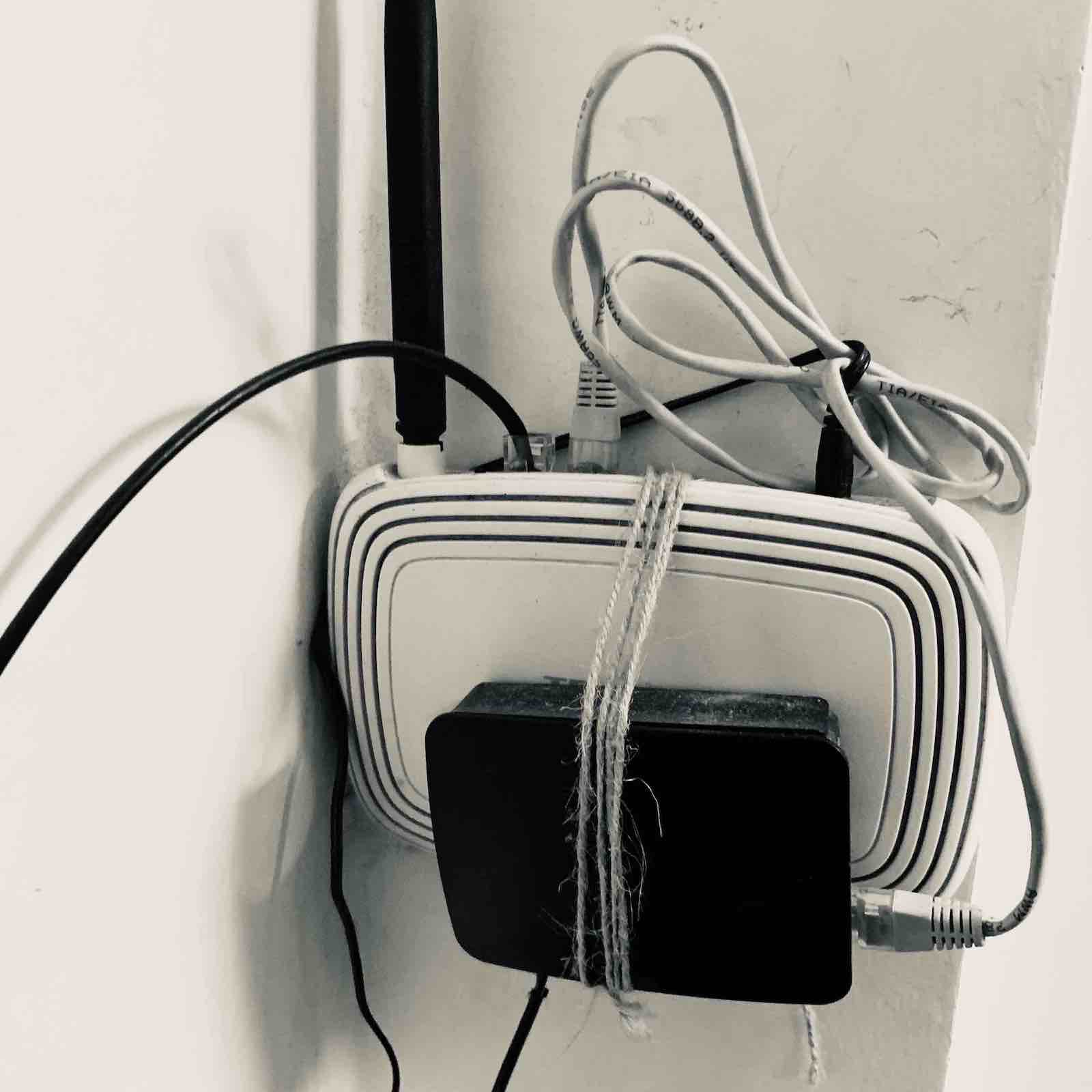
I’ve spoken a number of times about pi-hole, the open-source ad-blocking software that I run on a Raspberry Pi machine at home. The Pi computer is so small it’s physically attached to my router with a piece of twine; the whole setup is tucked away out of sight.

I wasn’t kidding. This is a smaller than palm-sized. And invisible behind a couch.

Since all DNS queries from my router go to the Pi, all devices that connect to the house wifi are protected from ads and trackers by pi-hole – phones, tablets, laptops, my other Pi machine.

The big limitation is that this protection only applies as long as I am home and connected to wifi. If my ISP’s facing problems and I switch to 4G, or I’m simply out of the house and connected to another wifi, I’m out of luck. I have a backup [1], but it’s not as good as the Pi. I can’t have the Pi accessible from outside of the home network, even behind a firewall, because my ISP is a PPPOE connection behind a NAT. Setting up dynamic DNS for this has been impossible for me.

Now. I had come across this guide on setting up a pi-hole on Google Cloud such that the usage would fall under the Google Cloud free tier, making it essentially free. I loved the idea. My concern was that the pi-hole instance would be open to the Internet. I’d have to set up my own firewall and VPN, and it always slipped down my todo list.

Recently I learnt that the author had updated the guide, in responses to concerns just like mine, with a script that installed the Wireguard VPN and pi-hole together. It also included instructions (rather simple) on how to set up firewall rules in the Google cloud virtual machine instance. It took me well under an hour to read through and set things up end to end: my Google Cloud account, setting up and configuring my VM, installing pi-hole and Wireguard on it, setting those up, and setting up my iPhone and iPad as Wireguard clients.

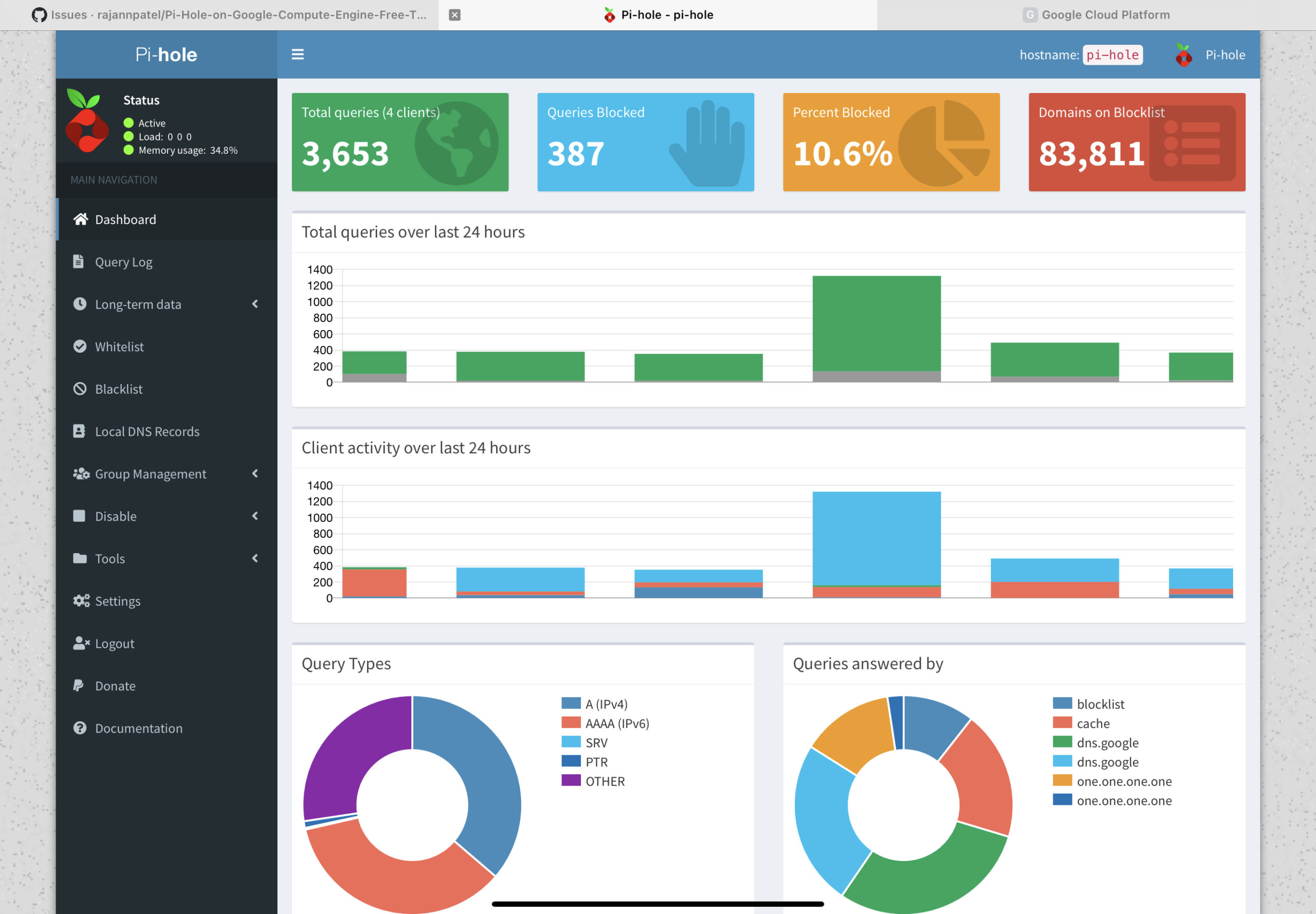
I now have a globally accessible but secure personal Pi-hole whose web interface I can access via a private address as long as I’m connected to the VPN. And because I’m on the VPN, my devices’ DNS queries are encrypted – all of these independent of the network I am on. It has nothing to do with my home wifi, or the pi-hole on my Raspberry Pi anymore.

This still hasn’t sunk in as I write this a couple of hours after I set it up. I’m looking at this new pi-hole’s web admin, and the VM’s terminal over SSH, and it’s weird that now, years after I began using the original pi-hole installation on my local network, I’ve just upgraded it to work anywhere in the world.


[1] I use the DNS sink Adblock on my iPhone and iPad, which are the two main devices I use.

Categories
The Next Computer

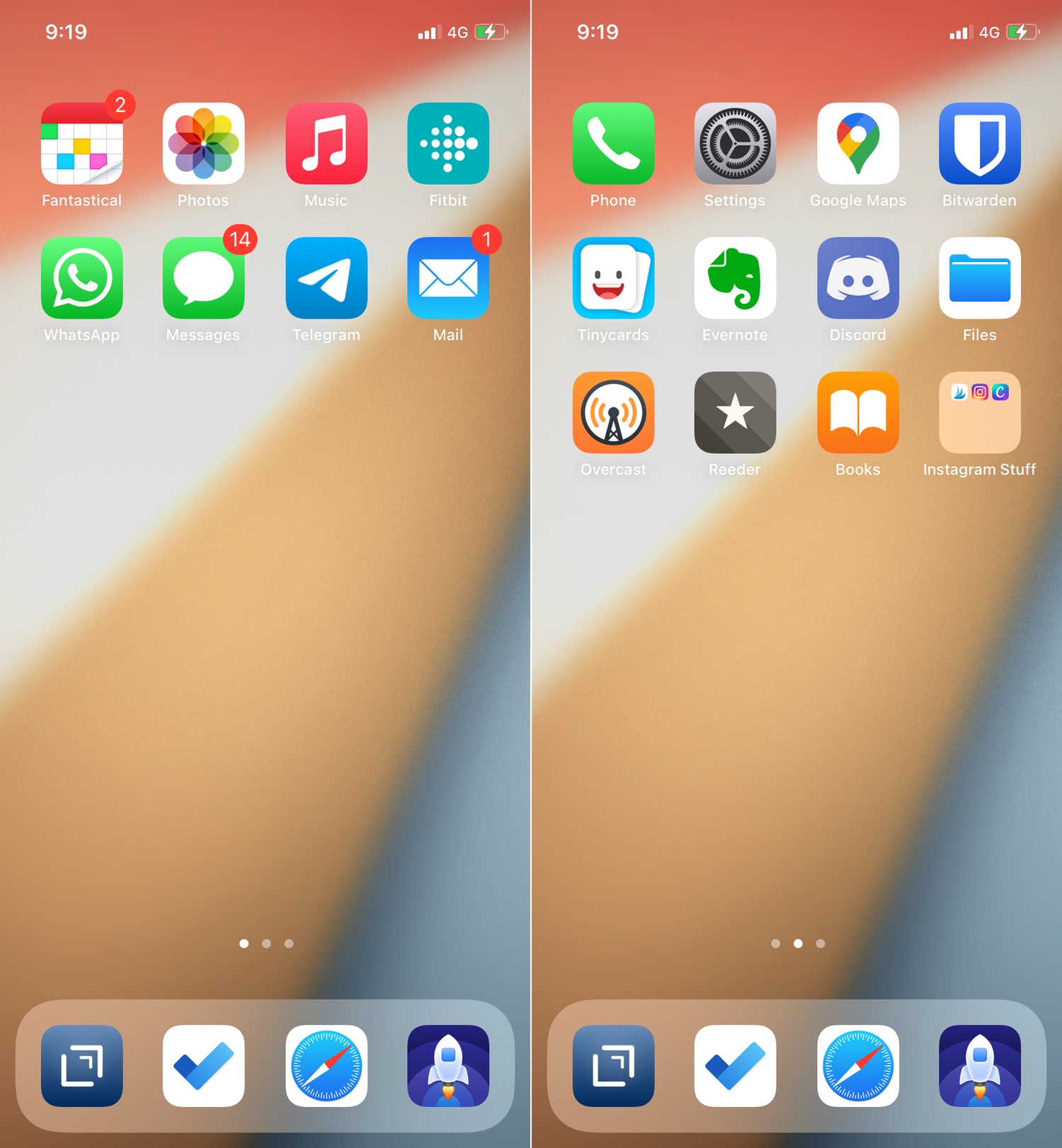
iPhone home screen, October 2020

Updated the phone to iOS 14 between the last Home Screen post and now, but that hasn’t made much of a change to the layout.

The Dock has remained constant for the third month running.

  • Drafts has become my most-used app. I use it as a scratchpad wherever possible: I’m typing this very post in it, after which I’ll copy it into WordPress. I’m not using many of even the free app’s features, such as tagging, or universal sharing, or the new iOS 14 widgets. All I use is the word counter at the top, the markdown formatting menu and preview, and search.
  • Todo is still in the menu but I’ve hit a plateau in its use. I want to use it as a general-purpose ‘checkout later’ tool, but I only use it for that sporadically. I think that has more to do with that I don’t have a process to revisit things I have captured, a weekly review.
  • The rest of the Dock has Safari and Launch Center Pro, the latter of which I use to launch my shortcuts, as we have seen every month.

My usage of Launch Center Pro has reduced this last month for two reasons:

  • One, Back Tap. In iOS 14, you can set your iPhone to perform preset actions – including Shortcuts – on tapping the back of your phone twice or thrice. I have set double-tap to launch my image-stitching shortcut, and triple tap for my expense-logging one. I’ve been using it for over a week and it still feels like magic.
  • Two, Shortcuts automation, which debuted in iOS 13 but I have only begun using now. Until now, I used Launch Center Pro to run my Shortcuts on a schedule. The Shortcuts app can also do this by itself. So I have set my headache-logging shortcut to run as usual at 9pm without LCP.

On the rest of the Home Screen, I have trimmed three rows of apps down to two by moving Settings, Files, Reeder and Overcast to the second screenful of apps. I don’t use Settings often enough for it to warrant a Home Screen location. Ditto with Files. Reeder and Overcast – I mostly read my RSS feeds on the iPad, and since I’ve begun working from home, I’ve barely listened to any podcasts. I know I enjoy them, but the context is missing – either a walk or a drive to/from the office.

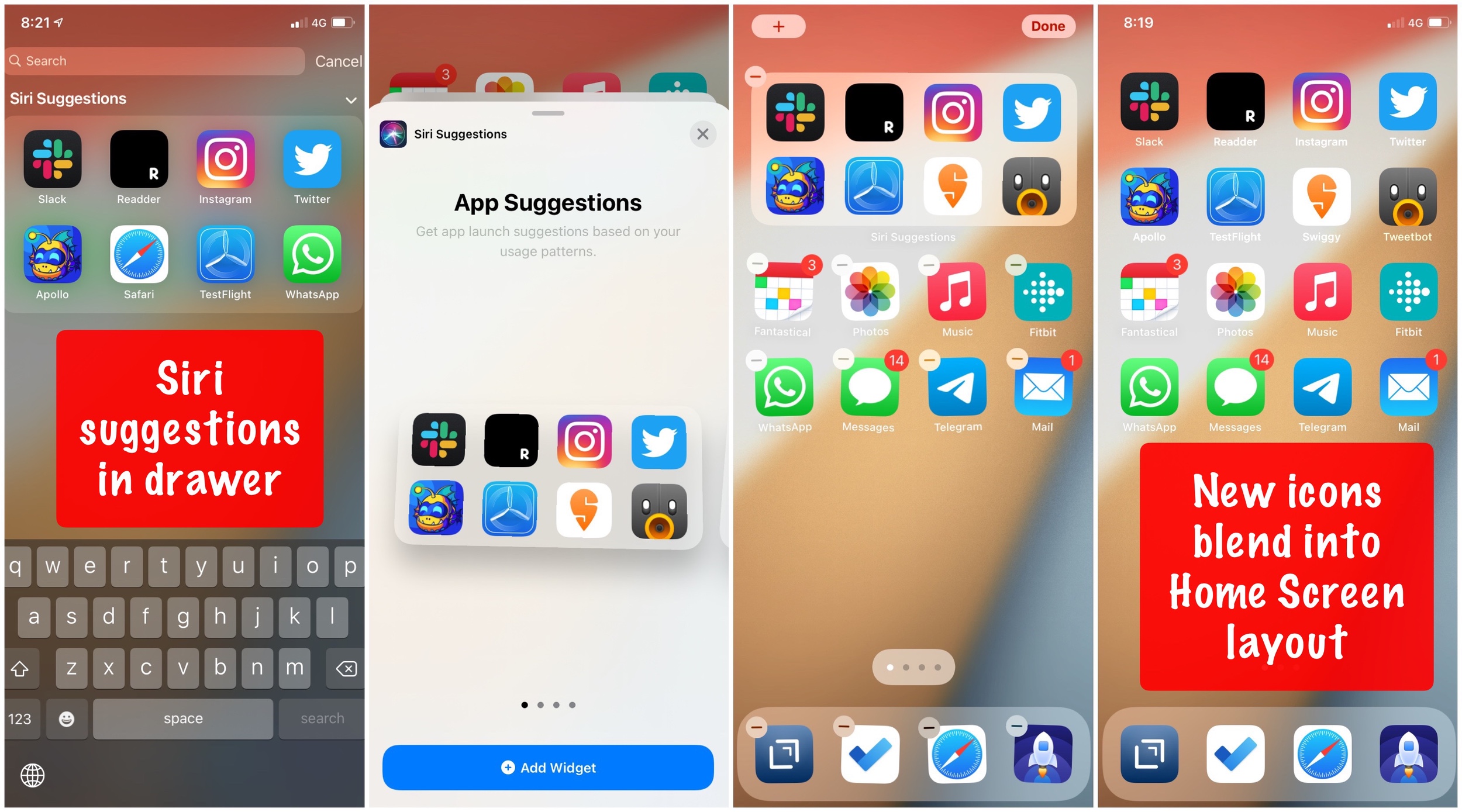
I tried using iOS 14’s new home screen widgets, but they didn’t take. I found them adding too much clutter. I was intrigued by the Siri Shortcuts widget, which adds eight icons to your home screen seamlessly. Their positions adjust automatically based on usage, just like with the Siri Suggestions drawer. In any case, they added too many icons on the Home Screen:

I’m looking forward to trying out other widgets to see if any will stick.

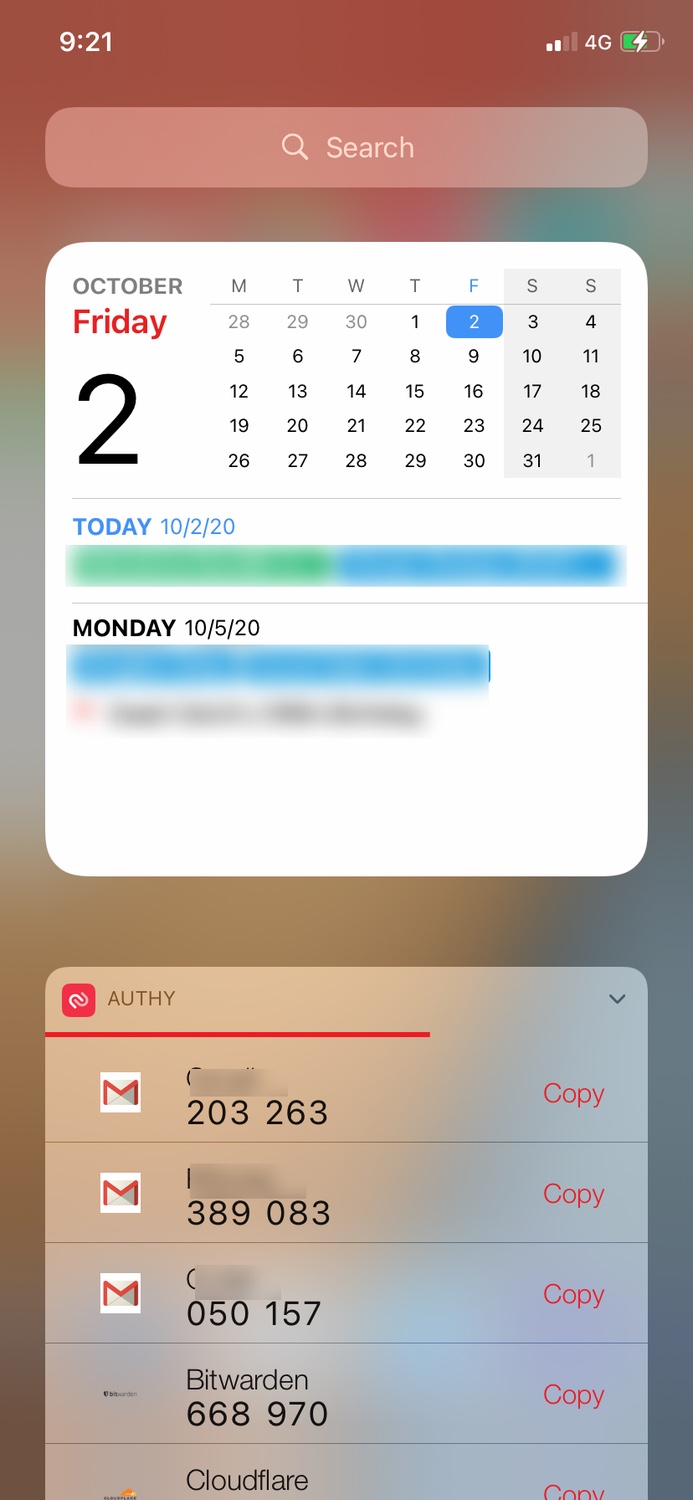
Finally, on the dedicated widgets screen itself, I have replaced the old Fantastical widget with the new iOS 14-optimised one. It’s not a great improvement over the previous one, but I don’t lose any information either:

By and large, despite the big update to iOS 14, the home screen has changed little. In fact it has gotten even simpler. This is unequivocally good, because it means I’ve been using fewer apps but more deeply. I look forward to what November brings.