Categories
Data Custody Decentralisation and Neutrality Making Money Online Privacy and Anonymity The Dark Forest of the Internet The Next Computer

Mozilla’s Grand Internet Opportunity – Part 1

Mozilla recently announced that it’d be laying off a quarter of its workforce. This also includes a “new focus on technology” and “a new focus on economics”.

The Verge’s article has the Mozilla Corp CEO say “… Mozilla will initially focus on products such as Pocket, its VPN service, its VR chatroom Hubs, and new “security and privacy” tools.”, although I cannot find that in the blog post she authored.

In the original blog post, the CEO stated that Mozilla’s long-term goal was “to build new experiences that people love and want, that have better values and better characteristics inside those products.”, which is neither here nor there.

I think Mozilla has a huge opportunity here, but its vision, at least as articulated publicly, is not broad enough.

The opportunity I see is the following: there is a growing section of people who have become aware, through increased press coverage, of the dominance of a few american internet companies and their own dependence on these companies [1]. They aren’t going to be Stallman-like in their use of technology any time soon – the trade off is far too unfavourable – but they are looking for reasonable alternatives and are willing to pay for them. Baker the CEO has said exactly this, that Mozilla plans to “build and invest in products and services that will give people alternatives to conventional Big Tech.”

Well to begin with, Mozilla should create a set of paid privacy-oriented products that anyone can setup on their phone to attain a basic level of privacy protection: the Firefox browser (exists), a VPN (available in a small set of countries), an DNS-sinkhole adblocker, a password manager and a second-factor authenticator app. They’ll need great documentation and guides about how to set this up – in this regard the Mozilla community is a great asset.

[1] See the reporter Kashmir Hill’s 2019 attempt to go a month and a half without services from Amazon, Apple, Facebook, Google and Microsoft.

(Part 2 – It gets even bigger)

Categories
Uncategorized

Will to power feat. Thiel

Power is sought so it can be wielded. Just as no one builds a multi-billion dollar empire without some sort of savage determination and intense will to power (otherwise they would have stopped at some earlier point, taken their winnings and gone home), no one accumulates power and then declines to use it in the face of existential threats—of which Thiel counted Gawker as one to his business interests. A Mark Zuckerberg or an Elon Musk doesn’t build an empire and allow others to encroach on their borders. And yet, it says something about our reflective, childlike understanding of the minds of these people that we condemn, the Koch Brothers or George Soros for various schemes, without stopping to think about why they are doing these things. It’s not simply to save on their taxes, I’ll tell you that. It’s because they have those same “privileged claims to knowledge” and “strong claims of human agency,” that Peter was talking about.

Ryan Holiday answering the Quora question “How powerful and resourceful is Peter Thiel?
Categories
Uncategorized

Measure to improve as a practice

David Cain of the excellent blog Raptitude is tracking his calorific intake for a month because he’s put on a little weight (The Covid Nineteen Pounds) when homebound:

My next official experiment is to track caloric intake for a month. I predict less overall intake, but I’m not setting a target, only tracking. I want to know:

-What I actually consume in a day

-Where the costliest habits are

-What’s worth consuming and what’s not

I’ll report daily intake each day of the whole month, and any weight change that occurs.

The working hypothesis is “What gets measured gets managed” — that simply charting the behavior will shape it in sustainable ways, whereas striving probably won’t.

The important bit is why he’s doing this:

As long as I’m tracking the numbers, however, I can’t escape the awareness that my choice will turn a 2200-calorie day into a 3500-calorie day, and I’ll have to ledger these figures.

Suddenly, no part of me entirely wants this “treat.” I can see the needless cost I’m about to incur, and it no longer feels like something worth rationalizing. The desires themselves have shifted, with no moralizing and little willpower involved

David’s tracking of calories is similar to my tracking of my water intake for the next 250 days, although unlike David I have a consumption goal.

I have always been a measure-to-improve approach especially given that I’ve managed consumer products for most of my career, but lately I have begun applying it daily life.

I’m considering a separate web property to catalogue people using the Internet to dramatically improve their lives, though not limited to fitness. By Internet I mean both software like MyFitnessPal and Strava, to iOS Shortcuts as well as connected consumer hardware like wearables, 3D printers and devices like the Raspberry Pi.

Categories
Personal Finance

“Five Rules to Build a Positive Investing Habit “

This is a draft of a post I wrote for Cube Wealth, where as of this writing I’m the chief operating officer.

We’re not taught personal finance well enough in school. Not even close. That’s why most of us start our adult working lives without a healthy relationship with money – I did too. It’s not even a subject taught at the best business schools in the country. This results, strangely, in highly paid MBAs working in banking and high finance who manage their own finances poorly.

I feel strongly about this, which is why I’ve been at Cube Wealth from Day One of its existence helping people invest well – it goes without saying I’m a customer as well. During this time I’ve been fortunate to spend time with some of the wisest and most successful investment advisors in the country. From what I have learnt from them, I’ve pieced together five exceedingly simple rules to build a low-overhead investing habit that creates wealth for you and your family. Here goes:

1. Start. Today.

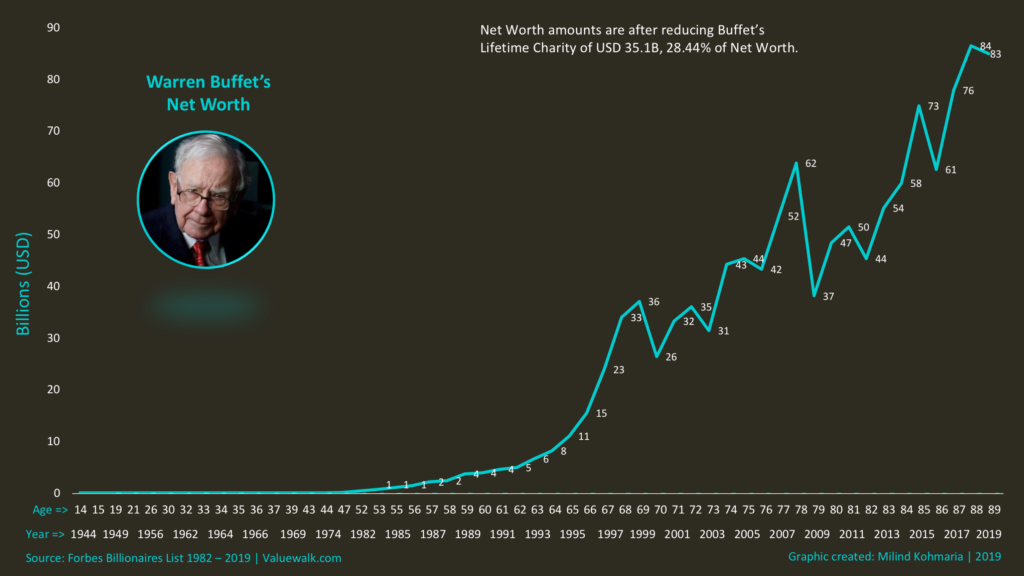
“The best time to plant a tree was twenty years ago. The second-best time is now” is a proverb as old as time itself. It is especially true for investing because money compounds: when left untouched growing at a steady rate, your money accumulates faster the longer it stays invested. Look no further than the grandmaster of investing, Buffet. This Morningstar article charted the growth of his wealth over his lifetime:

The kicker is at the end of the article:

Warren Buffet made his first investment at the age of 14. Had he started investing late, say after 5 years, what is the kind of money he would not have made? The answer. The wealth bars missing would be the last five!

2. Pay Your Future Self First 

You’ll always have outgoings during the month: there’ll always be bills, there’ll always be something you’ve been wanting to buy for a while, always something you have to gift. You can budget all you want, but in reality your month’s expenses follow Parkinson’s Law: they expand to fill available space. To make sure you invest regularly, invest a set amount of money the day your salary or income hits your bank account. What’s left is yours to spend. Your future self will thank you.

3. Set Yourself Up for Success 

So now you know that you should invest before you spend your monthly income. But doing that every month gets tiresome very quickly. The well-known financial writer Ramit Sethi describes how he makes it easy for himself: he has one bank account that everything flows into, like an email inbox. From there, he moves money into a separate investment account. I’ve done the same thing: at the beginning of every month, I make one single instant UPI transfer from my salary account into another investment account. Out of sight, out of mind. If you have fewer control issues than I do, you can automate this and simplify your life by setting up a recurring transfer on a particular date of the month. Some banks call this a standing instruction. Make it easy for you to be good.

4. Get a Coach

At this point, you’ve automated the movement of your monthly investment amount into a separate account so you don’t end up spending it. The next most important question you ask yourself is where to invest your money.

The correct answer is Don’t. Don’t decide where to invest your money. Leave that to a professional investment advisor. Not just because they will likely do a much better job at it than you, but because you have a career to pursue, hobbies to explore, places to see, family and friends whose company to enjoy. Unless you find joy in investing – in which case you probably wouldn’t be reading this – spend time picking the right investment advisor, not actually investing.

That is the whole point of Cube: to give people like you and me access to the investment advisors that so far only the rich have had access to, so you can live your life worry-free.

5. Fill it, Shut it, Forget it

Never before or after has a motorcycle ad imparted such wisdom. The idea is simple: don’t touch your long-term investments once you’ve made them, no matter what the markets say or what your immediate financial needs are. In his 1994 shareholders’ letter, Buffet had this to say:

We will continue to ignore political and economic forecasts, which are an expensive distraction for many investors and businessmen. Thirty years ago, no one could have foreseen the huge expansion of the Vietnam War, wage and price controls, two oil shocks, the resignation of a president, the dissolution of the Soviet Union… none of these blockbuster events made the slightest dent in [Buffet mentor] Ben Graham’s investment principles. Nor did they render unsound the negotiated purchases of fine businesses at sensible prices.

Too often I have seen people, including friends and family, treat their investments like a personal expense account. They are profligate when times are good, dipping into it to make gadget, vacation and other purchases, only to then panic when times are bad when markets fall.

That shouldn’t be you. Don’t use your long-term wealth chest for short-term stuff. First get good life and health insurance for yourself and your family. Then set up an emergency fund for 3 to 6 months of your typical monthly expenses. And save systematically for expenses you know are coming up in the next three years. Hand over everything surplus to your advisor.

Look at the five rules again. Start today. Set aside money for investments before you spend. Automate this. Let a professional handle the actual investment. And don’t touch your money as it compounds. None of these is complicated. None of these requires advanced financial know-how.

All it requires is a commitment to build a good habit. 

Good luck.

Categories
Wellness when Always-On

What is the opposite of not sick?

We have talked about burnout before (“Work and Success“, “Burnout as a Workplace Injury“), something I experienced a few years ago, and which I wouldn’t wish on anyone. This article describes the physiological response to the conditions that typically lead to burnout:

.. the body is handling all kinds of stressors through this allostatic process, the sum of which is also called allostatic load. All things going on in your life right now contribute to this load, including the stress from your work, finances, relationships, sickness, working out, and so on. The most important way that your body responds to these stresses is through the so-called HPA axis (hypothalamic–pituitary–adrenal axis) which results in the secretion of adrenaline and cortisol, the major stress hormones.

These hormones give an immediate boost to the system, preparing it for (intense) action and fight-flight behavior. In other words, when the HPA-axis kicks in you’re running on survival energy. This is great when you’re in acute danger, like escaping from threat or fighting of attackers. But it is unnecessary during normal daily living. And it can even become damaging when you’re functioning from your survival energy supply 24/7.

The rest of the article describes the progressive effect on the body of continuing to functions through such conditions.

The most important piece I think is at the end. The writer poses a simple question:

I want to also point to the necessity of defining the opposite of burnout. Sadly, in many medical and scientific literature pathology prevails. We know very well what sickness and disease look like, but what about the opposite? What’s it like to not be burning out?

This opens a whole rabbit-hole, but I think it is essential to think about this for oneself. Both our formal education and our societal norms condition us to think in terms of achievements. At no point does is one encouraged to consider what a desired end state looks like.

Categories
Decentralisation and Neutrality Making Money Online Privacy and Anonymity Real-World Crypto

The internet’s payments layer

This provocatively titled essay makes an important point about the economics of the online media today and its direct, immediate impact on society:

… the New York Times, the New Yorker, the Washington Post, the New Republic, New York, Harper’s, the New York Review of Books, the Financial Times, and the London Times all have paywalls. Breitbart, Fox News, the Daily Wire, the Federalist, the Washington Examiner, InfoWars: free!

A white supremacist on YouTube will tell you all about race and IQ but if you want to read a careful scholarly refutation, obtaining a legal PDF from the journal publisher would cost you $14.95, a price nobody in their right mind would pay for one article if they can’t get institutional access…

On the other hand, pseudo-scholarhip is easy to find. Right-wing think tanks like the Cato Institute, the Foundation for Economic Education, the Hoover Institution, the Mackinac Center, the American Enterprise Institute, and the Heritage Foundation pump out slickly-produced policy documents on every subject under the sun.

– The Truth Is Paywalled But The Lies Are Free

In our series on 21st Century Media, we imagined an operation that was reader-funded: “I am confident that people across income and interest segments will pay for something truly useful”. While 21st Century Media would be paywalled, we also sketched the outline of a micropayments system through which readers would frictionlessly pay for every article they read.

However, when it comes to the issue that this essay writer raises, which is widespread access to truth, the micropayments based system gets in the way – unless it’s widely used. Signing up to the micropayments system cannot be too much friction for the visitor who just wants access to that one article important to them at that moment.

This is a challenge, but also an opportunity – a massive one – to create a frictionless, universal, cheap, privacy-first micropayments system.

It’s tough to check all these off at once:

If it needs to be universal, Apple and Google, who have a browser and mobile OS duopoly, are in the best position to create such a system, and would get the most publishers to sign up. But there’d be serious concerns about privacy, particularly with Google.

A privacy-first browser such as Brave has a better shot at addressing privacy concerns, and has attempted to create one such cryptocurrency-based system built in, but the browser itself simply hasn’t gotten enough traction (and there are concerns about privacy among those that do use it.)

For the system to be cheap, it couldn’t use credit cards on file, which Apple and Google have hundreds of millions of, because the transaction costs are too high. Cryptocurrency-based wallets such as the one Brave implements could work, but adoption is an even bigger problem, although one worth solving.

India’s UPI system is widely used within the country, is natively digital, has near-zero transaction costs, but its use reintroduces privacy as a concern.

It’s a problem in the vein of “fast, good and cheap: pick any two”. But the payoff, a payments layer for the internet, is incomprehensibly large.

Categories
Product Management

Solving vs building

(Also posted on Linkedin)

One thing I have tried to make sure wherever I have run direct to consumer Product is to that the goal of the product + engineering teams is solving business problems, as opposed to knocking items off a roadmap list, however efficiently.

Knocking items off a list is akin to treating the symptoms rather than the underlying problem. Typically, the business owner doesn’t see enough users or enough revenue on their top-level dashboard (the symptom), so they keep suggesting product improvements and enhancements hoping one of them will be a hit with customers.

This is instead of tackling potential underlying problems. Poor free trial conversion rates, poor repeat usage of a particular revenue generating feature, below-par referral rates from existing customers, frequent customer complaints about a common issue – these are what problems sound like.

Marty Kagan of the Silicon Valley Product Group contrasts these well in his influential blog post “Product vs. Feature Teams“:

Specifically, [product teams] are cross-functional (product, design and engineering); they are focused on and measured by outcomes (rather than output); and they are empowered to figure out the best way to solve the problems they’ve been asked to solve… [but] much more often than not, the teams are not empowered at all. 

A team that builds line item after line item from sheet after sheet is a team that quickly feels it’s on an endless assembly line – because it is: product writes a specification, design translates it visually, engineering builds it, QA tests it, marketing sells it. Next.

If you had a cross functional team that instead tackled business problems, things’d be very different: 

  • Inherent to the idea of solving a problem is making explicit assumptions, forming hypotheses, building in order to test those hypotheses – otherwise how does one know one is successful? 
  • That leads to learning – what works and what doesn’t – so the next thing the team takes on is more likely to succeed with customers, and so on. That leads to momentum – the holy grail for any product.
  • And finally, teams that are cross-functional learn collectively instead of it residing in an individual, or being lost.

Such teams are rare because of the belief that solid roadmaps are what make management dashboards look good.

There are two important caveats to this:

First: Most DTC products will go though alternating phases of build and optimise. My experience is that companies spend far too long building and too little optimising. You build when you spot – and validate – a new opportunity: expanding into adjacent market or an externality like a welcome change in regulation. You optimise to get this right. Build is when a short list of features is in order. Optimise is when you solve problems.

Second: The problem-centric approach doesn’t apply to the early stages of a new product or a startup, where the point is to create and put out in the world something tangible. But once it begins approaching product-market-fit, leadership needs to make the shift from feature to product teams.

Categories
RG.org

Making it Happen

This spoke to me. Derek Sivers on Making It Happen:

When you experience someone else’s genius work, a little part of you feels, “That’s what I could have, would have, and should have done!”

Someone else did it. You didn’t.

They fought the resistance. You gave in to distractions.

They made it top priority. You said you’d get to it some day.

They took the time. You meant to.

When this happens, you can take it two ways:

You could let that part of you give up. “Oh well. Now I don’t need to make that anymore.”

Or you could do something about that jealous pain. Shut off your phone, kill the distractions, make it top priority, and spend the time.

It takes many hours to make what you want to make. The hours don’t suddenly appear. You have to steal them from comfort. 

In a small way, I made this transition from comfort to discomfort when I restarted regularly publishing on this site in December last year. But it’s another thing when someone who is clearly successful, like Sivers is, articulates it so plainly.

Categories
Data Custody Discovery and Curation Privacy and Anonymity Real-World Crypto

Use cases for real world crypto

This bit an interview with the founder of the ecommerce checkout system Fast:

Most of what people have predicted with cryptocurrency hasn’t happened. They’ve identified the right problems – payments need to be easier, identification needs to be better, we need to remove friction – but cryptocurrency isn’t the right technology for that. Part of the reason is the solution needs to be formed within the sphere of existing regulations and government identification.

It’s a strikingly different take and it’s articulated clearly what I have felt for so long. Blockchain-based alternatives to existing regulated use cases will have to fight a series of uphill battles to get traction. With regulators and governments, as the founder Allison points out. With entrenched interests and incumbents, and their vendors/suppliers. And with customers, who’re used to known processes and norms.

This is why tokenized real estate offered as investment has not taken off. Ditto with tokenized financial instruments such as ETFs. Or KYC on-the-blockchain. Or why Facebook’s Libra is highly unlikely to make it in its original avataar. All are great ideas, but there are too many entities that militate against them.

However. There are other problems that have no good solution today. Online trust is a problem that, as Facebook’s story has shown, is far too valuable to place in the hands of a single entity. Just yesterday we saw how in the news media, new institutions may emerge that become custodians of online reputation. Of brokering trustless relationships between source and publisher, between producer and writer.

DLT is also uniquely suited to solve issues with non-repudiation. Some weeks ago a consultant had reached out asking about a potential blockhain-based solution to problems of data access within a client company. It turned out that the problem was one of non-repudiation, and I suggested a fairly simple framework around an existing workflow that could have used either private or public blockchain (explaining the pros and cons of each). It was simple precisely because non-repudiation is inherent to DLT.

I also see provenance, or similar problems in supply chains, as an opportunity where the value of DLT hasn’t yet been captured by an company. This is not for lack of trying; it’s just very hard for all participants in a supply chain to sign up for it, both technically and because it disrupts special interests. It’s likely it’ll take off in a relatively self-contained subsection of a supply chain, and expand from there outwards. Perhaps it’ll even be this trial that the port of Rotterdam recently kicked off.

DLT – real world crypto – is a paradigm shift in the truest sense of that overused term. For instance solutions to the problem of online identity have so far tried to create improved versions of physical-world implementations, but because DLT makes possible trustless transactions, if obviates the need for verifiable identity itself for many use cases.

The killer app for Blockchain isn’t going to be an app that has killed before.

Categories
Audience as Capital Data Custody Discovery and Curation Real-World Crypto

From trust in institutions to trust in individuals – Part 2

(Part 1)

Like we saw in the series on Linear Commerce and communities, we are in the early stages of emergence of thousands of people, each a trusted source in their niche area of interest. When this comes to news, we’re going to see the golden era of independent journalism, where the person, not the institution, is the brand, is where trust resides.

The problem with this is one of longevity. Simply: institutions outlive individuals.

The person who you end up trusting for information and insight into an area that matters to you could take a break, come down with illness, retire or pass away. They are the brand. The trust you repose in that brand isn’t transferable, even to the staff they work with.

A small example of this is Tim Carmody’s Amazon Chronicles newsletter. It was ambitious, and it delivered. His introduction:

There’s no shortage of good Amazon stories, and good Amazon coverage… I think stories like this are just as important and just as interesting (more so, actually) as the latest on Jeff Bezos’s sex life or speculation about Amazon’s earnings and stock price. I like stories that help me see how a company like Amazon, with its tangled web of services and products, entwines itself into our lives, both consumer and commercial… But who is going to gather stories like these and help put them into context? Who, really, is able to take the time to get the big picture when it comes to what’s intermittently the biggest and most influential company in the world?

Also—it’s been a while, so I’ll forgive you if you don’t remember—I was a damned good Amazon reporter. At Wired and The Verge, I wrote stories about Amazon, its reach, and its ambition before it was clear to everyone that Amazon was going to be AMAZON. I’m proud of those stories. It was my favorite beat. I missed it, and wanted to find a way to cover it again.

Statement of Purpose

The less than two dozen posts between Jan and August 2019 were each some of the best writing I have read on the matter.

But sometime last year, Tim underwent a shoulder replacement surgery and put the newsletter “on hiatus”. He brought it back for a couple more months later in the year, but the last post on was 1st August. He also seems to be off social media so the status of the newsletter is unclear.

This would be different if it were set up and run as a media operation. There’d be other cons, for sure, and perhaps Tim himself wouldn’t have liked to run it as one. But it would be about more than one person, with some provisions for continuity.

Institutions vs individuals also reminds me of the book Sapiens, which in one chapter discusses how humans’ ability to think in the abstract as a group meant they could create virtual entities vastly more powerful than themselves. As this review states:

Yuval uses the example of Peugeot, a limited liability corporation intersubjective. You could kill every employee and stakeholder in Peugeot, but the corporate entity would still exist. The building isn’t Peugeot — it can move offices. Peugeot could make planes rather than cars, so it isn’t what they do that defines them. The only thing that makes Peugeot Peugeot is everyone’s agreement that Peugeot exists, duly noted in the papers of some lawyer.

Yuval also goes on to state how a judge could decree Peugeot disbanded and the company would cease to exist, despite the factory, employees, supply chain exactly as they were before the judgement. The point is that institutions aren’t subject to human limitations: they can’t fall physically sick, there are no physical constraints on their growth, no natural caps on their lifespans.

I think that the shift of trust from institutions to individuals, while real, welcome and exciting, is a pendulum that’ll soon swing back towards institutions, although of a different kind. It may be that some of these new institutions are custodians of reputations of individual publishers, of social norms that define reputation. That trust may reside on a distributed ledger; those social norms codified in a contract. Other institutions that solve the problem of discovery of online publishers may emerge. Their mechanisms of discovery too may be published on blockchains. Still others will broker trustless cooperation between these tens of thousands (more?) of independent publishers – again using DLT.

This is going to be fascinating to watch.