Categories
Real-World Crypto

“You will choose not to upset the apple cart, even if it’s wildly untethered to reality”

With that said, we believe there are fundamental problems with gold, oil, and the U.S. dollar as stores of value going forward. Below, we will make the case that bitcoin is ultimately the only long-term protection against inflation.

The Case for $500K Bitcoin

This piece is especially important in the context of the ongoing sharp rise in the dollar price of bitcoin. As bitcoin and cryptocurrency gains even more mainstream awareness and institutional acceptance, one must ask how much of this rise is pure speculation and how much is an educated guess about the future of assets & capital in general. The article lays out Winklevoss Capital’s case against the current liquidity boom fulled by relentless currency printing:

Even before COVID-19, and despite the longest bull run in U.S. economic history, the government was spending money like a drunken sailor, cutting taxes like Crazy Eddie, and printing money like a banana republic. 

What began as a shot in the arm during the credit crisis of 2008, never stopped, despite the U.S. economy being out of the woods for years. And so what started as an acute prescription, has morphed into chronic dependence and denial (aka addiction). The resulting maladaptive behavior is, not surprisingly, very difficult to correct. 

if stock market gains are your measure of success, you will choose not to upset the apple cart, even if it’s wildly untethered to reality. 

The Winklevosses have been early and big believers in cryptocurrency, and have historically held large amounts of it. They also set up the cryptocurrency exchange Gemini which received New York state’s “bitlicense” to operate.
Categories
Data Custody Products and Design Writing

Because of Notion, the web is no longer read-only

I learnt today that a friend of mine had set up his own personal website. He built it on Notion and linked a domain name to it. That set of Notion pages has a surprising amount of information on it, including what appears to be the beginnings of a knowledge base of the areas he’s built a career in.

His Notion pages have collapsible sections, text, images, embeds, multiple columns – the works. This is by a person who, from what I know, has not had previous experience with WordPress or Weblow or the like.

What Notion has done is simple and yet profound. It has made it super simple to put high quality, information-dense web pages online.

If you are technically adept, you can buy a domain, hosting, install WordPress, a theme or two, a few plugins like Elementor and build your web pages. If you have enough money, you can hire an agency to build a site for you – and train you to add/edit information on it. If you’re the leadership of a company in charge of public-facing properties, you can get a team to build it for you (well, for the company).

But if you’re outside of a fairly narrow set of people, the web is read-only for you.

That’s why social media became such a big deal. It gave everyone an input box and a send button that published to everyone on the Internet. You could fill that box with text, pictures, sounds, whatever you wanted.

But social media is linear, post-oriented and reverse-chronological. As are WordPress.com, Medium, Substack, Revue – all of which are holdovers from the blog era.

For true self-expression, you want to be able to create free-form information. Notion makes that possible. And makes it look pretty, so you aren’t distracted by themeing and customising looks-and-feels. You just focus on how you want to present what is important for you to say.

It does look like the future of publishing.

End note: we’ve spoken time and again about owning your data. Notion is not that. Whatever its data export capabilities may be, it’s still a proprietary format hosted on a third party service. Yet for most people, the benefit of self-expression and one’s own unique online presence is a powerful motivator. And you know what – that might be a good enough trade off for now.

Categories
Life Design The Next Computer Wellness when Always-On

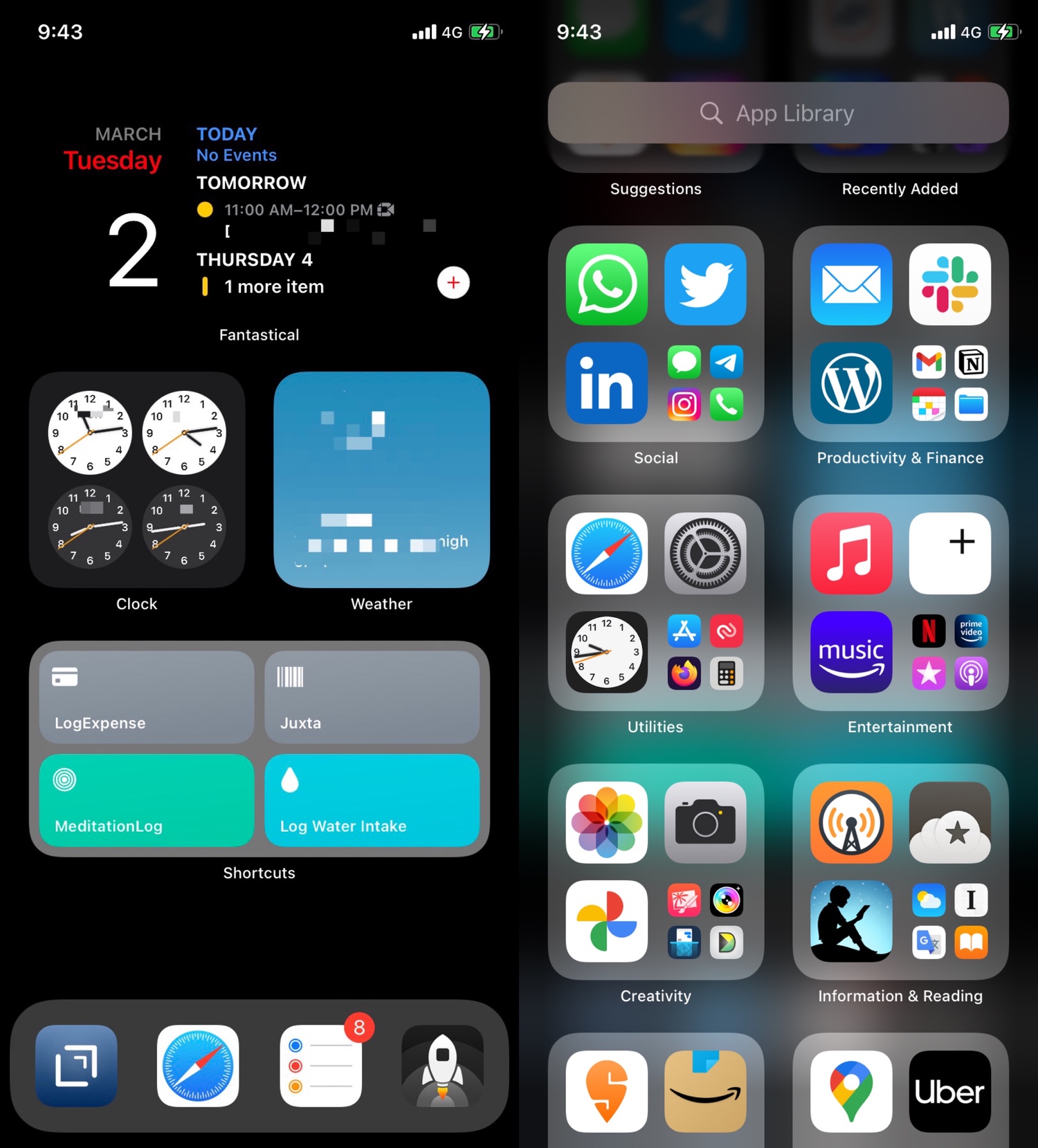
iPhone home screen, March 2021

(Previously:AugustSeptemberOctoberNovemberDecemberJanuary, February home screens)

I’m very nearly at a home screen setup that doesn’t change at all month on month.

The only change from February has been changing the Shortcuts widgets on the home screen from two 1×1 widgets to a single 2×2 widget. That means instead of two Shortcuts, I have four.

The two new Shortcuts are water consumption and meditation logs.

As temperatures rise in the tropics here, I’m prone to headaches from even slight dehydration – these are different from my migraines. We have discussed water tracking via the Fitbit app earlier, but I’m taking a break from wearing a device constantly on my wrist, and I want an alternative way to track my water habits – so this shortcut simply brings up a pre-set list of water levels for me to tap, and then logs it to a comma-separated file in iCloud Drive along with the timestamp. So I can track not just my daily water consumption levels but also the number of drinks and their time.

The other is my meditation log. Years ago, I had a pretty solid meditation routine. It helped me during some very challenging years dealing with mental health issues. While I’m much healthier now I’d like to get back to a daily twenty-to-thirty minute meditation practice. This Shortcut, which I have had a long time but rarely used, is to be invoked after I have completed the meditation session. It presents a prompt for how long I meditated, and then a pre-set list from 0 to 3 to log (subjective) quality, zero being no meditative state at all. So far I’m usually at a one. This is logged to another comma-separated value file with the timestamp. Much like water, I can not just plot my meditation streak, but also its quality, number per day and the time of day I typically meditate. The infrastructure exists, now to execute.

(ends)

Categories
Decentralisation and Neutrality Real-World Crypto

What needs to happen before bitcoin or crypto really threaten banks

The Financial Times writes about how cryptocurrency companies plan to make money through good old credit:

[BlockFi] is launching a credit card, a joint venture with Visa. The card rewards purchases with Bitcoin instead of airline miles. The purchases, though, are paid for with a consumer loan, like any other credit card.

Nexo, another crypto-finance company, will lend fiat cash against Bitcoin, at a 60 per cent loan-to-value ratio. That loan is brand-new credit money. Likewise, Kraken Financial, a crypto-coin brokerage, will let you trade on a so-called margin account in which they’ll lend you part of the purchase price of a coin.

– Bitcoin cannot replace the banks, Financial Times.

The article argues that in doing so, these companies are doing exactly what commercial banks have done for centuries – find new ways of issuing credit and creating new money in the process:

So-called “fiat” money derided by bitcoin supporters is usually defined as government-issued currency not backed by an asset like gold. But a lot of fiat money, which we use for purposes such as paying taxes, is actually a bunch of loans, regulated by governments but produced by commercial banks.

And so for all the promise of decentralisation and control over one’s own money,

Bitcoin is turning out to be a good way to reinforce the system we already have. There’s a lot about this system that functions poorly. The supply of credit money can be unstable, as banks stop making loans in a downturn, right when people need them the most. There is little incentive to extend cheap credit to people who need small loans. But there isn’t much, so far, that Bitcoin seems to have done to fix these things, and it’s not at all clear how it will.

This ultimate dependence on fiat cash is ultimately because of bitcoin’s limitations in being used as currency: there are issues of speed, scale, cost, convenience. Until those are sorted out, bitcoin will continue to be used mainly as a store of value, like gold.

When it does begin to be used widely enough as a medium of exchange – as currency, it will also begin being used as a unit of account. That is, transactions will be denominated in bitcoin, and in that context it won’t matter much what its price in dollars or euro or yuan is.

At this point, bitcoin fulfills the three functions of money.

Once that happens, to return to the FT’s examples above, BlockFi’s credit card will be used for purchases in bitcoin too. Nexo’s loans won’t always be fiat-for-bitcoin, they’ll simply be bitcoin-at-interest. And so on.

And it’s then that banks will be in existential trouble. But a long of things have to go right before one gets to that point.

Categories
Real-World Crypto

Tether as parallel US Federal Reserve

I posted this on my bitcoin and crypto Whatsapp group on 20th Feb:


Tether, or USDT, is supposed to be a ‘stablecoin’, always valued at USD 1 because it’s supposed to be backed by actual USD cash reserves. That’s been under question for years now. But it hasn’t stopped the token from being widely traded exchanges and used as part of financial products based on crypto. From a Bloomberg article:

“It has a market capitalization of about $34 billion, according to CoinGecko — but in a sign of how much it’s used in the system, the 24-hour trading volume on Friday was about $107 billion.”


I’m posting this today because of news from earlier this week about a settlement that Tether and Bitfinex, the crypto exchange closely associated with it, reached with the state of New York. The statements made by the state’s attorney-general are pretty damning:

Tether’s claims that its virtual currency was fully backed by US dollars at all times was a lie,” she added. “These companies obscured the true risk investors faced and were operated by unlicensed and unregulated individuals and entities dealing in the darkest corners of the financial system.”

The investigation found that, no later than mid-2017, Tether “had no access to banking, anywhere in the world, and so for periods of time held no reserves to back Tethers in circulation at the rate of one dollar for every Tether, contrary to its representations.”

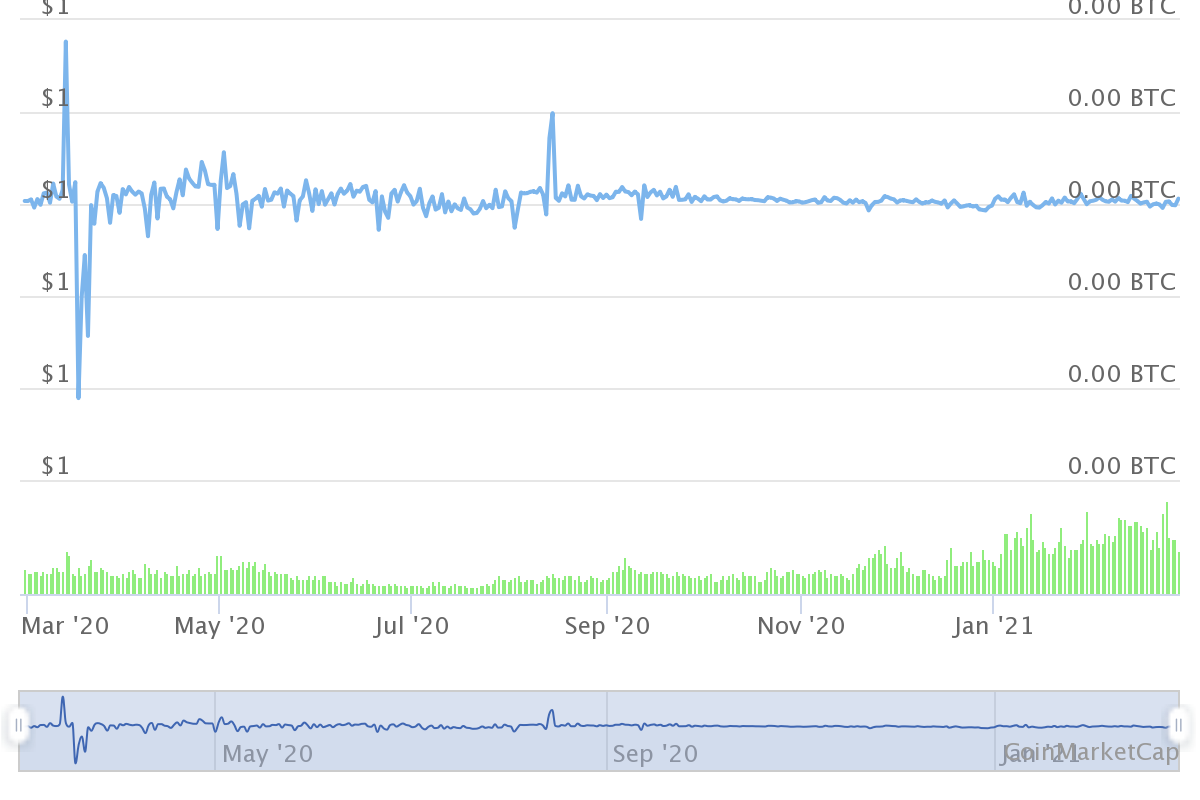
Regardless of this, its trading volumes didn’t fall much (down to USD 93 billion from the high of USD 107 billion in the Bloomberg article above). The price is still ~ USD 1, meaning buyers and sellers still treat it as the stablecoin it claims to be but cannot prove. Here are stats from the industry monitor CoinMarketCap. Blue is price, green is trading volume.

Essentially, if USDTs are simply created out of thin air without needing to be backed by anything, unlike other crypto tokens that need to be mined, and people are fine with pricing it at one dollar, then the company behind Tether is simply a parallel US Federal Reserve – printing money not backed by anything and (implicitly) pricing it at one dollar to every dollar.

Categories
Data Custody Products and Design

Notion as read-it-later app

I’ve recently begun using Notion as my read later app.

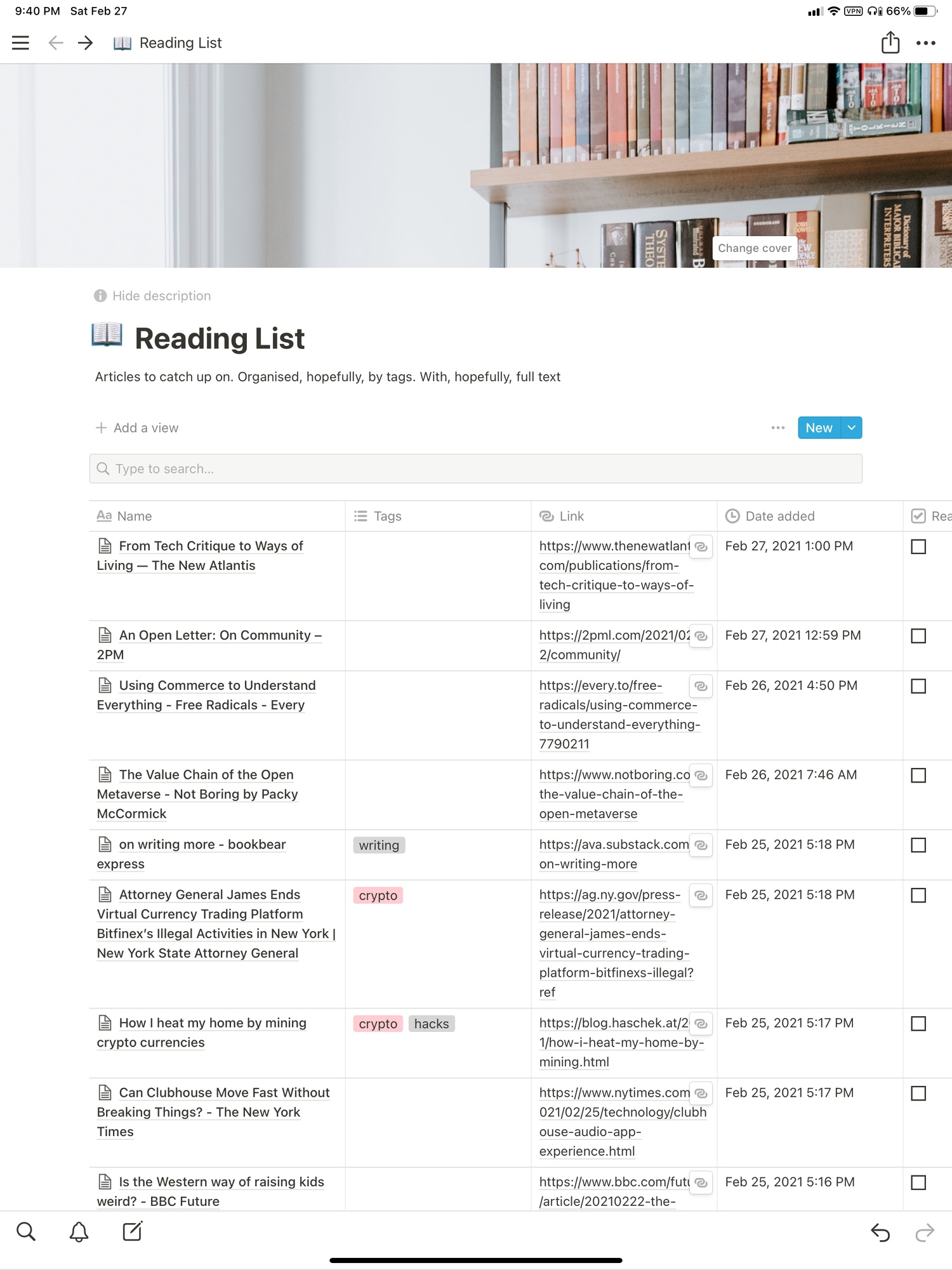
I’ve created a page with a basic database, and Notion’s excellent Share Sheet extension sends web pages from Safari to this database perfectly. Same for the Notion extension for Firefox on the Mac. I just wish both extensions had the ability to edit properties inline so I could add tags right there. This is what my reading list page looks like (the earlier articles have better tagging):

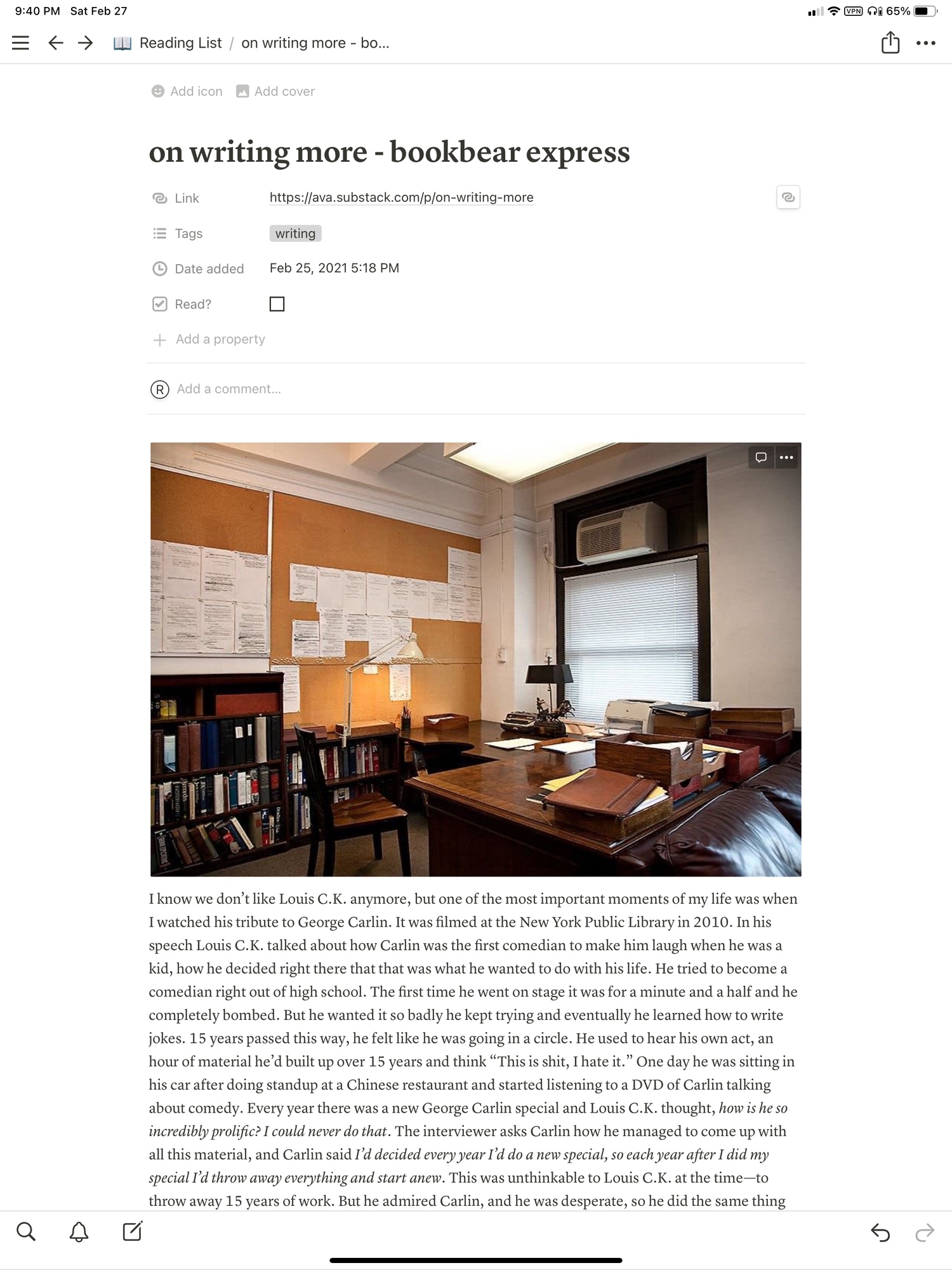
I’m impressed with Notion’s ability to extract text from a web page – it seems to work as well as Instapaper and Pocket, my main read-later services so far. It’s also a pretty good reading experience:

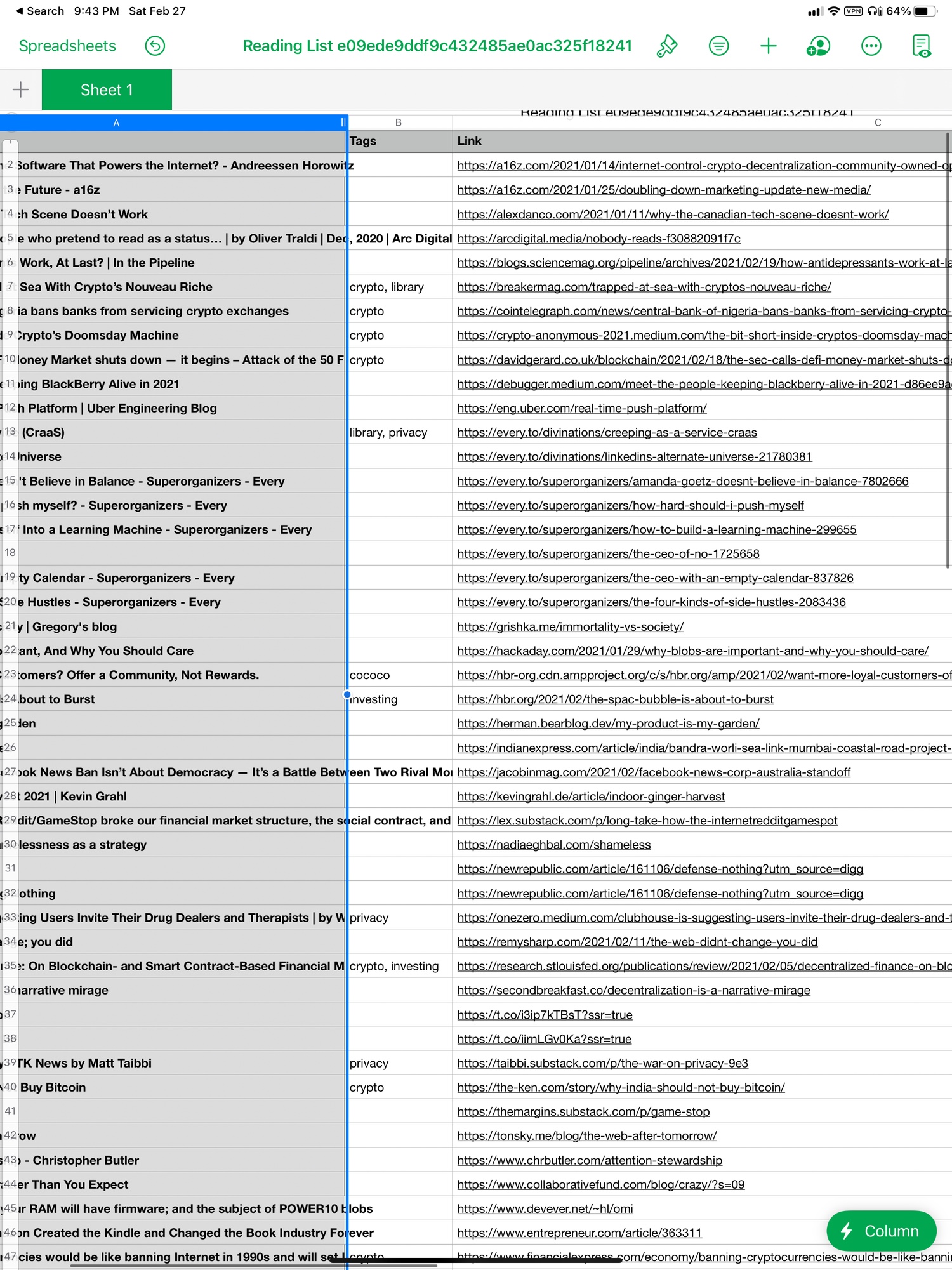
And just like with Instapaper and Pocket, I can export my database to a CSV so I have my URLs in an open format on my hard drive, and not locked away in a closed service. This limitation was what kept me from using Evernote for this:

Categories
Real-World Crypto

Crypto’s time has come

You can resist an invading army; you cannot resist an idea whose time has come.

– Victor Hugo

Governments’ reactions around the world to cryptocurrency remind me of this. Everything about bitcoin, by design, was intended to run outside of the existing monetary system. Not merely untouched by it, but also untouchable.

Short of a total internet shutdown, it’s difficult to cut off a region from global blockchains. Even then, tokens in offline wallets will survive indefinitely, like seeds, until they are reconnected.

Bitcoin – and many other cryptocurrencies – have no concept of a central issuing authority, no need for KYC or other identification, no need for a custodian like a bank, no vulnerability to being unilaterally devalued or demonetised.

In short, they strike at any government’s ability to distribute value and tax gains, the one thing more important to it than its monopoly on legitimate violence.

Yet, countries around the world are creating regulatory frameworks for cryptocurrency. Many have created separate agencies to work with the cryptocurrency industry. And it’s not just tax havens whose competitive advantage depends on them being not just receptive but ahead of the curve on financial innovation. It’s major economies whose government departments are learning to live with cryptocurrency.

The USA SEC is creating a standalone office to deal with digital assets.

“Our action to establish FinHub as standalone office furthers our commitment **to facilitate the introduction of new technologies for the benefit of investors **and the efficiency and resiliency of our markets,” said SEC Chairman Jay Clayton.

In the UK, a recent report commissioned by the Chancellor of the Exchequer in 2020 and led by the businessman Ron Kalifa, recommended “a new UK regime for the regulation of cryptoassets”, saying that

The UK has the potential to be a leading global centre for the issuance, clearing, settlement, trading and exchange of crypto and digital assets… the UK needs to act quickly to preserve its position.

The EU recognises that existing regulation “predated the emergence of crypto-assets and DLT. This could hamper innovation.” and is developing something called Markets in Crypto-Assets Regulation – MiCA – which “will support innovation while protecting consumers and the integrity of crypto-currency exchanges”

I think most governments, left to themselves, would simply like to ban crypto, likening ownership, distribution and use of cryptocurrency to that of drugs. They’d wage a War on Crypto and drum up public support. This is already happening in India, China and Nigeria where governments have raised the spectre of cryptocurrency being used to fund terrorism and other anti-national activities and have banned it.

But around the world, cryptocurrency has already reached critical mass (which doesn’t need to be very large). More importantly, financial institutions have seen it as an opportunity to create wealth and generate new buseiness In today’s finance-dominated era, these institutions are politically important enough for cryptocurrency to gain, if not outright legitimacy, then at least a guarantee of survival.

It is the idea whose time has come. At least for those that matter.

Categories
Real-World Crypto

Cryptocurrency Whatsapp group

Over the weekend, I started a Whatsapp group on bitcoin and cryptocurrency. It’s going to be non-technical – in fact, I began it specifically to cut through the hype and focus on the genuine excitement around cryptocurrency as a world-wide financial asset.

Here’s the chat URL: https://chat.whatsapp.com/BnoKrjH8hrHAtCQbE0F5f1

The idea is to share a link or two around a particular development and write a ~100 word commentary around it.

So far we’ve discussed Bitcoin as insurance, the controversy around Tether or USDT, digital collectibles or non-fungible tokens, Bitcoin ETFs that have just been launched in Canada, the fate of Bitcoin in growing economies with young populations, like Nigeria and India, China’s plans for its digital currency the e-yuan, and a few other topics.

Since Saturday, it’s grown to over 120 subscribers from many countries. Here’s part a recent message I sent out:

The group has since added people from Hong Kong and Singapore

I plan to cross-post from the group here often, so I can expand on the topic a little more than what’s appropriate for a message group.

Categories
Products and Design Real-World Crypto The Next Computer

Nvidia limiting its graphics cards’ ability to mine Ethereum cryptocurrency

This is rather interesting.

Graphics card-maker Nvidia says it will deliberately reduce the efficiency of its latest card by 50% when it is used to mine the crypto-currency Ethereum.

Crypto-currency enthusiasts have contributed to a shortage of graphics cards by snapping up supplies to use for non-gaming purposes… Nvidia said it had intervened to make sure its products “end up in the hands of gamers”.

But it will also sell a bespoke crypto-currency mining processor.

– Nvidia limits crypto-mining on new graphics card

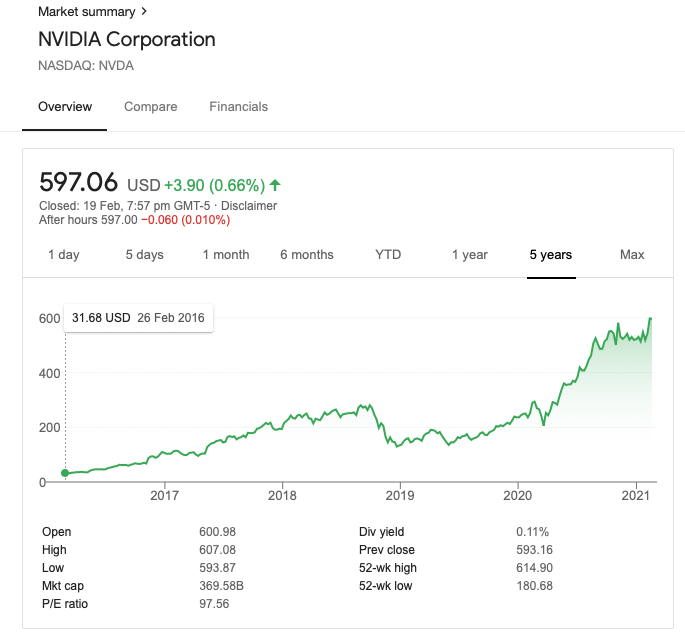
Nvidia’s stock has had a great run in the past year. It’s not only produced extremely popular gaming cards, but its hardware has also found use in the artificial intelligence/deep learning and cryptocurrency spaces:

I’m still reading about this, and I may update this post or add a new one about my thoughts. I thought the act of deliberately modifying one’s hardware to cripple a specific function was interesting enough to document. No value judgements yet.

A part of my reading queue:

NVIDIA’s own announcement

Nvidia is nerfing its RTX 3060 GPU to stop crypto miners from buying them all – Polygon

Nvidia May Restart Production of Crypto Mining GPUs if Demand Sufficient – Coindesk

I’m also looking forward to this being discussed on Nvidia’s earnings call for last quarter, scheduled for 24th Feb 2021.

Categories
Data Custody

Dropbox’s value proposition versus Microsoft 365 and Google Workspace

I didn’t know Dropbox launched a password manager in 2020. This is their product page as of this writing

I used to be an ardent user of Dropbox, with my entire Documents folder stored and synced in the service. I had referred so many people to Dropbox that my initial free 2GB had ballooned to 16GB through rewards. That changed with Dropbox limited the number of devices that you could use with its free plan to three. That made it untenable for me, since I use a variety of computers, tablets and phones and want my data to just be there when I want it. So I haven’t followed Dropbox for a while.

On their most recent earnings call, the CEO talked about “evolving the core Dropbox experience to become the organizational layer across all of our users’ content”.

The CEO described other products:

“We also introduced Vault, an additional layer of security for our customers’ most valuable content, where that content is accessible with a unique PIN code. Users can also grant emergency access to their Vault to trusted friends or family, so they can access the protected content when needed. And finally, we introduced computer backup, which automatically backs up users’ local desktop, documents, and downloads folders to Dropbox for secure access on the go”

This is interesting, because it’s clear now that Dropbox sees itself as another full-featured cloud for people, families and businesses, alongside Microsoft 365 and Google Workplace aka G Suite aka Google Apps.

Nearly a decade ago, they were questioned about being “a feature, not a product“. Since then they seems to have diversified their product from storage and grown enough to become a publicly traded company.

But Dropbox’s weakest proposition might be that its competition has ‘office’ apps – Word, Excel, Powerpoint and Docs, Sheets and Slides (Dropbox’s Paper is interesting but doesn’t hold a candle to office apps). Both Microsoft and Google also offer the sort of storage organisation and sharing features that Dropbox does.

Their pricing also starts at USD 12 per user per month, just like Dropbox’s Business/Standard plan.

For that price, businesses get not just storage and storage management, not just office apps but also mail infra, email clients (Outlook and Gmail) and video conferencing (Teams, and an integrated Meet/Chat/Gmail).

If businesses are paying one of these two companies for their office apps, what’s the case for Dropbox? Put another way, is there a particular segment of the market that Dropbox is chasing?