Links to articles and short commentary on living a less rushed, less stressful, less distracted life. A shared journey from surviving to thriving. From someone who’s been through the lows of burnout, depression and chronic pain.
On this site, we explore mental health in the context of technology under the tag Wellness When Always-on.
My first message on the channel referenced a quote I had linked to in a blog post from almost exactly a year ago:
Bitcoin surged to over $55,000, albeit briefly, this week… the interest comes primarily from institutional investors as they hope that stimulus checks from the Biden administration will pump financial markets and lift cryptocurrencies.
Just a couple of years ago, mere interest from ‘institutional investors’ in cryptocurrency was weird. Bitcoin – and cryptocurrency in general – was dismissed as too volatile, purely speculative, a conduit for terror financing and the drug trade.
All of this is still true. And yet, institutional investors have not just come around, their buying of bitcoin now influences the price itself.
China’s e-yuan – the Financial Times takes a look at how the Chinese Government is pushing adoption of the natively-digital currency, not just to advance payments and investments, but also to exert even greater control over its population: “Virtual control: the agenda behind China’s new digital currency”
(Article on Financial Times; may be paywalled; consider supporting good journalism)
China is intent on becoming the first large economy to introduce a digital currency, showcasing its position as the global leader in payments technology to the world at next year’s Winter Olympics.
Cryptocurrencies are often decentralised; they are not issued or backed by governments. The “e-yuan”, by contrast, is part of China’s top-down design… the digital currency project is tied up in the Communist party’s drive to maintain control over society and the economy. The technology is partly designed to reinforce its surveillance state.
Its digital format enables the central bank to track all transactions at the individual level in real time. “we will give those people who demand it [paper money and coins] anonymity in their transactions… but at the same time, we will keep the balance between the ‘controllable anonymity’ and anti-money laundering, CTF [counter-terrorist financing], and also tax issues, online gambling and any electronic criminal activities”
If current statements by the government are any measure, it’s a pretty big blow to privacy. The e-yuan is also seen
as a means to reassert state control over its fintech industry and a vast e-payments market that is dominated by two huge private companies, Ant Group and Tencent… the digital renminbi is distributed directly to the e-wallets of users by state-owned banks, thus setting up payments channels that circumvent Alipay and WeChat Pay.
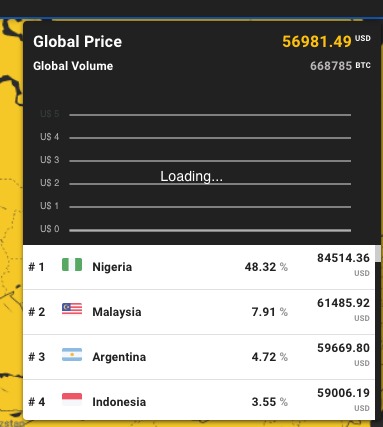
~ Since there are no online exchanges, this is probably on local P2P markets like https://localbitcoins.com . This is as transparent a signal as you can get for how desirable cryptocurrency is there. Bitcoin in Malaysia, Indonesia, India, Turkey, and most South American countries is also trading at significant premiums – although Nigeria is off the charts.
~ Throughout 2019 and 2020, Nigeria topped Google trends for searches around bitcoin. One reason could be simply because Nigeria’s currency really hasn’t done well versus the dollar, or simply because Nigeria is a very young country and there’s curiosity about crypto: “Why Nigeria Tops Google Searches for Bitcoin“
The first one, Purpose Bitcoin ETF, trades under the ticket BTCC, and had over USD 700 million in asset as of Thursday. The second one, Evolve Bitcoin ETF, began trading as EBIT and has assets of over USD 500 million.
Both started with management fees of 1%, which pretty high is as far as ETFs go. Evolve has since cut its fees to 0.75%.
Evolve has also started paperwork for an Ethereum ETF (press release).
In general, this means that the institutional infrastructure required to support an ETF is up and ready and running for the bitcoin world: a custodian to actually invest the money into bitcoin and hold that bitcoin securely, a reference price that the regulator is confident enough to sign off on, and so on.
I think it’s very interesting to see new jurisdictions like Canada open up to innovation like this.
The USA SEC has been wary of bitcoin ETFs for years now, having shot down many applications from asset managers to launch one. There have been new applications in 2021, and the Canadian green light may help persuade the SEC to follow suit.
According to the article, the main difference between these and the cashless payment systems we already use, like prepaid wallets, is “money held on a CBDC app or website will be equivalent to a deposit at the central bank”.
Similarly, the article predicts, such money held in private payment/wallet apps will still be equivalent to being held at the bank, not on the payment providers’ balance sheet. This is unlike today, where adding money into an Amazon Pay prepaid wallet is no longer on your banks’ balance sheet, it’s on whatever Amazon subsidiary holds the prepaid wallet license.
To be clear, none of these central bank digital currencies are really on ‘public’ blockchains, even though governments may piggyback on the term since it’s usually associated with them. They’re centralised, in that while their architecture may nominally resemble decentralised one like, say, the Ethereum blockchain, there’s almost certainly going to be tight control over who can run nodes.
Finally, I was disappointed that the article made only one passing reference to the programmable nature of digital currency, something that is widely done in crypto projects today’s using “smart contracts”, often the most innovative part of such projects. But back in September 2020, we had explored this topic in more detail:
With that said, we believe there are fundamental problems with gold, oil, and the U.S. dollar as stores of value going forward. Below, we will make the case that bitcoin is ultimately the only long-term protection against inflation.
This piece is especially important in the context of the ongoing sharp rise in the dollar price of bitcoin. As bitcoin and cryptocurrency gains even more mainstream awareness and institutional acceptance, one must ask how much of this rise is pure speculation and how much is an educated guess about the future of assets & capital in general. The article lays out Winklevoss Capital’s case against the current liquidity boom fulled by relentless currency printing:
Even before COVID-19, and despite the longest bull run in U.S. economic history, the government was spending money like a drunken sailor, cutting taxes like Crazy Eddie, and printing money like a banana republic.
What began as a shot in the arm during the credit crisis of 2008, never stopped, despite the U.S. economy being out of the woods for years. And so what started as an acute prescription, has morphed into chronic dependence and denial (aka addiction). The resulting maladaptive behavior is, not surprisingly, very difficult to correct.
… if stock market gains are your measure of success, you will choose not to upset the apple cart, even if it’s wildly untethered to reality.
The Winklevosses have been early and big believers in cryptocurrency, and have historically held large amounts of it. They also set up the cryptocurrency exchange Gemini which received New York state’s “bitlicense” to operate.
I learnt today that a friend of mine had set up his own personal website. He built it on Notion and linked a domain name to it. That set of Notion pages has a surprising amount of information on it, including what appears to be the beginnings of a knowledge base of the areas he’s built a career in.
His Notion pages have collapsible sections, text, images, embeds, multiple columns – the works. This is by a person who, from what I know, has not had previous experience with WordPress or Weblow or the like.
What Notion has done is simple and yet profound. It has made it super simple to put high quality, information-dense web pages online.
If you are technically adept, you can buy a domain, hosting, install WordPress, a theme or two, a few plugins like Elementor and build your web pages. If you have enough money, you can hire an agency to build a site for you – and train you to add/edit information on it. If you’re the leadership of a company in charge of public-facing properties, you can get a team to build it for you (well, for the company).
But if you’re outside of a fairly narrow set of people, the web is read-only for you.
That’s why social media became such a big deal. It gave everyone an input box and a send button that published to everyone on the Internet. You could fill that box with text, pictures, sounds, whatever you wanted.
But social media is linear, post-oriented and reverse-chronological. As are WordPress.com, Medium, Substack, Revue – all of which are holdovers from the blog era.
For true self-expression, you want to be able to create free-form information. Notion makes that possible. And makes it look pretty, so you aren’t distracted by themeing and customising looks-and-feels. You just focus on how you want to present what is important for you to say.
It does look like the future of publishing.
End note: we’ve spoken time and again about owning your data. Notion is not that. Whatever its data export capabilities may be, it’s still a proprietary format hosted on a third party service. Yet for most people, the benefit of self-expression and one’s own unique online presence is a powerful motivator. And you know what – that might be a good enough trade off for now.
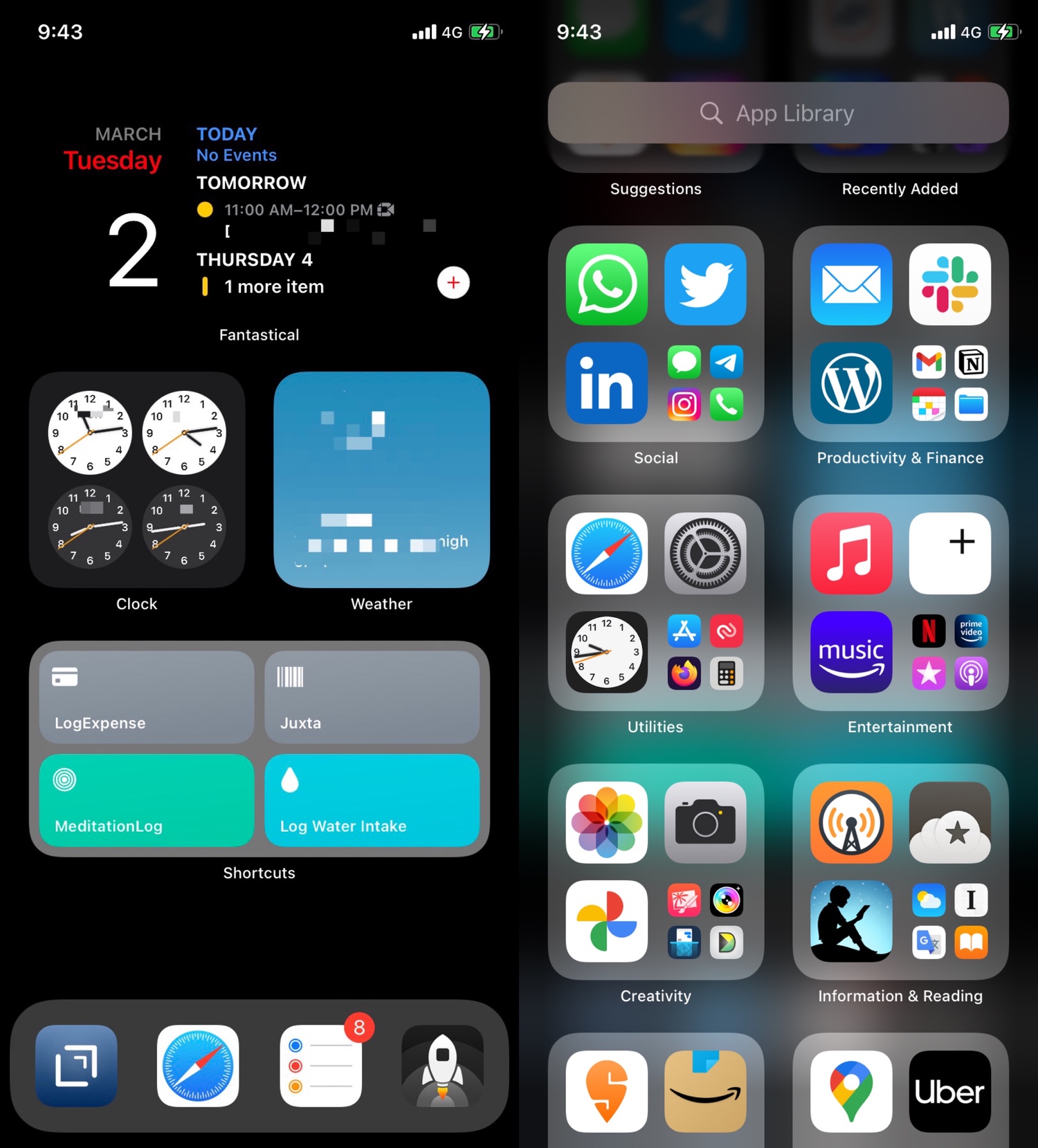
I’m very nearly at a home screen setup that doesn’t change at all month on month.
The only change from February has been changing the Shortcuts widgets on the home screen from two 1×1 widgets to a single 2×2 widget. That means instead of two Shortcuts, I have four.
The two new Shortcuts are water consumption and meditation logs.
As temperatures rise in the tropics here, I’m prone to headaches from even slight dehydration – these are different from my migraines. We have discussed water tracking via the Fitbit app earlier, but I’m taking a break from wearing a device constantly on my wrist, and I want an alternative way to track my water habits – so this shortcut simply brings up a pre-set list of water levels for me to tap, and then logs it to a comma-separated file in iCloud Drive along with the timestamp. So I can track not just my daily water consumption levels but also the number of drinks and their time.
The other is my meditation log. Years ago, I had a pretty solid meditation routine. It helped me during some very challenging years dealing with mental health issues. While I’m much healthier now I’d like to get back to a daily twenty-to-thirty minute meditation practice. This Shortcut, which I have had a long time but rarely used, is to be invoked after I have completed the meditation session. It presents a prompt for how long I meditated, and then a pre-set list from 0 to 3 to log (subjective) quality, zero being no meditative state at all. So far I’m usually at a one. This is logged to another comma-separated value file with the timestamp. Much like water, I can not just plot my meditation streak, but also its quality, number per day and the time of day I typically meditate. The infrastructure exists, now to execute.