
Categories
Data Custody The Next Computer

Apple M1 and the ultimate closed system – Part 1

Apple this week announced new Mac laptops and a desktop computer with its in-house system-on-chip. These computers do not use Intel’s processors. Instead, the “M1” chip includes Apple’s own CPU, RAM, graphics chip, and special-purpose chips for security and for machine learning.

By designing the Mac operating system specifically for this hardware (and vice versa), Apple’s M1 computers are now much more powerful at the same power consumption levels than their equivalent Intel ones.

However, with this chip, Apple’s computers are well and truly closed machines.

This closed nature is a problem because of just how much control it takes away from you, who’s paid for and ostensibly owns the machine and the software on it.

Let’s see just how bad it is.

1. Application software is controlled

The question is one of control over the software that you can run on the machine. With the M1, Apple will only allow signed software to run. From Apple’s documentation ealier this year:

New in macOS 11 on Apple silicon Mac computers, and starting in the next macOS Big Sur 11 beta, the operating system will enforce that any executable must be signed with a valid signature before it’s allowed to run.

This other article describes this in a little more detail:

Over the years, Gatekeeper has become more strict, recently adding a notarization requirement. On macOS Catalina, Gatekeeper not only checks whether the software was signed by a valid Developer ID certificate, it also “phones home” to check whether Apple has notarized the software, again refusing to run it if the check fails. Mac developers must sign up for the Apple Developer Program, sign a legal agreement, and pay an annual fee of USD $99 plus tax in order to obtain a Developer ID code signing certificate and upload software to Apple for notarization.

This article goes on to describe how – while not obvious – one could override these warnings on Catalina and run unsigned software. On MacOS Big Sur running on the M1 chip, Apple appears to have removed this exception. No matter what software you download and run – whether command-line tools or graphical applications – they will need to be signed.

This level of control means that Apple could refuse to sign certain apps if it wanted to, for reasons that have nothing to do with security. We have recently discussed how the youtube-dl project was taken off the code hosting site github. In the future, should Apple decide, it could disallow the running of youtube-dl binaries entirely, either downloaded from github or sourceforge or others. The only way that anyone would be able to run this tool would be to download the source code, compile it themselves and run it on their computers only by issuing themselves a local certificate to sign with. But they would not be able to hand that compiled code to someone else – even another Apple M1 machine they own – without compiling it separately.

That effectively kills distribution for software that Apple chooses to censor.

A long-time iOS engineer I know, who I ran this post by, had the following counterpoint:

Apple is definitely making it a pain for anyone to arbitrarily run 3rd party executable code, but to me the end result is just that developers will have to jump through a few more hoops. There will probably be a homebrew/pip/npm like solution that solves this soon. The end user should not see any significant change if they’re coming from modern Macs.

As for the Developer ID requirement – anecdotally I have only heard of one developer whose certificates were unilaterally revoked. Apple is far more likely to suspend your developer account and leave the certificates. This still makes Apple the arbiter of what you can run on your computer, and they will charge the developer for that privilege, but if you’ve only ever run GUI apps on your Mac this has been effectively the case for several years.

However, even Mac OS Catalina, leave alone Big Sur, appears to check for notarization of unsigned executables – even those not built using XCode. A simple hello world program compiled directly using clang is still subject to the same notarization check.

(Part 2 – It’s not just software; it’s control at the Operating System level and at the chip level)
Categories
Discovery and Curation Wellness when Always-On

Switching off from alternate realities to focus on the real one

Conviction in your own opinions is tough when you’re exposed to millions of people living in their alternate realities.

The Biden campaign decided that to focus on the ‘actual’ reality – and change it – they’d need to turn off that exposure.

You and I aren’t bringing about massive social change everyday, so we don’t necessarily need to cut ourselves off the way the campaign did. But it’s good to set aside some time during the week thinking about stuff that matters to you – however trivial that might be – independent of what people say about it online.

Categories
Wellness when Always-On

Anxiety and awareness

In an article on handling anxiety:

Ask yourself why you’re anxious. Is it because you’re excited? How you interpret anxiety could be good or bad. If you’re about to give a speech, for example, anxiety is good. Instead of trying to avoid it, understand it.

I think parts of the article are platitudinous, but this is spot-on.

There is simply too much information thrown at us all day each day. There’s years of evidence that shows our brains are not properly wired to consume, triage, process and respond to all of it. More often than not, they simply jump from consume to react.

They react to notifications. To ads on a web page. To dialog boxes asking for decisions to be made. To visual complexity in software interfaces. And this is just on our computers and phones. We have discussed before how our public spaces, especially in developing countries, are suffused with visual and auditory advertising and messaging.

Is it any surprise, then, that we are in a state of anxiety? Perhaps perpetual low-grade anxiety?

Personally, anxiety causes breathing to become shallower. It causes my shoulders to tense. It causes me to be less aware of when I need water. These lead to migraines. The necessity of getting through the day while in pain leads to more anxiety.

Earlier this year I decided to break the chain by simply being more aware of how I was physically at any given moment – I figured that your physical state is easier to observe objectively than your mental state. In January, I began training myself to breathe deeply and evenly. The next month, I began tracking my water intake – first via an iOS shortcut, then in the Fitbit app. In June, I began observing when my shoulders had begun to tense.

This has reduced how long I stay anxious before I notice it. I’m not anywhere as good as I’d like to be, but I’m getting there.

The article I linked to above goes deeper. When the writer recommends ‘understanding your anxiety’, she says

It’s often not the event that causes anxiety; it’s the story we tell ourselves about it.

And therefore

When this happens, take a long walk or breathe deeply if you have too much anxiety. Meditation is a force that helps you live in the present moment. “When you meditate, you get a better sense of how your body and mind are reacting,” he says. “Deep breathing creates a direct connection between your breath and reducing stress…

I agree. Awareness of one’s physical situation addresses the symptoms of one’s anxiety. I’ve found that reducing anxiety itself requires you to switch your brain from consumption mode to reflection mode.

Meditation, specifically mindful meditation, does this well, but it’s not easy. If you end up silently criticising yourself every time you find your mind has wandered away, it simply causes more anxiety and makes for an unhappy meditation session. But over time, you become less hard on yourself .Choiceless awareness, as the thinker J Krishnamurti termed it, removes anxiety from the equation because you are now looking at how anxiety comes about, as opposed to being ‘in’ the anxiety. As the writer says

You can get a sense of the source of the anxiety, peel back the onion, and find the cause.

If you aren’t comfortable with mediation yet, I have found a short daily period of solitude to be quite helpful too.

(Article via Jitin B)


(Featured image photo credit: Ray Zhou/Unsplash)

Categories
Data Custody Decentralisation and Neutrality Products and Design The Next Computer

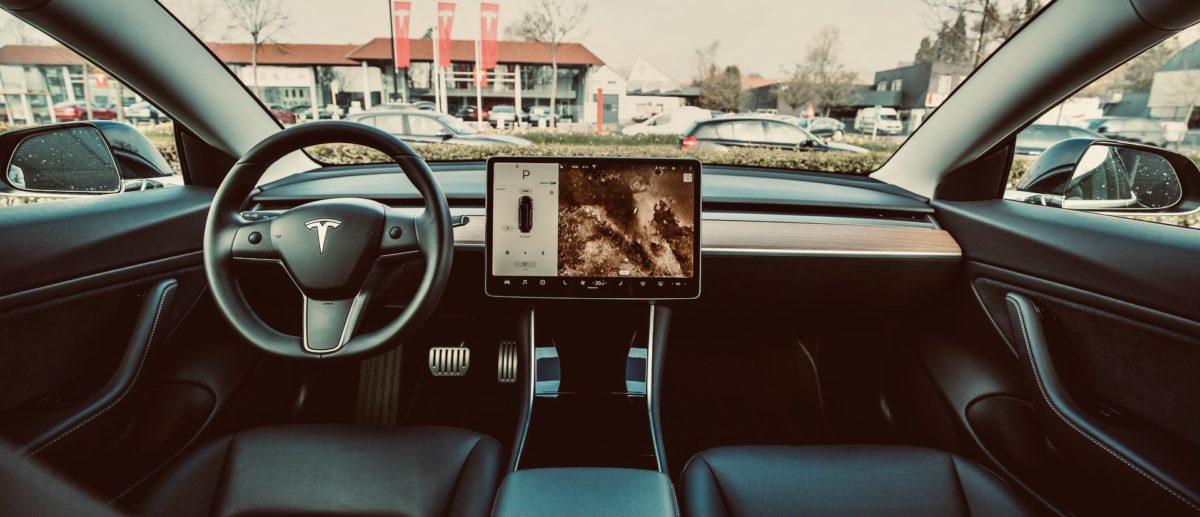
Tesla remotely disabling functionality in cars

From Vice:

a person… bought a used Tesla from a dealer—who in turn bought it at auction directly from Tesla under California’s lemon law buyback program—advertised as having Autopilot, the company’s Advanced Driver Assistance System. The entire Autopilot package, which the car had when the dealer bought it, costs an extra $8,000. Then, Tesla remotely removed the software because “Full-Self Driving was not a feature that you had paid for.” Tesla said if the customer wanted Autopilot back, he’d have to fork over the $8,000.

To be clear, this is not a subscription service. This is a one-time package that was paid for by the original buyer, upgrading the car’s capabilities over software. Tesla’s policy here is that the purchase belongs to the owner, not to the car. There still appears to be confusion about whether enhancements can be transferred to the new owner. I couldn’t find anything on Tesla’s site, but found these two contrasting threads. One, on Tesla Motors Club titled “Why is FSD not transferable to your next Tesla?” FSD is full self-driving. The second is on the Only Used Teslas site, “Does Autopilot/Full Self-Driving Transfer to Subsequent Owners?” which states that it in fact does:

Q: What about owners who added Autopilot and/or Full Self-Driving Capability after delivery? A: Those features will also be active for the life of the car, and will transfer from the current owner’s Tesla account to the next owner’s account.

The tech news site The Next Web also did an article on this, stating

TNW spoke with a number of new and used Tesla sales departments in the UK who all confirmed that if a second-hand Tesla is specified with additional options like Autopilot and FSD, that is what the customer will receive.

In the case of the individual mentioned in the Vice article, Tesla did restore the functionality the original owner had bought, but only after the car enthusiast website Jalopnik ran an article about it – and Vice and The Next Web.

We have seen before (here and here and here) about “smart” devices that you do not own despite having paid full price for. A Tesla seems to be among the most expensive one in that list.

I’m not advocating for or against buying a Tesla – or for that matter any smart device [1]. I do think we should be more conscious, more circumspect when we buy new devices, since an increasing number of them have electronics, a connection to the Internet, and a link to the manufacturer throughout their lifetimes.

Advertising is sexy. Skepticism never is.


[1] I had in fact paid the deposit for two Model 3 units when they were announced in 2016 (and had it refunded when it was clear Tesla would not be launching in India any time soon).


(Featured image photo credits: Bram Van Oost/Unsplash)

Categories
Wellness when Always-On

Outdoors, but without its social elements

… the Scandinavian concept known as friluftsliv (pronounced “free-loofts-leev”), which translates most directly to “free-air life.” The term is attributed to Norwegian playwright Henrik Ibsen, but the concept of spending time outdoors in all seasons long predates him as a deep-seated element of life in the Nordic countries.

But in Norway, it’s this deeper concept of having space from other people, which is kind of a Norwegian thing to do, and then it has that sense of being able to wander freely outside.”

We belong out there’: How the Nordic concept of friluftsliv — outdoor life — could help the Pacific Northwest get through this COVID winter

Lovely. But for most of us, this is what the outdoor experience has in fact become during the pandemic. Sounds like an introvert’s dream come true.

Categories
The Next Computer

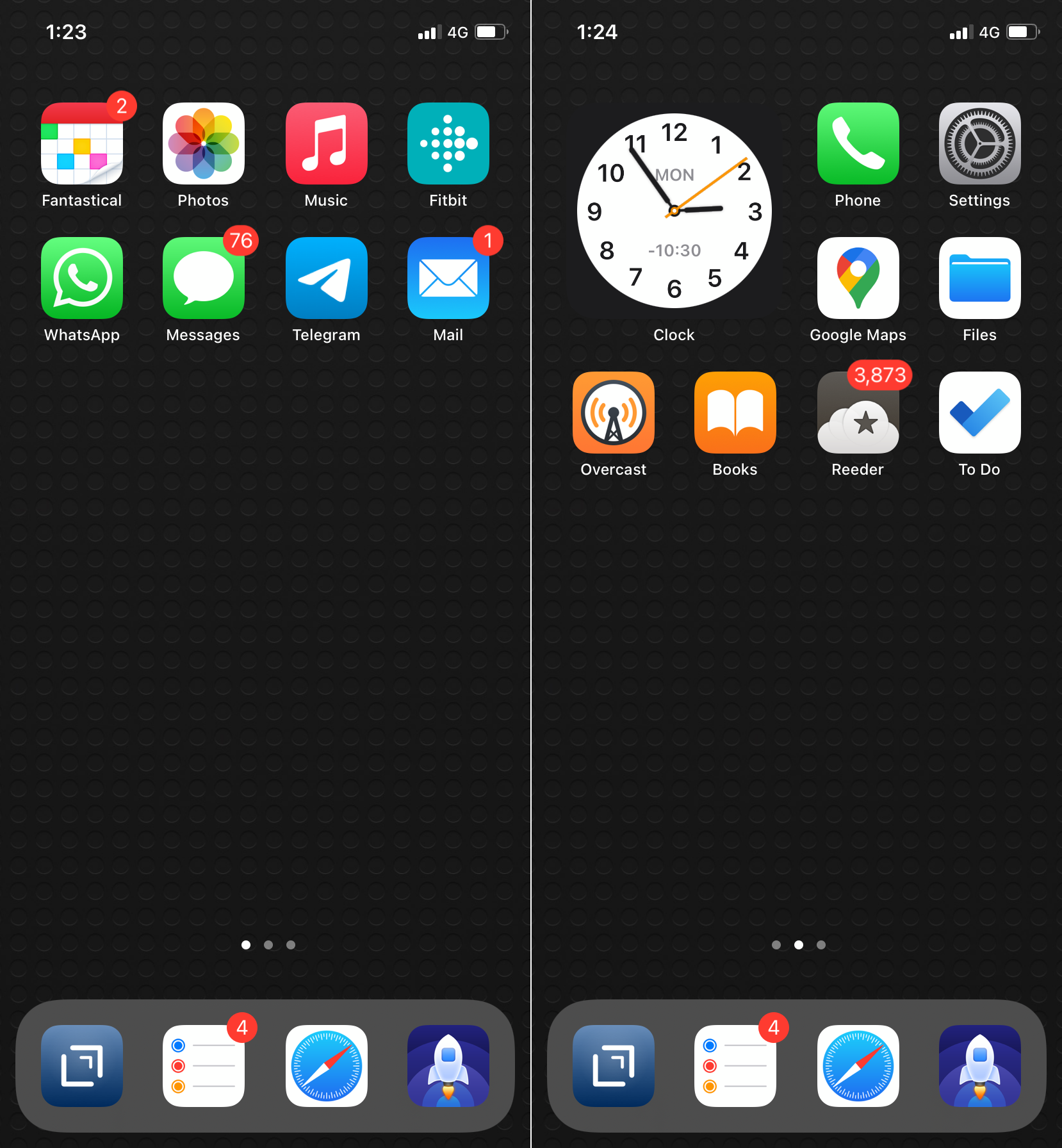
iPhone home screen, November 2020

(See August, September, October home screens)

First home screen

On the first/main home screen, the Microsoft Todo app in the Dock has been replaced with Reminders. I don’t use either app much on the phone, but Reminders is marginally more useful for the one purpose it serves.

As we’ve discussed before, I use Microsoft Todo as a task manager organised according to the PARA principle, with a list of each of my Projects. This site is one such project, and it lists both ideas for future posts as well as improvements to the site itself. In that role, I use it more on the iPad and on my Mac. That’s why on the iPhone it’s been moved out of the Dock and the main home screen.

The rest of the first screen remains unchanged:

  • Drafts for all-purpose text capture. I’m writing this blog post in Drafts
  • Reminders
  • Safari (with the 1Blocker content blocker)
  • Launch Center Pro (a beloved app, but whose use diminishes with each passing month. I would not be surprised if something changed here soon)
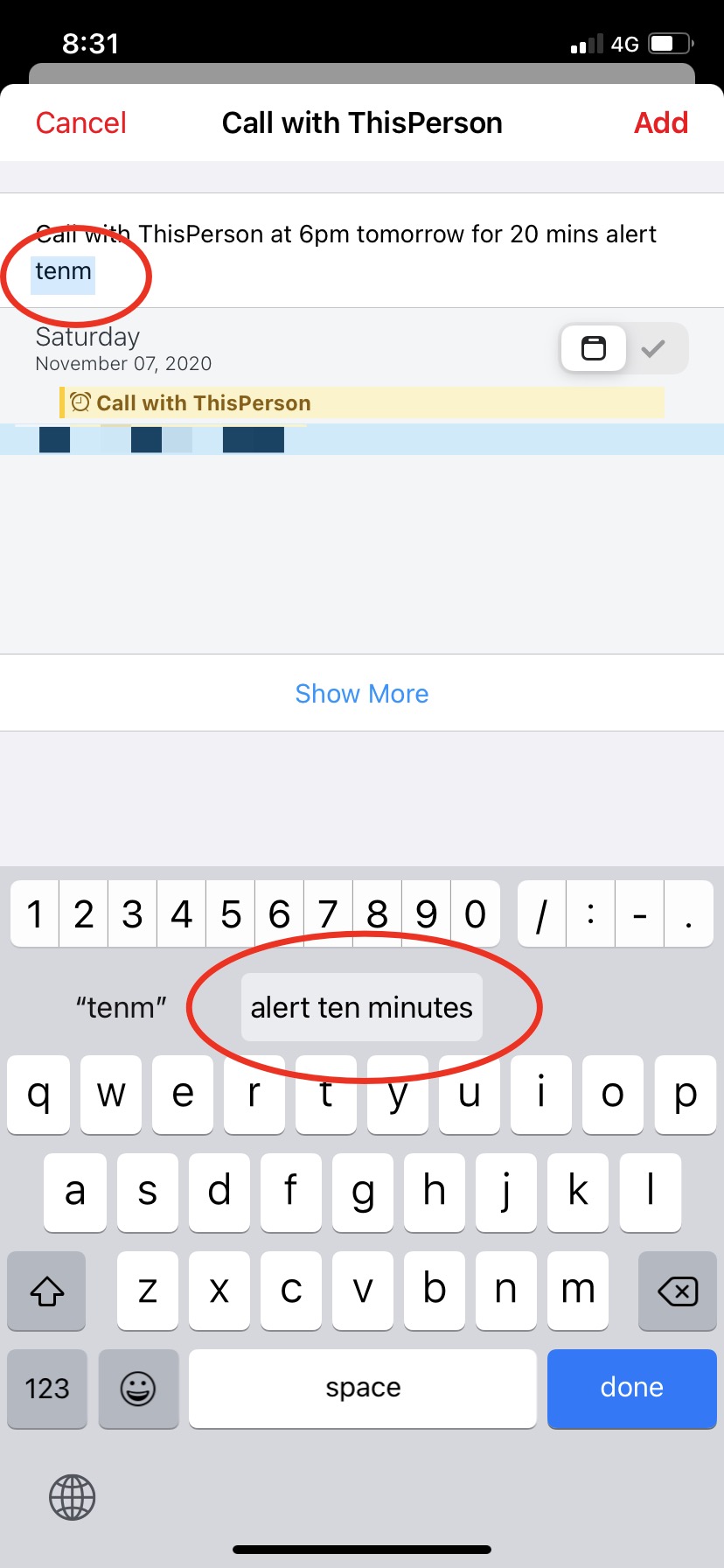
  • Fantastical: I love it for its natural-language input. Typing “Call with {Name} at 6pm tomorrow for 20 minutes alert ten minutes” is now second nature. I also have an iOS Text Replacement so that typing “tenm” auto-expands to “alert ten minutes”
  • Photos, Music: I use these default iOS apps multiple times everyday
  • Whatsapp, iMessage, Telegram, Mail: messaging and email. Daily use
  • Fitbit: we’ve discussed this many times before. I use my Fitbit to maintain a basic level of activity daily: 5000 steps, 5 days of exercise, 10 hours of activity, 3 litres of water and so on.

Second home screen

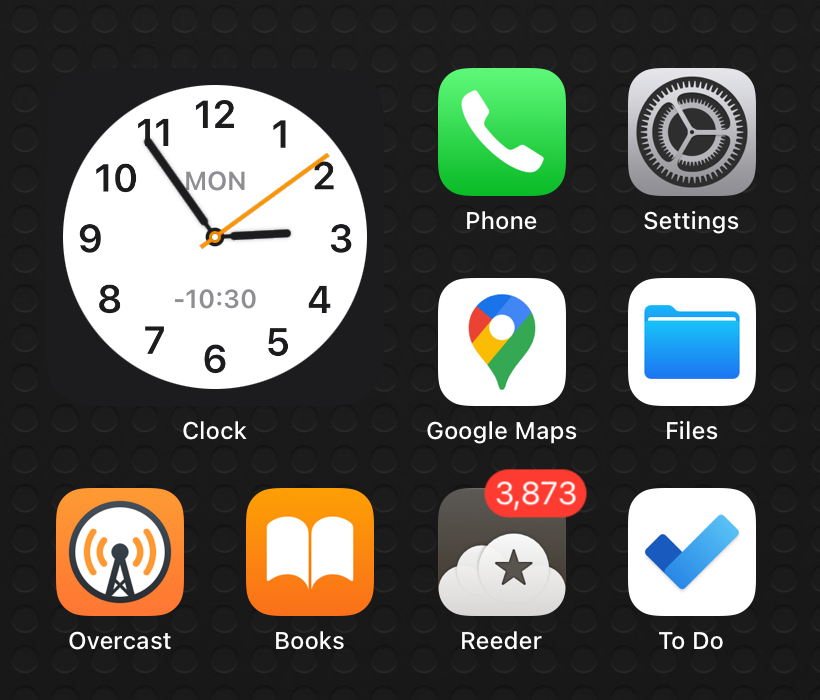
The big change on the second screen is the clock widget, which displays time on the USA East Coast. I know and communicate with a few people in that time zone, so it’s useful to quickly look up the time there.

I have not picked the other apps on this screen as mindfully as on the first, but they are fairly regularly used:

  • Phone, Settings: vanilla apps with no replacement
  • Files: I rely heavily on iCloud Drive
  • Overcast: podcasts for when I drive. I don’t commute anymore but I do drive to different places in the city for half an hour or so every day to get outdoors time.
  • Books: we’ve discussed before about how Apple Books (formerly iBooks) helps foster a daily reading habit. I read a little over twenty minutes most days. This is a list of the books I’ve read this and previous years
  • Reeder: my longtime RSS app. I recently bought version 5 (read the MacStories review), as I have all previous versions. I don’t read on the phone much, so this does not get a lot of use on this device.

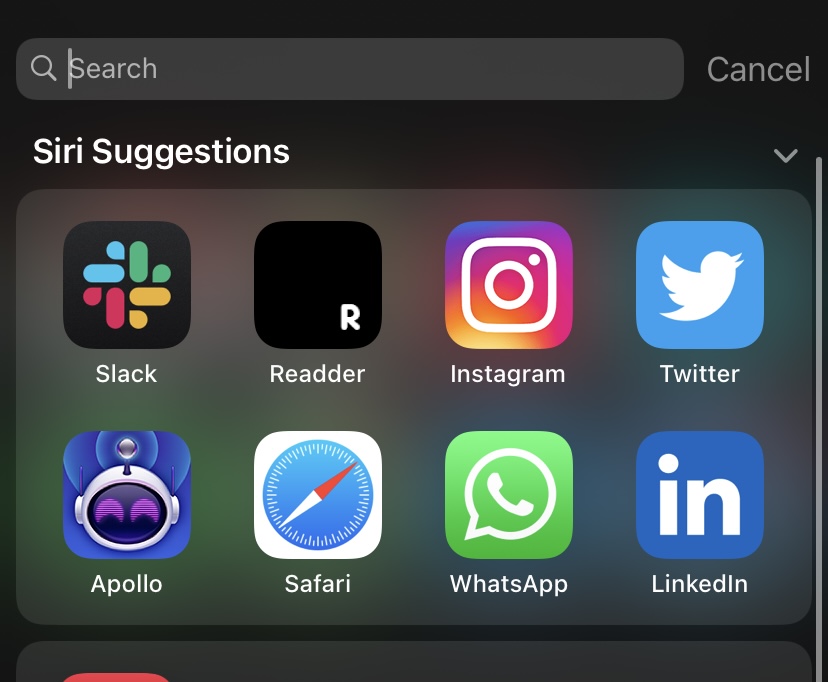
Siri suggestions

This is what I end up using more than my actual home screens. It is the source of both my productivity and distraction. These are my suggestions as of this writing:

  • I’m glad that Slack is just a swipe and tap away. This is the main communication tool at the day job.
  • I don’t know why Linkedin shows up. Perhaps because I’m writing this post during the daytime on a weekday and Apple’s algorithms think the app is useful during the workday? I rarely use the app itself
  • Ditto Instagram. I barely use the app. A couple of months ago, I created an account to post about coffee and home gardening, two of my other interests. But I don’t follow or scroll through other people’s feeds, so I have no idea what it’s doing here.
  • Readder and Apollo: just yesterday we saw how I have unhealthy Reddit habits, and that I am checking into another thirty-day Reddit rehab. Siri suggestions is the main reason I end up launching them – after all they are nowhere on my home screens. I have since disabled them from showing up in Siri Suggestions through their settings (see how)

Categories
Discovery and Curation Wellness when Always-On

Reddit Rehab

Back in June and July, I spent a month away from Reddit and Twitter, visiting the site only in a strictly time-boxed twenty minutes at the end of the day. During that isolation,

I realised how much the endless rapid scroll-and-read tired my brain out. I was starting each working day with a depleted brain, right after I had refreshed it overnight. Starting my day with my small list of websites and my RSS instead of scrolling through Twitter and Reddit makes for a much clearer rest of the day

– Reflections on the 30 day Twitter-Reddit isolation, July 2020

Another good thing that emerged from that period is my daily practice of 20 minutes of solitude, which I do while sipping my cold brew in the morning. Solitude

… means not simply being alone, but being alone with your thoughts. So watching TV or Netflix, reading a book or articles, listening to music or a podcast, even if alone, do not count as solitude – your mind is still receiving, as the author says, “input from other minds”.

– Solitude, July 2020

This has worked out well for me, and it is now something I look forward to.

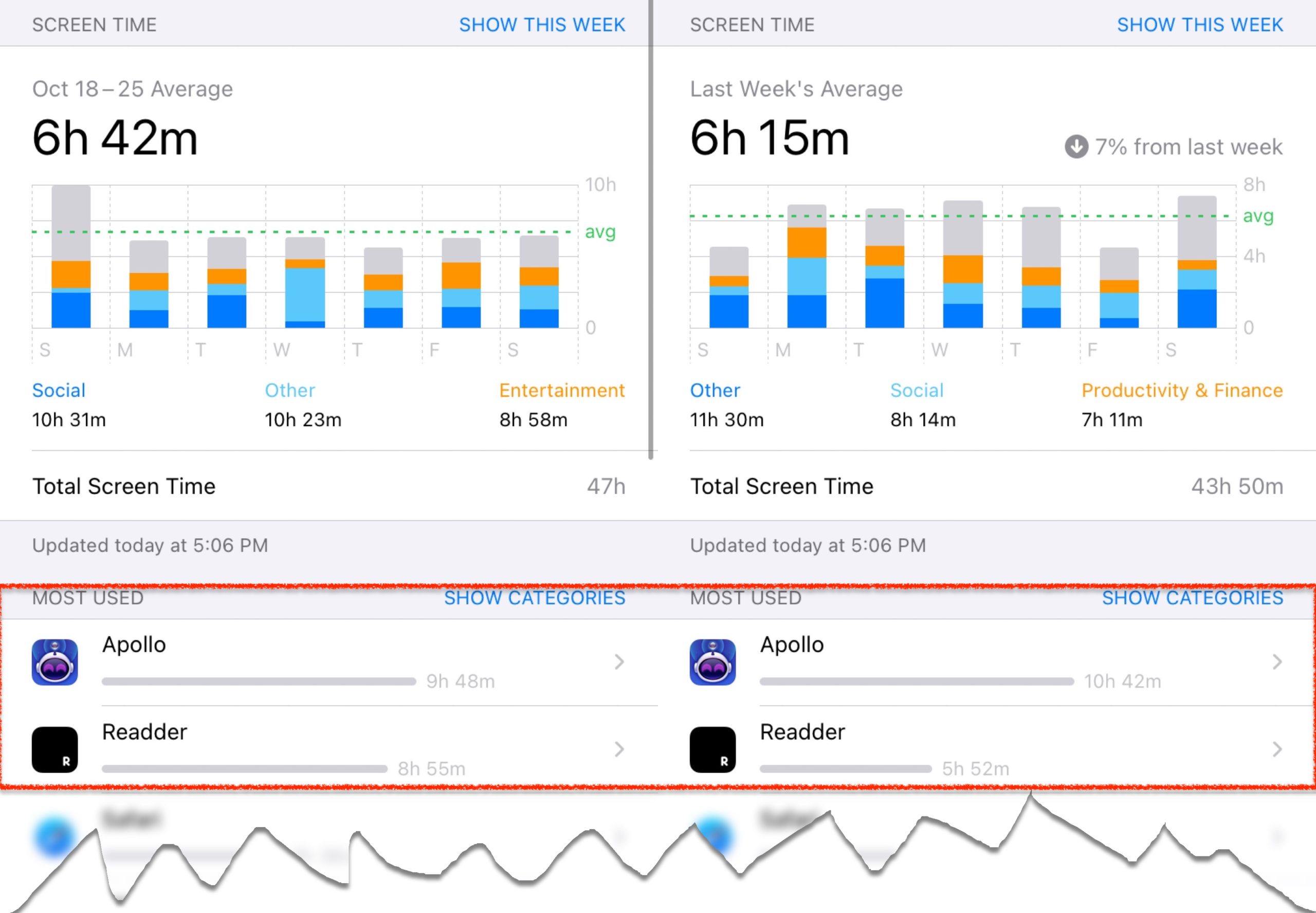
However, I’ve slid back into reading unhealthy amounts of Reddit. This chart, from iOS’ Screen Time, shows numbers I am not proud of:

That’s 2 hours 21 minutes every day during the last two weeks of October.

There is much to like about Reddit. I have been deliberate about the subreddits I am on, avoiding negativity and divisiveness. Because the network is anonymous, there’s no envy or fomo on someone else’s achievements – just plain happiness for them.

But not only it is a large time suck, it’s also not time that I spend deliberately. I am not even aware of my opening my Reddit apps, and coming out of a Reddit scroll binge feels not unlike awakening from a deep nap. Hours have passed by without you being aware of them. This is not how I’d like to live, as we just saw:

So I’m checking myself into Reddit Rehab, again. From 6th November to 5th December I’m going to time-box my Reddit usage to twenty minutes at the end of the day. I’m hoping that along with my practice of solitude and of greater deliberation, I’ll be able to use Reddit more consciously.

Let’s see how this goes. I’ll report during and at the end of the isolation.


(Featured image: Frangipani reflected in my morning cold brew)

Categories
Decentralisation and Neutrality Discovery and Curation

The cusp of something exhilarating and terrifying

The musician David Bowie was remarkably prescient in a 1999 interview about what the Internet would do to society:

… I think that we, at the time until at least the min (19)70s, really felt that we were still living under… the guise of a single and absolute created society where there were known truths and known lies and there was no kind of duplicity or pluralism about the things that we believed in.

That started to break down rapidly in the 70s and the idea of a duality in the way that we live. There are always two, three, four, five sides to each question. The singularity disappeared and that, I believe, has produced such a medium as the Internet which absolutely establishes and shows us that we are living in total fragmentation.

I don’t think we’ve even seen the tip of the iceberg. I think the potential of what the Internet is going to do to society, both good and bad, is unimaginable. I think we’re actually on the cusp of something exhilarating and terrifying!

… It’s an alien lifeform!

I’m talking about the actual context and the state of content is going to be so different to anything we can really envisage at the moment, where the interplay between the user and the provider will be so in simpatico, it’s going to crush our ideas of what mediums are all about.

Except “the interplay between the user and the provider will be so in simpatico”, he was right about several things: the magnitude and imminence of change, the fragmentation of opinion and of truth and the emergence of new forms of content, entirely new mediums.

The 16 minute interview with BBC Newsnight’s Jeremy Paxman is on YouTube. The quote above starts at 9 minutes 10 seconds in:

Categories
Discovery and Curation The Next Computer Wellness when Always-On

Slowing down time itself by living deliberately

Some perspective on how why 2020 feels both like it’s been momentous and that it’s whizzed past:

It’s not entirely an illusion. Without the usual work mixers, festive holiday celebrations, far-flung vacations or casual dinners that typically mark and divide the calendar, the brain has a harder time processing and cataloging memories, psychologists say, and the stress of the year itself can shift how our brains experience time… Sheer monotony has the ability to warp time and tangle our memories, psychologists say, with quarantines and lockdowns robbing us of the “boundary events” that normally divide the days, like chapters in a book.

I think it’s more important than ever to practice deliberation in our lives. To live deliberately, according to the writer and thinker Thoreau,

… to live deep and suck out all the marrow of life, to live so sturdily and Spartan-like as to put to rout all that was not life, to cut a broad swath and shave close, to drive life into a corner, and reduce it to its lowest terms

Neat.

In more prosaic terms, in my interpretation,

Living deliberately is making an active choice in how to spend one’s time – and, over weeks, months and years –  one’s life.

Each of us has some leeway in the everydays of our life, even if not in immediately in the broad strokes. We can make choices to pursue what is dear to us, or to invest in ourselves, or to become part of something larger than us, or any combination of these.

We can choose to restart an interest of ours. Re-engage with communities and groups we’ve fallen out of touch with. Start a new hobby we’ve always liked but didn’t know if it’d stick. Pursue our physical and mental well-being. Join a local cause. Whatever it looks like for each of us. And do it for no reason than because we can.

We do this by examining how we spend our average day, which in 2020 looks like all other days. And being honest with ourselves about which things we do by default. Which things we do inefficiently. Which things we would be better off trading for something fresh.

We also do this by actively using the technology in our lives in addition to its passive consumption. We can be deliberate even with consumption-only tools: finding shows and/or documentaries on Netflix about an interest of ours, instead of merely accepting its recommendation about what to watch next. Or creating a new Reddit account with fewer but more carefully chosen subreddits and using that for a few weeks.

Being deliberate means we spend most hours actively making a decision about how to spend them, instead of letting habits and circumstance dictate this. Consequently,

Fewer hours just slip by. Days begin to look different. Milestones emerge. Memories form. A narrative forms about how we spent October or November. Time crystallises, no longer disappearing through a sieve.

This is not to diminish the very real constraints each of us face, whether they are problems with money, health, relationships, opportunities, quality of life. The principle is simply to recognise and act on whatever agency we have in our lives, however large or small it may be.

2020 is the epitome of the adage the days are long but the years are short. By spending each day deliberately, we can lengthen some of those years.


(Featured image photo credit: Ryan James Christopher/Unsplash)

Categories
Data Custody Decentralisation and Neutrality Discovery and Curation

More on how youtube-dl – taken down by Github and the American music industry – actually aids journalism

I wrote earlier about the code of the youtube-dl project being taken down by the Microsoft-owned code-hosting website Github, in response to a notice by the American music industry’s RIAA.

This is a travesty, and it should have gotten much more coverage in general news channels across the world.

In that blog post I wrote about, and linked to, a few instances of how journalists use the youtube-dl tool. Later, I came across this article that has more detail on this use-case. An example:

Numerous reporters told Freedom of the Press Foundation that they rely on youtube-dl when reporting on extremist or controversial content. Øyvind Bye Skille, a journalist who has used youtube-dl at the Norwegian Broadcasting Corporation and as a fact checker with Faktisk.no, said, “I have also used it to secure a good quality copy of video content from Youtube, Twitter, etc., in case the content gets taken down when we start reporting on it.” Skille pointed to a specific instance of videos connected to the terrorist murder of a Norwegian woman in Morocco. “Downloading the content does not necessarily mean we will re-publish it, but it is often important to secure it for documentation and further internal investigations.”

Central to all of these examples is the fact that journalists can process a local copy in ways that the video hosting platform does not offer. It’s possible to download a high-quality video and audio file from YouTube [1], but the quality at which YouTube streams that same file in your browser depends on the quality of the internet connection, your actual device.

There is a perfectly good reason for YouTube streaming a lower-quality version: you want your viewing experience to be as lag-free as possible. But seeking to remove tools like youtube-dl take away choice in the matter.

Similarly, as the article describes, journalists use downloaded files of protests or events for further video or audio analysis. They may use it to compare video frames, voices and so on. These are not features that YouTube provides – once again, justified.

The appeal of YouTube is its audience, which is why people post videos there in the first place. So YouTube optimises for ease of use and discovery [2] not for analysis. Once again, seeking the destruction of youtube-dl, and presumably others like it, means removing all other capabilities than just passive viewing.

The USA recording industry’s massive overreach to safeguard its narrow – and narrowing domain, and Microsoft/Github’s capitulation, has great implications for access to information world-wide.


[1] Remember that YouTube is only one of the video hosting and streaming sites that the unfortunately-named youtube-dl supports.

[2] There are other issues there with YouTube’s recommendation algorithms often promoting misinformation and indirectly inciting violence, but that is another topic for another day.