
Categories
Uncategorized

The old is dying and the new cannot be born

A longform read on how the absorption of the Internet into our daily lives has shared our politics, via a comparison of the dynamics in an Analog City with old media and a Digital City with new media. The section on the Perpetual Now resonates most with me:

Digital communities emerge in shared time rather than in shared space; simultaneity is the coin of the realm. The Digital City orders the lives of its citizens in keeping with a perpetual present disassociated from both past and future, heightening a tendency already present in electronic mass media like television… Under the guise of pervasive documentation, the architecture of digital platforms sanctions forgetting, while preoccupying us with instantaneity. It is not currently this era or this year, but rather this day or even this hour. To live on social media is to be sucked into a hyper-extended present, upon which the past only occasionally impinges.

We have touched upon this when we discussed the endless News Cycle in Part 3 of the series on 21st Century Media. Whenever the discussion arises about whether a certain political scandal in the US will determine the outcome of the upcoming 2020 election, of whether the [mis]handling of a situation in India will determine whether this government is re-elected, it is now obvious to me that elections will be determined by what the dominant topic of that week, perhaps month, is. We are now at a point where government can lurch through crisis after crisis, outrage after outrage, but be elected because of a sufficiently divisive or sufficiently unifying piece of shared media experience at election time.
Categories
Uncategorized

Knowledge tree

On cultivating a mind-garden:

When consuming content, grow branches on your knowledge tree by taking notes. Short notes, long notes—it doesn’t matter as much as writing your thoughts in your own words. That’s called the generation effect, and it states that you better remember information when you create your own version of it.

Over time, you will find yourself going back to certain corners of your mind garden more often than others, and that’s alright. That’s you developing your unique perspective and own gardening expertise.

A mind garden is not a mind backyard. It’s not about dumping notes in there and forgetting about them. To tend to your garden, you need to plant new ideas. The best way to do this is by replanting stems and cuttings from existing ideas you’ve added to your garden—by consistently taking notes, and combining them together,

Lately I have been thinking about a personal system to collect, annotate and publish (privately) my own knowledge base. As of today the collection and organisation (tags and PARA folders) is still somewhat haphazard, although probably more organised than many. It lacks a system of annotation and interlinking, and I’d say more importantly it lacks a process of revisiting. Publishing, or separating the editing from the reading, will come into play with interlinking.

Categories
Uncategorized

Contact-Tracing adoption in India

The Indian government’s location-based coronavirus contact-tracing app has been used to identify potential future hotspots:

“The Aarogya Setu App alerted the government about more than 650 hotspots across the country and over 300 emerging hotspots which could have been missed otherwise. It gives accurate forecast of hotspots and it is also preventing the origin of newer hotspots. The engine has generated incredible insights and impact with precise projections of locality, direction and velocity of the spread of infection,”

Very encouraging. The NITI CEO also claims the app has seen extensive adoption, although nowhere close to universal, unrealistic in India:

69 million people have taken the self-assessment test, an adoption rate of more than 71 per cent, out of which, over 3.4 million people have self-declared themselves as unwell since they were showing one or more than three symptoms. 

Incidentally, the ‘security issues‘ that an ethical hacker claims to have uncovered in the app should in fact be a feature in the app. He was able to set his location to an arbitrary point in India and, like any person who was actually at that location, retrieve an aggregate count of people unwell and infected in a radius around that point. Both out of curiosity as well as concern for my friend and (potentially elderly) family, I’d like to look up stats for locations other than my own.

Categories
Uncategorized

Complexity

Years ago, Larry Tesler, then a vice president of Apple, argued that the total complexity of a system is a constant: as you make the person’s interaction simpler, the hidden complexity behind the scenes increases. Make one part of the system simpler, said Tesler, and the rest of the system gets more complex. This principle is known today as “Tesler’s law of the conservation of complexity.” Tesler described it as a tradeoff: making things easier for the user means making it more difficult for the designer or engineer.”

– Don Norman, Living with Complexity, quoted in this blog post.

Categories
Uncategorized

Infinite Jest on Zoom

The recent mass adoption of video-calling has reminded people of David Foster Wallace’s otherworldly tale of “videophony” in the then-near-future in the book Infinite Jest. This is from Jason Kottke’s blog post referencing the book when FaceTime was announced:

… even as you were dividing your attention between the phone call and all sorts of other idle little fuguelike activities, you were somehow never haunted by the suspicion that the person on the other end’s attention might be similarly divided.

[…] Video telephony rendered the fantasy insupportable. Callers now found they had to compose the same sort of earnest, slightly overintense listener’s expression they had to compose for in-person exchanges. Those caller who out of unconscious habit succumbed to fuguelike doodling or pants-crease-adjustment now came off looking extra rude, absentminded, or childishly self-absorbed.

My favourite part is in the continuation of this, when people moved to wearing “form-fitting polybutylene-resin masks” in order to improve how they found themselves looking on video phone calls, but which then had unintended consequences:

“consumers’ instinctively skewed self-perception, plus vanity-related stress, meant that they began preferring and then outright demanding videophone masks that were really quite a lot better-looking than they themselves were in person”

so much so that

“enormous psychosocial stress began to result, large numbers of phone-users suddenly reluctant to leave home and interface personally with people who, they feared, were now habituated to seeing their far-better-looking masked selves on the phone and would on seeing them in person suffer (so went the callers’ phobia) the same illusion-shattering aesthetic disappointment that, e.g., certain women who always wear makeup give people the first time they ever see them without makeup.”

which led to the abandonment of masks altogether in favour of

“”…a heavily doctored still-photograph, one of an incredibly fit and attractive and well-turned-out human being, someone who actually resembled you the caller only in such limited respects as like race and limb-number, the photo’s face focused attentively in the direction of the video-phonic camera from amid the sumptuous but not ostentatious appointments of the sort of room that best reflected the image of yourself you wanted to transmit”

which eventually led to some people returning back to audio-only telephony, only now as a “status-symbol of anti-vanity“, a form of virtue-signalling.

DFW may have been an oddball, but he understood human nature better than most, and was able to describe it as no one else could.

Categories
Data Custody Making Money Online Privacy and Anonymity

Data Ownership vs Custody for the 21st Century – Part 2

(Part 1)

The question is which party/parties you trust. It’s a question of who the right custodian of your data is. Because that is the question we are dealing with here:

Our terms of engagement in the connected world make it impractical and even unnecessary for you to have sole ownership and control over the sharing of the data your actions and transactions generate. But you do have agency over who you transact with. Whether you allow Google to build your social graph as a result of your email, video chat and text messaging or whether you allow Facebook is up to you. Whether you subscribe to Apple Music or Spotify is up to you. Whether you buy groceries from Amazon’s Whole Foods or from Trader Joe’s is up to you. So is who you bank with. All companies will use your data to enrich themselves directly or indirectly. But whether they will do it at your cost is something you can evaluate.

The question is Custody for the 21st Century.

For example as of May 2020, you can argue that it makes business sense for Apple to protect your data with them because their revenue – whether from hardware or from services – does not depend on selling your data to advertisers who may build harmful, incomplete, incorrect profiles on you. It makes logical sense then for you to entrust your personal information, say that generated by your everyday usage of your phone, to Apple instead of other companies. Extend that to the other places where you share your data or get your media.

The decision is also simplified – in many cases it may not be who to trust, it may just be that I don’t care enough.

Viewed as a choice of custody, it becomes an issue that people in tech, maybe even the broader public, can be coaxed to consider the importace of.

Endnote: Framing the issue as a choice of custody also makes it easy for people to realise where they have little or no practical choice: One’s ISP. One’s choice of phone. One’s choice of online store.

Categories
Data Custody

Data Ownership vs Custody for the 21st Century – Part 1

Data ownership is a topic important to me. Recently I have been thinking of ways to increase awareness of the matter among at least people in technology – not even the broader public. As I began diving into what I would call it – nomenclature is important; the words we use as a pointer to something affects the way we relate to it – I experimented with terms like digital liberty. Or ‘info-steading’, like homesteading. It turns out I’m not great at catchy terms.

But as I cycled through terms that would best capture why ownership of your own data is important, my thinking naturally expanded to what ownership actually means. Does it mean self-hosting your contacts, calendar, email? Does it mean storing your documents, photos, music, video only on your own hard drives? What is the benefit in each case?

If defined as self-hosting/self-storage as opposed to ‘cloud storage’, what about your browsing history and bookmarks? What does giving up Safari or Chrome sync across your phone, iPad and laptop yield in terms of you owning that data? Streaming Spotify and Netflix means these services own your viewing/listening data instead of you. For you to own your data, it means not using them and instead buying all your music, movies and TV shows. For your bank to not own your financial data, you’d pay and be paid entirely in cryptocurrency held in some offline wallet. Investing is going to be quite difficult. It’s all possible, but what does the trade-off look like for you?

Ultimately it’s the wrong question. It’s not an absolutist question about whether you or some other party owns your data. Today’s world – and the last couple of decades – has meant that to acheive any reasonable quality of life, you will end up sharing your data, in fact in many cases your data – or at least, data about you – will primarily reside with some other party.

Part 2 follows.

Categories
Uncategorized

Time at one second a second

I believe there are two ways to spend the occasional moments of down time during the day.

1. You can do something that will “slow down” time and creates a restful pause.

2. You can do something that will speed time up. Something that gets you lost into a black hole where you emerge on the other side not knowing how long you were out of it.

Shawn Blanc describes, simply, his deliberation in spending the extra time he finds at home during the shelter-in-place.

Whether out of boredom or avoidance, many of us indulge in time-sinks. As Shawn describes, we can lose hours, even the major part of a day watching streaming shows or scrolling endlessly through social sites, living in a constantly distracted state. Then it becomes a habit, and one’s default state of awakeness.

This makes for two problems.

One, the mind does its best to bring reality into our consciousness. If you’re distracting yourself from being bored, occasionally you might find your mind suddenly blank, or suddenly aware of a hole. If you’re avoiding, it might emerge as a vague recurring thought during the day or in some garbled form in a dream/nightmare. Either way, it’s not something you can will away.

Two, the constant low-effort entertainment strengthens reward pathways in your brain, leading to what is essentially an addiction. This is well-known by now:

… they reinforce the association between a particular stimulus or sequence of behaviors and the feel-good reward that follows. Every time a response to a stimulus results in a reward, these associations become stronger through a process called long-term potentiation. This process strengthens frequently used connections between brain cells called neurons by increasing the intensity at which they respond to particular stimuli.

But it also means that your brain will find it difficult to focus, whether at work or during a conversation. Your lowered self-control will make it that much more difficult to, say, resist over-indulging in food or drink. This is hard to reverse because the deliberation that will be needed itself requires attention.

Excluding the case of people who distract themselves to avoid facing trauma, we will have to learn/re-learn being okay again with the passing of time one second every second, not worm-holing our way through our days. Our very quality of life depends on it.

Categories
Uncategorized

Barbarians at the (investing) gate

From George Gilder’s ‘Life After Google’, about Renaissance Technologies’ Medallion hedge fund:

With more than $65 billion currently under management, Mercer’s team relies on racks of Renaissance workstations linked to form supercomputers. They parse immense Markov chains of ordered data to find filigree “ghosts” of tradable correlation. Like Google’s PageRank and its Deep Learning successes with language translation and games, like IBM’s earlier speech-recognition breakthroughs, and like “Watson,” IBM’s supercomputing master of Jeopardy searches and chess strategies, it is founded on ever-faster processing of pure statistics from ever-larger databases.

As James Simons explained in a speech in 1999, “Efficient market theory is correct in that there are no gross inefficiencies. But we look at anomalies that may be small in size and brief in time. . .. We’re always in and out and out and in. So were dependent on [intense] activity to make money.’!! Their strategy is based on round-the-clock processing of terabytes of data in search of correlations that yield profit opportunities. “Some of the signals that we have been trading on without interruption for fifteen years make no ‘sense. Otherwise someone else would have found them,’ Mercer acknowledges. “But there is no question from a statistical point of view that they work”

What’s notable about this is that the fund algorithms were created and are tuned by people with no financial or trading background:

Relying on its world-leading complement of mathematicians and physicists, Renaissance “avoids hiring anyone with even the slightest whiff of Wall Street bona fides,”… Instead, it takes in vast troves of information [which] enables the Markovian system to ignore human intentions and purposes.

Contrast with this take from January 2020 on about algorithmic trading having driven down the ‘alpha’ from value investing down to nearly zero, leaving growth investing to lead returns.

Categories
Uncategorized

General-purpose software

The problem with tools such as Notion is that

Judged as a standalone tool, e.g. a project backlog, Notion is simply not well designed for that task. It’s almost undesigned due to its forced genericness. Everything is a compromise. Everything becomes its lowest common denominator. Nothing has purpose or is easy to scan visually. Being generic forces generic design onto everything.

– Notion encourages busywork and I’m tired of it

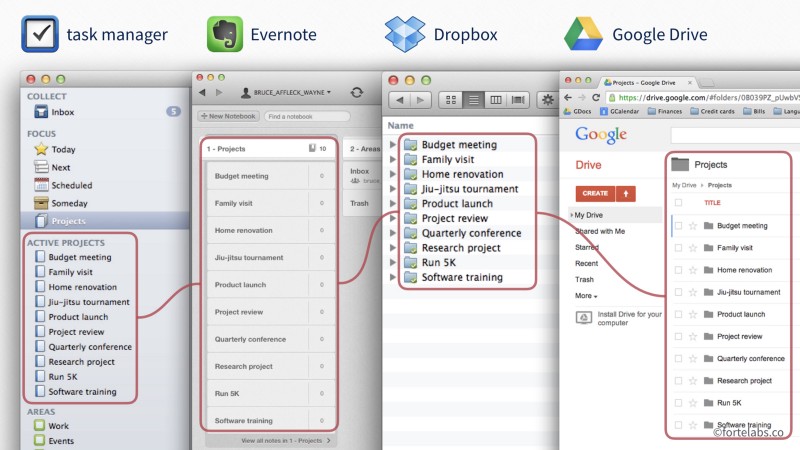
Notion takes the idea of general-purpose tool to the extreme. Evernote, with which it is frequently compared, is a note-capture and search tool. As is Microsoft’s OneNote. Mediawiki and other wikis are shared document management systems. Asana is primarily a task-management tool. All of them optimise for a particular primary use case – they’re great at that one job and substandard at others.

And that is the problem with general-purpose tools. They are better than substandard at many use cases, but just not good enough for any. You have to mangle your own management layer atop it. Twenty years ago, Excel was such a tool. You could use it as a business ledger. Or a task management service. Or a CRM. Or a sales commission calculator. It required you to massage it to get it to serve each of those functions and it still wouldn’t make you happy compared to a well-designed single-purpose tool.

What I like about information management frameworks like PARA is that you can use all your favourite single-purpose tools – simply replicate the same management structure inside each of them. This screenshot from the PARA creator’s website describes it:

End note: reading about these do-everything tools always reminds me of Alex Payne’s timeless ‘Rules for Computing Happiness’. Among them:

Use as little software as possible.

Use software that does one thing well.

Do not use software that does many things poorly.