“In a study during the run-up to the Brexit vote, a small majority of both Remainers and Brexiters were able to correctly interpret made-up statistics about the efficacy of a rash-curing skin cream, but when voters were given the same exact data presented as if it indicated that immigration either increased or decreased crime, hordes of Brits suddenly became innumerate and misinterpreted statistics that disagreed with their political beliefs. Kahan found the same phenomenon in the United States using skin cream and gun control. Kahan also documented a personality feature that fought back against that propensity: science curiosity. Not science knowledge, science curiosity.”
In an age where we are inundated by information and skim instead of digest, there is every incentive for publishers to present information selectively and in a way that appeals to our biases and reinforces them. More than ever before we must be skeptical of everything we read AND be open to new ideas. At the same time.
Hardware has literal and metaphorical edges — it must be fully complete and largely bug free to ship. Software? It’s far more amorphous, like mist. Patches can be endlessly pushed. It never ends. Faulty hardware can destroy a company. Faulty software can be patched. The [Macbook] butterfly keyboard debacle may never be lived down.
It also follows that software can get better over time, although very often it gets worse. Gmail was a delight in its early years. It just got better and better every few months. Hardware, by its nature, always gets worse.
Finally, Good Hardware and Good Software are both memorable, years after you’ve stopped using them. I miss the Nokia E71 and the email client ProfiMail, at least eight years after I stopped using them in favour of an iPhone 4. If it weren’t for the failure of the underlying operating system to compete, they would both have lasted for years. (I still have both the phone and the email client; it’s just not practical anymore).
This piece, “Avoiding the Global Lobotomy”, is among the more powerful I have read in a while. It is particularly relevant to the Mega-trend of Wellness when Always-On that we discussed yesterday. Some quotes below, but the context is important and the piece should be read in its entirety.
… this entire ‘timeline’ of spectacle events are simply empty happenings which momentarily infect your thought leaving you no time to analyse your being until the next comes in and slams your mentality to the floor.
Time becomes constrained to the point where one is not ‘living in the present’ in a Buddhist or Taoist sense, but merely existing at the whim of the latest dopamine feedback response, whatever spontaneous social-media based or dopamine-inducing masturbation session the user succumbs to that day is their nano-present.
…the end-game is roughly 3 or 4 seemingly different thought loops which lead back to precisely the same reality, one wherein you are born, you go to work, you consume, you produce and you die, and you do not question whether or not you want to do this, whether you like to do this, or whether you even thought about any of this in the first place.
How Wellness when Always-On relates to other Mega-trends and Big Questions:
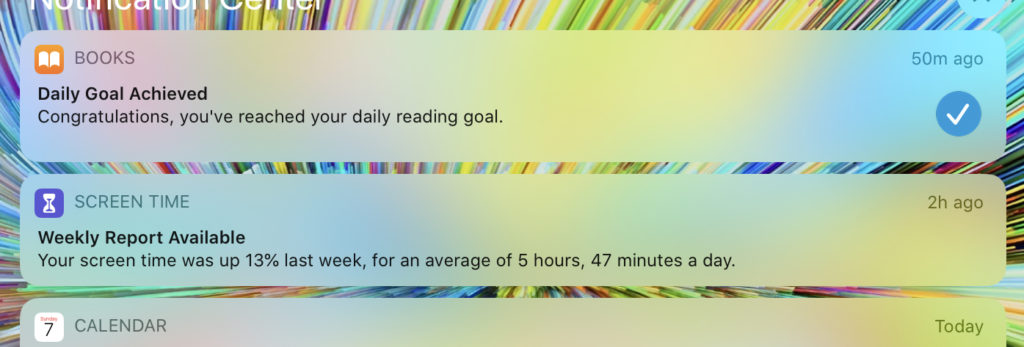
Because The Next Computer is likely to be iPad and other mobile-first devices, they will have native support for social media apps, which have turned notifications into a dark art for holding people’s attention. Apple’s solution to this has been Screen Time, which chiefly measures the time you spent on your phone, along with a list of your most-used apps. With iOS 13 Apple now also nudges you whether you really want notifications from an app – perhaps by tracking if you haven’t responded to past notifications. Over and above this, apps like Moment not only measure phone pickups and screen and app usage, but also have coaching programmes to help you kick your phone (or tablet) addiction. Regardless, none of this is a substitute for you being conscious about your computer usage, and apps being actively designed to get and hold your attention.
Conscious Discovery and Curation is extremely important to wellness. Not only because of its sheer abundance, but also because the incentives are stacked towards making it as outrage-worthy and negative as possible. It is now difficult to find mainstream news institutions, whether in print, on TV or online, that do not optimise for attention in this manner. But there are encouraging signs of individuals who recognise this, who have opinions on what is important and what is not, and while finding them is hard, following them is not.
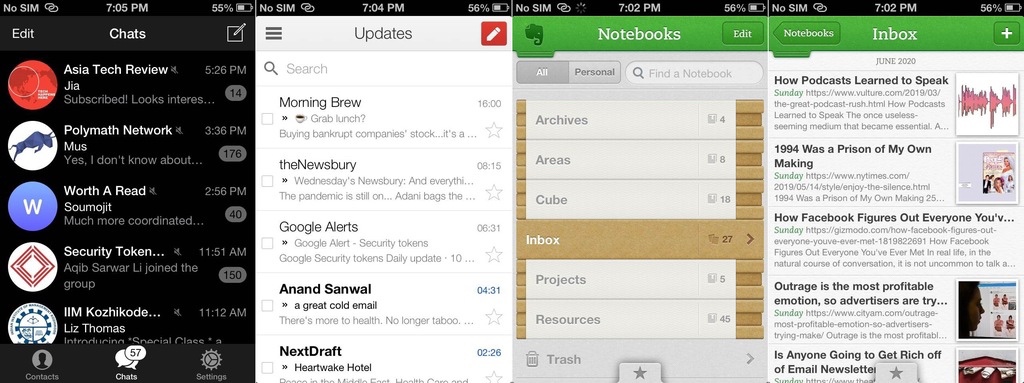
Speaking of which, email newsletters and podcasts are making a comeback from over ten years ago because of a sense of fatigue with the constant emotional manipulation and lowest-common-denominator algorithms of social media. These are part of the Dark Forest of the Internet, private, in that they are not typically not available as publicly indexable web pages. As conversation shifts away from the noise and hostility of Twitter and the envy-stoking of Facebook, it is shifting towards closed groups on messaging apps like Telegram in order to maintain a sense of sanity and focus. (Telegram has for many years been the medium of choice for cryptocurrency projects, but it’s expanded to several interest groups, including becoming a test-prep platformin India.)
So there we have it. Wellness when Always-on requires being aware of the distractions of our Next Computer, how we Discover and consume new content and the Dark Forests we retreat into, even as we build direct relationships with people who know that that Audience is their Capital.
In an age where our attention is the most valuable commodity of all, with entrenched systems and institutions that cultivate, hijack, farm, package, sell and resell it, paying that very attention, being conscious, is more important than ever before.
Yesterday’s post about Uber’s decision to scrap, en masse, tens of thousands of perfectly functional electric bikes due to, according to them, potential liability issues reminded me of the debate between shareholder and stakeholder responsibility of corporations.
Stakeholders are a broader set of people, which include employees, the communities in which the company’s offices operate, the environment, among others. Shareholders are therefore a subset of stakeholders.
Only 12 percent of the CEOs and CFOs of S&P 1500 companies believe that addressing stakeholder interests is a short-term cost that leads to long-term value…
Common consensus is that U.S. companies are not investing in areas like sustainability, the environment, their employee base, or communities because they do not want to incur the costs today that are necessary for long-term success in these areas. However, the companies themselves do not see it this way. Most do not believe that a tradeoff exists between short- and long-term outcomes. Instead, their viewpoints tend to fall into one of two buckets: either they believe addressing stakeholder concerns is costly to the company in the short run and will continue to be costly in the future, or they believe that addressing these concerns is immediately beneficial to the company and will remain so into the future—a so-called ‘free lunch.’”
No wonder that Uber didn’t much care for, or go the extra mile for ensuring its bikes ended up with the hands of people, neighbourhoods, communities that could have really used them.
These machines appeal to me because they’re such a terrific example of sustainability. Apple may release new laptops and revisions every year but you don’t have to buy them that often. In fact you can go five years, even ten depending on what you use your computer for. The relatively high price you pay up-front translates to many years of trouble-free use. The ‘cost per wear‘ equivalent of Apple’s laptops is extremely low.
May 2020 saw an incident that is the polar opposite of this ethos, which is why it caught my attention.
The summary is this: In 2018 Uber bought the electric bike sharing company Jump. In 2020, Uber made an investment in another shared electric scooter company named Lime. As part of this deal, the ownership of Jump’s assets was transferred to Lime. In other words, Lime took Jump off Uber’s hands. Except that “there were also “tens of thousands” of older-model bikes that Lime did not inherit as part of the deal”.
These electric bikes were all destroyed.
Specifically, the company that has the contract
is removing and keeping the electronic and battery components. After that… the bikes and scooters will “be shredded through the auto shredder, and the metal will be distributed out from there.”
The statement from Uber simply says
“We explored donating the remaining, older-model bikes, but given many significant issues—including maintenance, liability, safety concerns, and a lack of consumer-grade charging equipment—we decided the best approach was to responsibly recycle them.”
This is a travesty. These bikes could have been donated to communities in the US or even to lower-income countries, de-branded and with the battery pack and tracking elements removed. A bike-sharing enthusiast website describes how this could be done for the specific Jump bike model being scrapped. It is hard to imagine that Uber could not have found a single local government body in the US that was not willing to work with liability issues.
The same bike sharing enthusiast site described a worse problem with a new Jump model that is now with Lime:
the JUMP engineers who designed the 5.8 were never able to get the system to work just right… The new 5.8 has chipsets with firmware built into almost everything. Even the taillight has to talk to the other boards, or it will not unlock or power up. It is arguably the most technologically progressive dockless bicycle ever built, and all of the code and engineering behind this firmware was executed entirely in-house by JUMP techs… And UBER fired every last JUMP engineer that designed the system.
For a combination of corporate fecklessness in the name of risk avoidance, this episode is going to be hard to top.
This week I learnt of the concept of open-washing, labelling a project ‘open’ without any actual substantial openness. Mozilla responded to India’s IT ministry’s call for feedback about its Strategy for National Open Digital Ecosystems:
…the current white paper also leaves much to be elucidated on both the need and manner of implementation of such ecosystems before a national strategy can be finalized. In addition to a distinct lack of clarity on how governance mechanisms of NODEs would operate within existing and upcoming regulatory frameworks, the paper also creates the potential for ‘open-washing’ of projects.
because
The white paper leaves the definition of “open” vague and at the complete discretion of individual implementers. Consequently, implementers are not required to adhere to any minimum baseline of “open”. This risks empowering private parties to develop closed ecosystems that are only open in appearance while being closed in practice.
The response recommends that the ministry define
a clear minimum baseline for “openness,” guided by internationally accepted best practices and the Indian government’s own policies. Adherence to this minimum baseline should be made a mandatory criterion for a project to be considered a NODE.
Having read this, it sounded analogous to what I call Category Pollution.
This occurs when a company or its product runs a high-visibility awareness or distribution campaign claiming to be part of a new field, but in fact does only the bare minimum to qualify.
People who experience the product are inevitably let down, but it also sours them on even considering other players in this new fields whose product are in fact deserving of the new label. The company’s campaign has polluted the new term, the new category itself.
I have most recently seen this in the ‘wealth tech’ or ‘digital wealth’ space in India. Products that do little more than offer mutual funds claim to provide Wealth services. People who sign up for what they think is a new way to invest in a range of assets are disappointed and are unlikely to trust others truly different products in the space.
Identities needn’t even be stolen. As the tweet demonstrates, in the deluge of information that is everybody’s life, appearing plausible is all that’s needed.
Similarly, videos can and will be doctored, voices can be added in. It is easy enough to imagine someone quoting a credible tweet but inserting a modified video in place of the original. Twitter, Facebook, Reddit and other social media will need to put in place processes to mark media as verified. This is much harder to do than for accounts, but just as important.
But perhaps we should not leave it to such platforms to establish provenance. Such a use case – trust-less verification – is a great use case for decentralised ledgers like blockchains.
There already exist proofs-of-concept and trials for establishing provenance in supply chains. Everledger provides companies private blockchains on which they can trace the ownership of assets. OriginTrail does the same thing on its own blockchain. Ascribe was a project that focused on this for intellectual property (but admitted it was a few years too early).
More specific to the use case we are discussing, Prover makes possible “Authenticity verificaiton of user generated video files”. Truepic does this for both photos and videos in the following manner:
When a user clicks the shutter button inside the app (or inside any app that has embedded Truepic’s SDK software), Truepic sends the metadata, including time stamp and geocode, to a secure server and assigns each photo or video a six-digit code and URL for retrieving it. Truepic then initiates the chain of custody on the image itself, allowing Truepic to prove its authenticity. Last, Truepic logs all of the unique information about the image or video to a blockchain.
This still leaves open questions about the actual use of these verified images. The biggest is whether social media platforms will make it easy to identify these verified images. I can think of ways that the verification platforms could make it possible on their own, perhaps via an embed code. But it’s native support that’ll make it easy for the average user scrolling through hundreds of tweets and posts to identify verified images/videos amid a sea of unverified and possibly altered ones – I don’t see that happening any time soon.
Aside: in December, Twitter’s Jack Dorsey had announced a funding programme named Bluesky for research into an “open and decentralised standard for social media”, of which Twitter would ultimately be a ‘client’ of this standard. One of its target problems (perhaps the main one) was that
… centralized enforcement of global policy to address abuse and misleading information is unlikely to scale over the long-term without placing far too much burden on people.
This is possibly the only public indication from any major social media platform about a decentralised solution to the problem of fake/doctored media. Even here, decentralised does not necessarily mean neutral, or not owned by the company – people responded to that twitter thread with examples of such protocols and implementations that already existed.