Categories
Real-World Crypto Uncategorized

China and programmable money – Part 1

Bloomberg reports that Hong Kong will trial China’s upcoming digital currency:

In trials in Shenzhen, Suzhou, Xiong’an and Chengdu, the digital yuan has relied on banks for distribution. The People’s Bank of China gives out the tokens to state-run lenders, which transfer it to customers’ mobile wallets when, say, a municipality pays workers. However, this money isn’t part of bank accounts. A digital yuan transaction from Hong Kong can go global, bypassing both the dollar and the heavy fees of correspondent banking channels, which are under American surveillance and control. Payment can be received in Europe or America as private stablecoins such as the ones Facebook Inc.-sponsored Libra Association is planning…

a recent Brookings Institution paper found that the People’s Bank can issue tokens that carry interest rates. This could be a new way for people.., to take out mortgages — directly from the Chinese monetary authority.

Very recently, the mobile app of one of China’s largest banks temporarily surfaced an interface to set up a digital currency account and send/receive digital ‘money’ to/from this account. The same site CoinDesk had reported the ridesharing app Didi’s public statement that it would trial the use of the digital currency as well. So the issuer (central bank), providers (banks) and use cases (merchants/businesses) are all part of the trial. Despite all the concerns about a parallel money system, this is going to be exciting to watch.

It’s also becoming clear that this isn’t a typical blockchain-based system, as early reports had had it – and with China, it was hardly going to be decentralised. But the reports of interest-bearing tokens does mean that there are elements of programmable money, which borrow from smart contracts.

(Part 2 – A simple, entertaining but ultimately useful example of what programmable money could look like)

Categories
Uncategorized

The brokenness of IPOs

The venture capitalist Bull Gurley published a great long read comparing the traditional IPO process with the more recent direct listing process and with Spacs or special purpose acquisition companies, of which there have been some recent high-profile examples.

I found the details of Spacs somewhat hard to follow, but the bulk of the article is readable and darkly fascinating. He describes just how inefficient the IPO process is for both the company going public and ordinary investors buying into the newly public company.

In simple terms, the intermediary investment bankers set the listing price below what they estimate its market value would be. This is so that private investors, typically clients of the investment bank, who buy into the company right before it goes public have a rise in price, and the investment bank itself, which facilitates this. This is unfair to most retail investors who now buy at the much higher market price, and to the company and its promoters, who are giving away equity to these pre-IPO investors at a price lower than what it will (shortly) command.

You are told the “optimal” target is to be 30X over-subscribed. This is not a joke. You are told that you actually need 30X more orders than you actually plan to sell. This is an explicit admission that they plan to ignore 97% of the actual orders and fill only 3%…

Now imagine you are selling any other asset, be it a piece of art, a home, a piece of software, or perhaps your car. Where would you have to price that asset to ensure that 97% of the people that considered that purchase would make an offer, and you would have 30X more demand than you need? It is truly tautological that underpricing is happening, because this flawed process is being used by each and every investment bank… it is increasingly hard to understand how a board of directors can legitimately exercise their fiduciary duty, while subjecting the company to such a structurally backwards approach…

Who benefits from underpricing? Clearly the people that are handed the shares in the hand-chosen allocation process. On the IPO process the underwriters are agents for both the company and the buyside (the shareholders who are allocated shares). The IPO may stand-alone as the only very high-dollar transaction in our world where a single agent represents both sides of the transaction.

Categories
Wellness when Always-On

Asana

In the early days of the task- and project-management software Asana, I had been interested in a number of public statements made by the co-founder Dustin Moskovitz, also a Facebook co-founder, on calmness and deliberation while working, and how that influenced their product decisions. That resonated with me enough to try it out in the business unit I ran in 2011-12.

From then to now the company has mostly flown under the radar. Now it’s getting some press as it files for its IPO. One of those articles once again covered their company culture:

Internally, Moskovitz and Rosenstein took their time crafting their idealized corporate culture. They interviewed experts, brought in executive coaches and tapped a diversity-and-inclusion officer and a “head of people” over the years to get it just right. Moskovitz, who spent years studying Buddhism and leadership strategies, set up a company org chart with himself at the bottom, to represent the trunk of the company tree. Asana eschews traditional executive titles and instead makes people heads of a particular topic or business outcome. Moskovitz says it’s only right that a company focused on better teamwork invest in it as well: “We want to practice what we preach, figure out what’s best and export that.”

Along the way, Moskovitz leveled up as a leader, too. Known for his temper as a twenty-something at Facebook, he says he has learned not to agonize so much over setbacks. He invokes a saying from mindfulness expert Jon Kabat-Zinn: “You can’t stop the waves from coming, but you can learn to surf.”

Categories
Wellness when Always-On

Burnout and distraction

From the venture capitalist Fred Wilson, writing about something I have experienced first-hand myself:

I’ve gone through a few periods of burnout in my career and it was usually brought on by a string of painful failures. I’ve watched others navigate that similarly. If you are heavily invested in something that doesn’t work, it hurts. And the more the investment is of yourself, your time, your enthusiasm, the worse it is.

I’ve gotten out of these periods of burnout by turning my attention to something else. Crypto was helpful for me back in 2013 and 2014 when I was going through one of those periods. It was something new that I could throw myself at, that was different, and that was working.

The first time I experienced burnout I spent time laying the groundwork for an India-specific Demand Side Platform for ads. This is before my current thinking on privacy and anonymity evolved to what it is, and in retrospect I’m glad I never built upon that work. The second time, with burnout combined with poor mental health, I spent time on the Someone To Talk To chat application that we recently discussed.

Categories
Decentralisation and Neutrality Privacy and Anonymity

Pi-hole

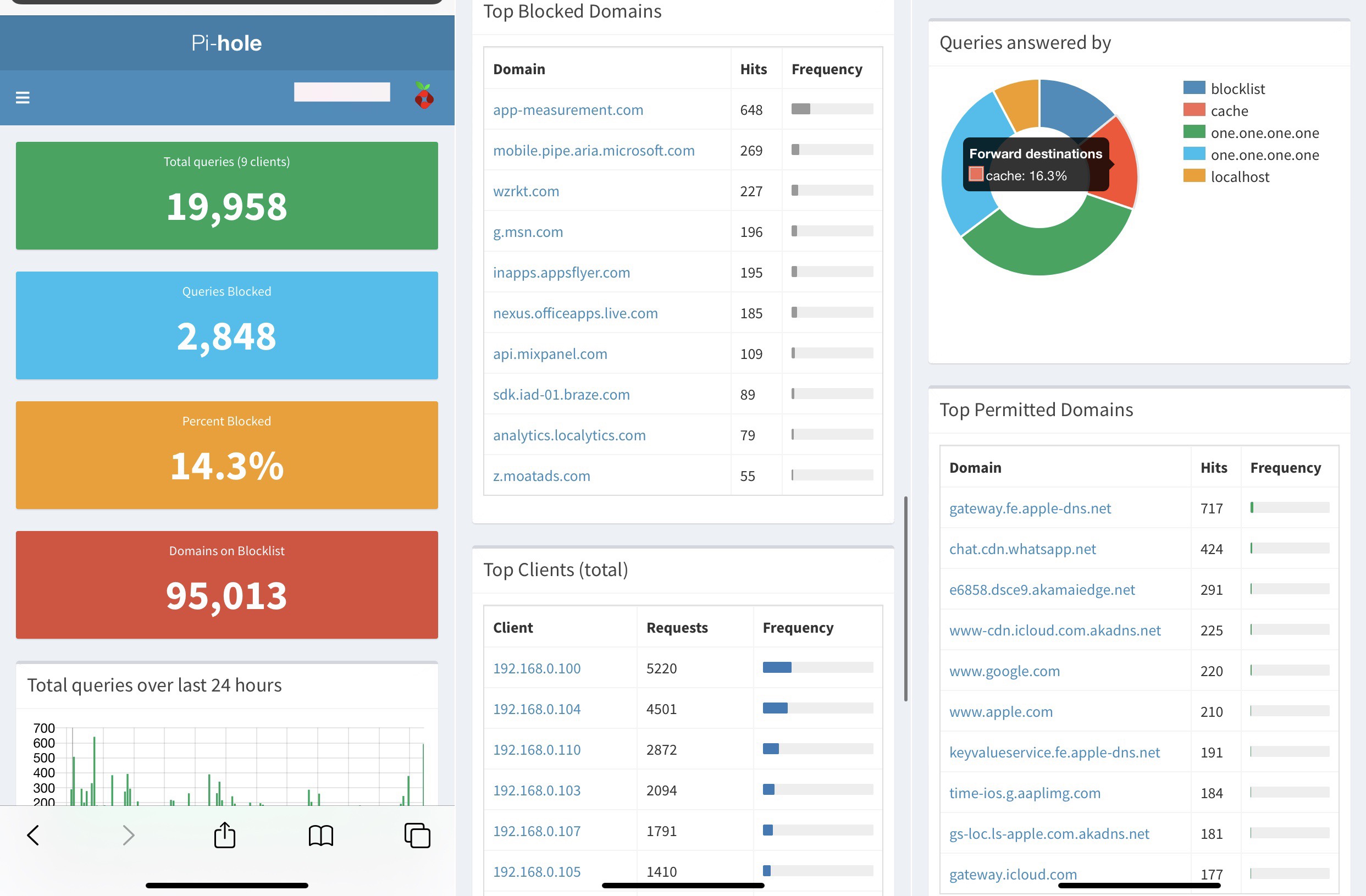
We’ve discussed home-network-wide ad-blocking a few times before. Every few weeks I’ll remember that I have have had a Raspberry Pi attached with twine to my home router, running pi-hole silently, for a few years now. I’ll login to the web interface and dwell on how well it does the one job it was created for. This is one such time.

It tells me that over the last 24 hours, a typical day, one in every seven requests was to an ad network or tracker. And that the numbers really add up.

I also see that it replies to 16% of queries from its cache, and a little over 8% are queries from itself – the pi also does some file syncing for me. That means 14 + 16 + 8 = over 38% of queries don’t need to be resolved by the public internet. It’s a rough measure of how much more efficient the Internet feels at home.

Finally, it reminds me just how many devices we have at home that connect to the internet. Two phones, two iPads, a PC and at least one Mac, the Pi itself. That just ten years ago most of us had no tablet and used either a dumbphone or a smartphone that had no meaningful wireless syncing. Everything was on one laptop we carried around everywhere. That today we are firmly in a multi-device world.

Categories
Making Money Online

When your work network is no stronger than your other networks

In a free flowing look at how the move to remote work will impact cities, the office, the way people approach a job itself, even politics, I found this interesting:

Working from home, our connection to the office weakens, and our connection to the world outside the office expands. At the kitchen counter, hunched over your computer, you are as close to the people and communities on LinkedIn, Twitter, and Instagram as you are to the Slack messages and chats of your bosses and colleagues. By degrees, the remote experiment can weaken the bonds between workers within companies and strengthen the connections between some workers and professional networks outside the company.

With the effect of

I am alone, and I might as well monetize the fact of my independence. A new era of entrepreneurship may be born in America, supercharged by a dash of social-existential angst.

Categories
Real-World Crypto

Blockchain and incumbents obviate, seek blessing or ignore?

The security writer and author Bruce Schneier, in an article about blockchain that we will refer to in a future post:

I listed [in his book Liars and Outliers] four very general systems our species uses to incentivize trustworthy behavior.

The first two are morals and reputation. The problem is that they scale only to a certain population size. Primitive systems were good enough for small communities, but larger communities required delegation, and more formalism.

The third is institutions. Institutions have rules and laws that induce people to behave according to the group norm, imposing sanctions on those who do not. In a sense, laws formalize reputation.

Finally, the fourth is security systems. These are the wide varieties of security technologies we employ: door locks and tall fences, alarm systems and guards, forensics and audit systems, and so on.

Then he paraphrases another writer who described four trust architectures:

 The first is peer-to-peer trust. This basically corresponds to my morals and reputational systems: pairs of people who come to trust each other.

His second is leviathan trust, which corresponds to institutional trust. You can see this working in our system of contracts, which allows parties that don’t trust each other to enter into an agreement because they both trust that a government system will help resolve disputes.

His third is intermediary trust. A good example is the credit card system, which allows untrusting buyers and sellers to engage in commerce.

His fourth trust architecture is distributed trust. This is emergent trust in the particular security system that is blockchain.

This immediately brought me back to a recent post, where I said that blockchain-based solutions that tried to reinvent parts of the regulated financial system were doomed to face heavy opposition from regulators and incumbents. This makes it clear why. Regulators are institutions, representatives of leviathan trust above. Incumbent players in finance are intermediaries, pillars of the third trust system above.

A blockchain based system that looks to obviate the need for either of these systems is going to be blocked by both of them. A blockchain based system that seeks the blessings of either of these system renders the blockchain superfluous. It follows that blockchain use cases that will really succeed are those that are either unregulated, or existing regulation has utterly failed at.

Categories
Uncategorized

On reading and the reader

An engineer at Google wrote a wonderful Twitter thread a little while ago on becoming a better reader.

https://twitter.com/juvoni/status/1295057579681501196

Someone had already summoned the ever-useful Threader app to stitch the thread into a single page, which I sent to Instapaper to read leisurely. I’m quoting some tweets here:

Read Non-fiction for mental models & perspectives on how the world has worked, currently works, and how you can create new works within it.
Read Fiction for emotional models on how to feel deeper within yourself and in relation to others.

Lindy Effect is a theory that longer a non-perishable thing has been in existence, the more likely it is to be in existence.
Old Ideas & Books that are still relevant today, have a lower chance of becoming expired knowledge and are therefore more valuable in the present

5-star reviews can be gamed & don’t tell you why you shouldn’t read the book. Read passionate, constructive, and specific 3 & 4-star reviews to find out what the book lacks to see if what remains is worthwhile.

Cultivate a Triathlon Reading Pace
Learning to see:
– Flat planes of a book to speed up,
– Wet hills to climb up slowly with care, as to not fall back to re-reading,
– Rocky patches with varying shapes for a hop and skip & more dynamic reading speed for the changing terrain.

Some books are meant to be sat and soaked in. Immerse yourself over, many days, weeks, months.

I identify with that last tweet. Once a year I’ll go through the ritual of reading my well worn copy of David Foster Wallace’s Infinite Jest. It’s a river that takes several weeks to ford, during which time I’ll read a few other books in parallel. During those weeks my mind floats in DFW’s alternate universe even as it carries on its business in the real one. As with many great books, each experience is different, each experience uncovers something new, each experience is a different me.

Categories
Data Custody

Dropbox and the Digital Hub

Returning for just a bit to our discussion earlier about Mozilla’s big opportunity to be the trusted, neutral, privacy-first custodian of data in the 21st century. It seems increasingly like Dropbox sees itself as that custodian. [1] It recently released a set of features that points towards that positioning:

  • a password manager
  • support for encrypted files/folders – though in beta at the time of this writing
  • automated backup of common folders – Desktop, Documents and Downloads, which it is calling computer backup
  • digital signatures to sign files stored in Dropbox – also in beta

Dropbox already

  • syncs files in the main Dropbox folder – the core service
  • backs up phone photos
  • allows for collaborative document creation and editing like Google Docs, with its Paper product

This checks off a lot of the services we’d discussed for Mozilla to offer, and is for Dropbox a more ambitious positioning than a cloud storage providers, which Steve Jobs had once dismissed as a ‘feature, not a product’

[1] Without of course Mozilla’s reputation for privacy-consciousness.

Categories
The Dark Forest of the Internet The Next Computer Wellness when Always-On

Mental health tech cannot be like regular tech – Part 4

(Part 3 – My personal experience with seeking help with my mental health)

I’d called it simply Someone To Talk To.

Someone To Talk To – a chatbot

Background:
Several – most? – people with anxiety or mild depression would benefit tremendously from just having someone to talk to. Someone who is receptive and non-judgemental, and doesn’t have any other relationship with the person. It’d be ideal if people had someone like this to talk to in person, but it is impractical: not just because it involves travel for one or both people but also that it requires scheduling and therefore a set time, and that people may feel the need to talk at any point in the day. The mobile phone, a deeply personal device available 24×7, is ideal.

Now, this need goes far beyond mood-logging apps that ask for a rating or emoticon to describe one’s mood. Not only do people’s emotions vary significantly during the day (especially those that are anxious or mildly depressed), not only are they more likely than not to rate their overall day as negative, thereby further feeling down at their own constant negative rating of their days, but more importantly that their needs go beyond such a one-point (or even multi-point) rating. They need an outlet for thoughts and anxieties and fears, to put in words.

Another approach to this is journaling apps, including visually beautiful ones like Day One. Journaling apps take on many types, inluding 5 Minute Journals and Gratitude Journal. But the prospect of filling up a blank screenful, especially day after day, is too often overwhelming for someone who has low emotional bandwidth in the first place.

Here are the characteristics of what I think will make a good Someone To Talk To:

It will be conversational. It’ll feel like a chat (and in fact will be one, with pictures and links sent both ways just like in a regular chat) instead of a set of screens and buttons. The bot will be able to organize what one says, with context, into a journal of sorts for the person’s reference any time later. The person will be able to share with the bot not only text, but also pictures and other media. The bot should be able to respond with at least some context – gentle encouragement or reassurance – but must take great care to not overdo it or sound artificial. Not responding is better than responding like, well, a bot. The bot will also learn about the person over time – what the person seems to like and not, and whether that changes over time, specific people, persons, places that the person refers to and their relationship to the person. The person may give them appellations that are not their real names/descriptions, and that is by choice. The bot will know this.

It will be empathetic and sensitive. It will be designed knowing that a regimental approach of asking for a mood update, or a diary entry at the same time every day, as many apps seem to do, is counter-productive and causes more stress than it relieves. It will be designed knowing that on occasion a notification or picture or video or piece of music can trigger anxiety/sadness/distress in people and they may not even recognise it as such, much less know why. Finally, it will know when the person is looking for a response from it, and when it simply needs to ‘listen’, providing occasional acknowledgement of its ‘presence’.

It will be gently intelligent. While it will often initiate conversation, it won’t ask with every interaction if it felt right, or if the person liked it or not. Being the one expected to be ‘in charge’ of the bot-human relationship can feel challenging. If the bot is designed to be a stand-in for a human companion, it must do better than ask for feedback often (wouldn’t it be stressful to have a friend do so?) Just like making decisions, being made to pass judgement also brings pressure. It will never expect anything from the person it engages with, such as a response in a certain amount of time, or at all. It will also be able to gauge improvement or decline in mood over time and adjust accordingly.

In addition to being empathetic, sensitive and intelligent, it will also be realistic. It will never make empty promises about things always getting

As things turned out, I returned to my day job and never actually worked on this beyond a few simple test versions with a couple of other collaborators. But this, still, is exactly how I’d go about bridging the gap between dealing with mild mental health issues on one’s own, and full-fledged therapy.

(ends)