Categories
Discovery and Curation

Why is bigger better?

In this piece titled “What is the measure of a good company?”, in the context of the clothing brand Brooks Brothers having recently filed for bankruptcy:

You could see the race to the bottom as the brand became more and more volume focused… But making great products and having a few great stores wasn’t what they wanted. They wanted volume. Maybe no one stopped to think about the fact that maybe Brooks Brothers wasn’t meant to be a two-billion-dollar brand. J.Crew and GAP do that kind of volume — why would anyone want to end up like that?

All of this comes down to: Why is bigger better? Why does multibillion in sales make your company great? Why is that the goal when you are already rich? Even if I had a few hundred million invested in a business I would feel a lot better about the unlikelihood of doubling it if I were just making great things. 

We went from an era of small local brands upto the 1850s to some 175 years of a few large brands that used global wage arbitrage in their favour – the era of capital as a moat. 

I think over the next few years we’re going to see the era of the long tail of a much laarger number of small, niche brands across all sorts of industries including clothing.

While brands in the previous era created leverage using the global supply chain, those in this era will use the Internet and that same supply chain.

As we have seen in our series on Lienar Commerce, the community-first model will eventually become the norm. This allows brands to thrive while still staying small.

Finally – if the creators of these new era brands are sensitive to and deliver what what the community wants and values, then those brands are likely to be more resilient to pricing pressure from large, more generic brands who have economies of scale in their favour. At its extreme, this may put less pressure on the supply chain and on the incentives to keep wages in third-world-countries as low as possible.

Featured image photo credit: Jezael Melgoza/Unsplash

Categories
Data Custody Decentralisation and Neutrality

Cloudflare and the Internet Archive Cache

Cloudflare is one of my favourite Internet companies. They’ve made previously-enterprise-level services like CDN, denial-of-service protection and HTTPS available to every website owner. They also run the excellent 1.1.1.1 DNS resolution service, which I use on my pi-hole adblocker. I am a Cloudflare customer for this website, and Cloudflare is part of my US stock portfolio as of this writing.

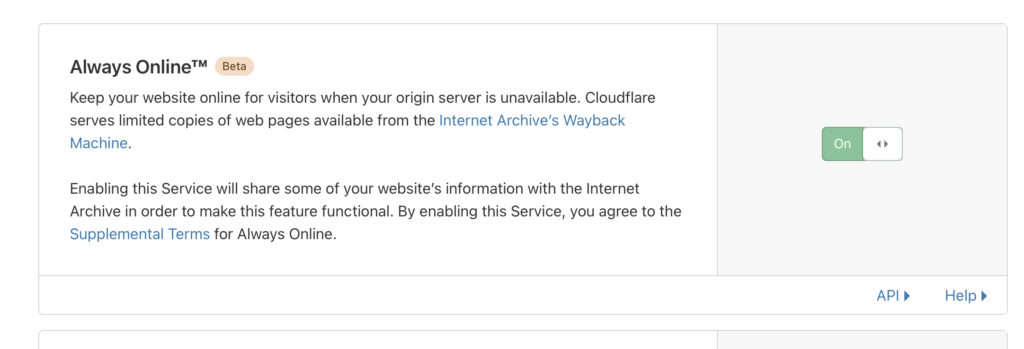
I recently learnt that the Internet Archive and Cloudflare announced an elegant partnership: The Internet Archive operates one of the Internet’s most precious artefacts, the Wayback Machine, which has archived billions of pages from the web’s earliest days (see this website’s pages on the W.M.). It will now begin to also archive pages of Cloudflare customer website. Under the partnership, if a Cloudflare customers website is unavailable for any reason, such as problems with the web host, the Wayback Machine will kick in and serve archived copies of that page instead.

Turning it on on my Cloudflare dashboard only required toggling a switch:

It’s elegant because each party operates what it does best. Cloudflare runs a site’s DNS anyway, and can determine when a site is down. The Wayback Machine archives web pages anyway; it now serves some of them repurposed as cached pages. I imagine these pages are stored differently so as to be retrievable quickly.

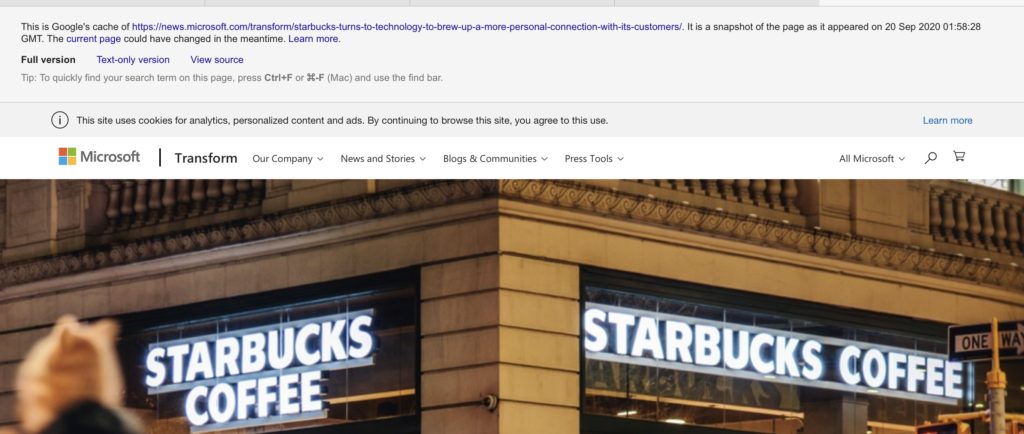
Google has long offered cached versions of pages on its search result pages:

But this partnership is baked into the web – if there’s a problem with a site, pages will be served by the Wayback Machine regardless of whether they were accessed via Google Search or were linked to from another website or were sent via a chat or email. It just works.

Featured image photo credit: Jon Hieb/Unsplash

Categories
Uncategorized

#rahulisreading

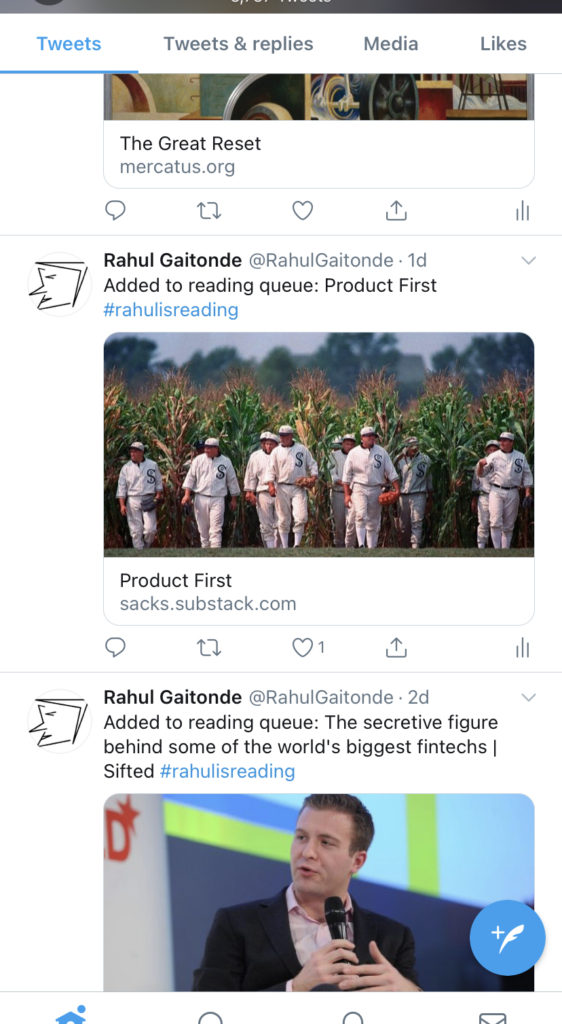
For a few years now, I have had an IFTTT applet that tweets the title and link of every article I save to my read-later Instapaper queue. It think it’s a good way for my followers to discover new things to read too:

I’ve updated the automation so that each of these tweets is also tagged with the hashtag #rahulisreading.

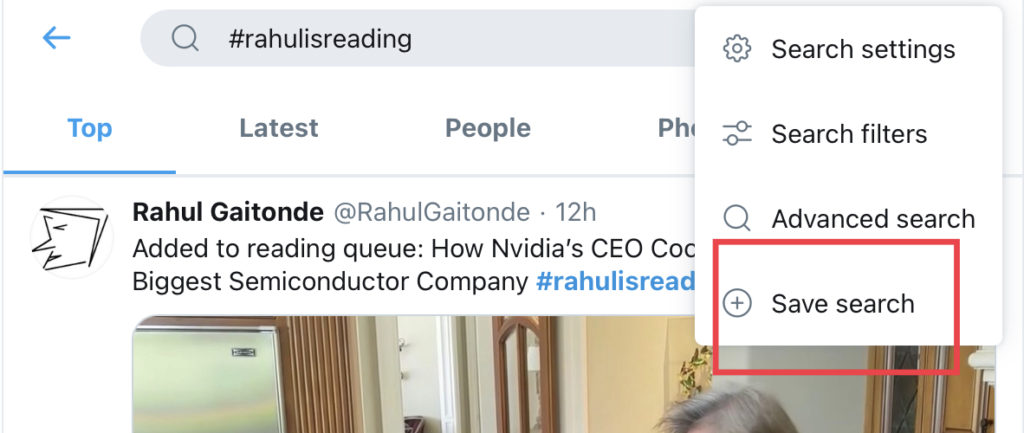
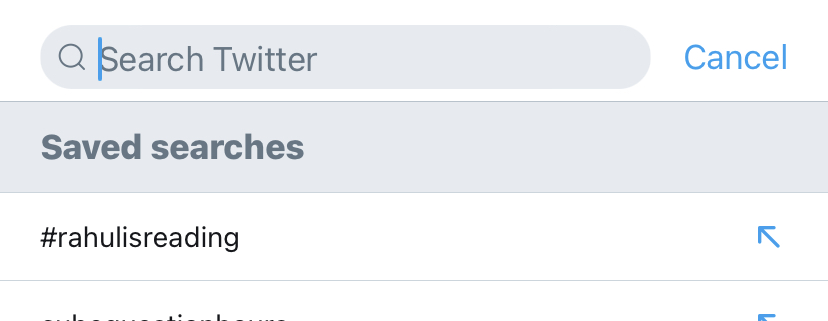
Now it’s easy to bookmark it in a browser – just save this URL. Alternatively you can save the hashtag within Twitter as a saved search:

On Twitter web, tap the ellipsis menu next to search, and tap ‘Save Search’.

You’ll see it on both the web and in the Twitter app:

Try it out. Search for #rahulisreading on Twitter.

Categories
Data Custody Decentralisation and Neutrality Making Money Online Personal Finance The Next Computer Wellness when Always-On

My portfolio of US stocks for the post-pandemic world

The New York Times:

The coronavirus pandemic has accelerated trends that were building for years by forcing large swaths of the population to work from home and shop online. And many obscure companies are taking off, driven by investors who expect them to flourish in an economy whose future arrived ahead of schedule.

“When it comes to remote work in particular, the past 10 weeks have seen more changes than we’ve seen in the previous 20 years”

Erik Brynjolfsson

Erik Brynjofsson co-wrote the seminal The Second Machine Age in 2014 – he is a keen observer of this trend.

Surveys conducted by Mr. Brynjolfsson and economists at the Massachusetts Institute of Technology found that the share of Americans working from home jumped to about 50 percent this year, from around 15 percent before the pandemic.

The article describes companies whose stocks have risen much faster than the overall tech-dominated NASDAQ index:

Fastly is up more than 310 percent this year. Zscaler is up over 180 percent. Chegg and Veeva are up 75 percent and 90 percent. In a tech universe dominated by Apple, Amazon, Microsoft and Google, the share prices of little companies you’ve probably never heard of are soaring… Zoom — the suddenly ubiquitous video conferencing service — has been an investor darling, up close to 500 percent this year as workplaces shut down. Peloton, the home video cycling company, is up almost 200 percent amid widespread gym closures… [Docusign’s] shares are up 166 percent this year.

My own US stock portfolio are based on a similar thesis, and have seen similar performances this year. My qualifying criteria for companies are the following (as with things like this they are perennially a work in progress):

  1. B2B companies enabling
    ~ Remote working
    ~ At-home lifestyle
    ~ Small business commerce
    ~ Internet infrastructure
  2. Dominant in one of above categories
  3. Low political risk domestic (US) and international
  4. Resilient during the March-April 2020 crash
  5. A business I understand

Some companies in my portfolio:

A. Companies other than ones mentioned in the article:
~ Atlassian
~ Cloudflare
~ Twilio
~ Nvidia
~ Wix

B. Companies also mentioned in the NYT article:
~ Shopify
~ Docusign
~ Peloton
~ Fastly

C. Companies that are Big Tech but fall within my thesis
~ Amazon (because of AWS)
~ Microsoft (Office, Teams, Github, Azure)
~ Apple (iPad, Macbooks)


Featured image photo credit: Rohit Tandon/Unsplash.

Categories
Data Custody Making Money Online Privacy and Anonymity

The Social Dilemma and Software as Tools

I am watching the recent Netflix documentary The Social Dilemma. Obviously, it discussed many of the issues I write about regularly on this site. So I have a few opinions about it that I will think about and post here later. For now, this bit from Tristan Harris stood out:

… we’ve moved away from having a tools-based technology environment to an addiction and manipulation-based environment. That’s what’s changed. Social media isn’t a tool that’s just waiting to be used. It has its own goals. And it has its own means of pursuing them by using your psychology against you.

He’s articulated what have felt for a long time. Software used to be tools. Some were free and open-source, others were paid. Either way, business was separate from product, in the same way that business and editorial are separate in a well-run news organisation. Now some of the companies that we depend on every day no longer make money by customer paying for their software, they make money from other software paying for their customers.

You can see this with open source software. When you use the email client Thunderbird with an email account from your domain name provider, you’re using it as a tool. The relationship is simple and straightforward. You owe Thunderbird nothing; Thunderbird takes nothing from you. When you use Gmail.com with your Gmail email address, it’s a lot less simple. If you were old enough to use IRC, it was simply a tool you used to chat with friends and strangers online. Whatsapp on the other hand is hardly a tool. The relationship is much more unequal, in Whatsapp’s and Facebook’s favour.

While it may be already too late to live your existing life and maintain your existing relationships without using software from companies like Google and Facebook, you can learn from documentaries like this and make much more deliberate choices about these same tools – specifically, are you getting what you want from them, or are you doing what they want you to do?

Categories
Data Custody Decentralisation and Neutrality Privacy and Anonymity

Wishlist: iOS 15 and privacy

Ars Technica has a succinct overview of the many privacy-oriented features in the recently-released iOS 14.

Regardless of whether you are actively concerned about privacy or are in the ‘but I like my ads’ camp, it’s worth reading about the actions of a company that has a very clear view on this issue.

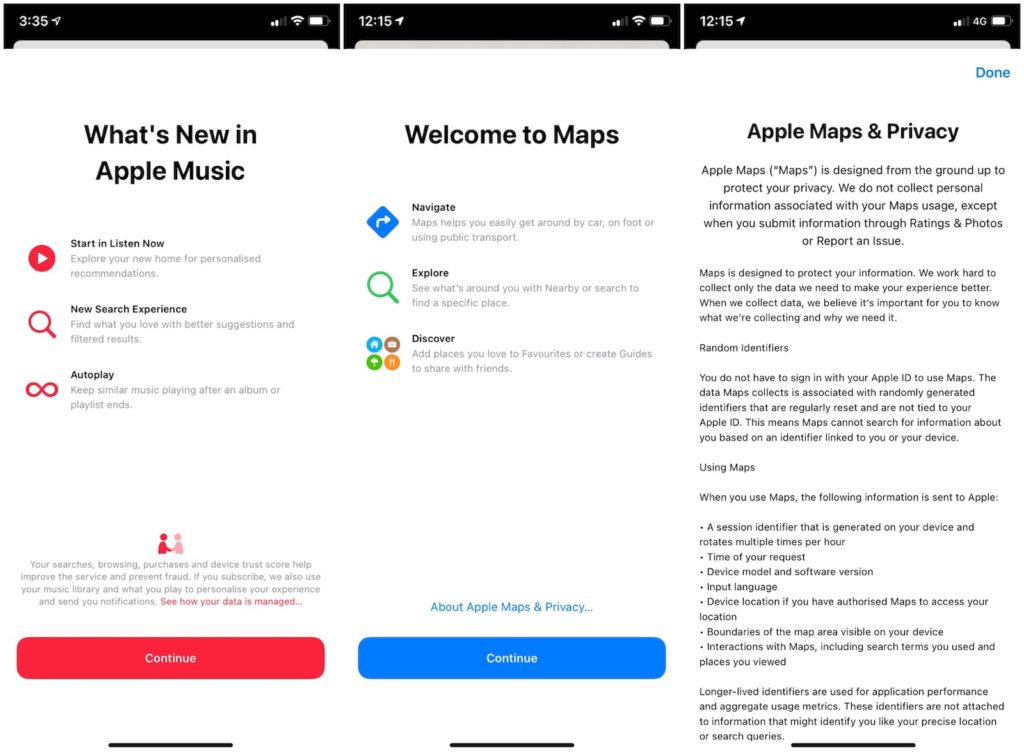
As with iOS 13 in 2019, this year’s release also has prominent notices in its built-in apps about Apple’s stance on privacy.

There have been rumours about Apple launching its own search engine in the next iOS. The evidence seems to be how iOS 14 already retrieves information that is displayed in Spotlight searches – that it seems to be using Apple’s own crawlers.

While this would be welcome, I’d like Apple to

  1. Roll its own privacy-centric encrypted DNS service built into the next iOS.
  2. Allow device-wide traffic routing via the Tor network.Taking this even further, I’d like it to
  3. Offer a full-fledged VPN as part of its Apple One subscription bundle

Combined with iOS’ own privacy features, this’d give those that wanted and cared about privacy to get it, even at a price.

Categories
Data Custody Decentralisation and Neutrality Discovery and Curation Privacy and Anonymity The Dark Forest of the Internet Wellness when Always-On

Alternate realities – Part 3

(Part 2)

8/ And its why real-world consequences of online behaviour, such as the people jailed for merely like-ing a Facebook post critical of politicians, is distressing. As George on Seinfeld cried, World Are Colliding.

9/ All of this works both ways. Communities of fringe loonies will use the same tools to block you from injecting reason into their online dialogue. And when reporting online harassment results in a real-world arrest we are gladdened.

This is a plot point in several movies or books that involve virtual worlds. They are never fully independent of the physical world, and their interaction with the physical isn’t always sanguine. It’s often the case in the real real world. People have been jailed for writing their mind, for sharing videos in jest, even simply liking Facebook posts – usually pricking the fragile ego of a person in power. Mere anonymity is often not enough. Even when you’re all wearing masks, your virtual town square can be invaded by the real-world Basij.

However benevolent and forward-looking the authorities online may be, they’ll clash with – and usually lose against – authorities in the real world. Just look at Twitter’s transparency report regarding data requests from governments. According to themselves, they complied with four out of every ten such requests. Facebook complied with 3 out of every 4 requests, and nearly 90% of requests from the US and the UK.

10/ In any case, this kaleidoscope theory accommodates more of what we are seeing happening than the more common polarisation theory. It posits that polarisation is a special case of the sharding of reality.

Most reporting frames the problem as one of polarisation – like a dumbbell, there is a concentration of people around two diametrically opposite viewpoints.

This is not new: most of the US’ 20th century relationship with the world outside through the lens of communism versus capitalism, never mind those that didn’t care, didn’t matter, were explicitly non-aligned, or had widely varying interpretations of each economic system. It has resulted in a with-us-or-against-us mindset. If you weren’t a committed communist, you were a capitalist pig. If you weren’t for the Vietnam war, you had to be against it – and therefore unpatrioric. Ditto with the 21st century Iraq occupation. Then it was Christianity versus Islam. Today the country’s much more insular, so it’s supposed to be Democrat versus Republican.

In India you’re either a secular, used as a pejorative term, or a mindless devotee of the Hindu right, never mind what secularism was supposed to mean or the many schools of Hinduism. The definitions of each now form narrow edges meant to cleave.

But online, while the war of polar opposites is fomented and waged, myriad cultures form, thrive and die, each with their own biases and rivalries. For the first time they can exist freely and openly without having to pick sides in someone else’s battle. This freedom is important – so far only the privileged have been able to declare themselves against ‘the world’. Now any group that feels marginalised in real life can do so.

11/ Either way, we’d entered this age of infinite realities sometime in the 2010s. The diminishing of the physical space this year marks an inflection point, when a critical mass of us begins defecting into our online realities and being shaped by their cultures.

The pandemic has cause the diminishing of our real world public spaces, making online ones all that much more important. New types of closed communities hog attention – Houseparty, Clubhouse – and several other similar apps – but the other inevitable shift will be to true public spaces. Today there is little other than Twitter.

It’s going to be fantastic to look back in ten years’ time at the movement of people’s social lives to such online worlds – all run by private entities. In a decade, 2020 is going to seem as quaint as the web of twenty five years go – Lycos, DMOZ, Photobucket, Kozmo – seems today.


End note: The other development we haven’t explored in this series is the increasing popularity of game-oriented virtual worlds like Animal Crossing and Minecraft. They fall somewhere between closed communities like groups & subreddits on the one hand and town squares like Twitter. World-building is more deliberate, more visual, more explicit. But they also provide the same sort of open endedness of Twitter and the creation of communities. In fact, as we have seen, of entire economies.

(end)

Featured image photo credit: William Álvarez/Unsplash

Categories
Decentralisation and Neutrality Discovery and Curation Privacy and Anonymity The Dark Forest of the Internet Wellness when Always-On

Alternate realities – Part 2

(Part 1)

5/ The vastness of Twitter is what gives this the scope of a whole reality. A Facebook or Slack group or email list seems closed in comparison, a direct digital analogy of a forum or group meeting. Twitter seems like whole new worlds.

6/ Imagining hundreds of such alternative realities is heartening. This was already true – it’s what we speak of when we speak of VC Twitter, Crypto Twitter, Infosec Twitter. We are now seeing this more evenly distributed.

Twitter is an extraordinary phenomenon, the closest we have to an internet within the Internet. It’s smaller than other social networks, a fraction of Facebook’s size, but its easy publish-subscribe nature gives it a limitless feel that no other comes close to. Twitter’s natural velocity is also faster than, say, Facebook or Instagram. It’s not quite a messaging app, but you don’t see the equivalent of tweet-storms on other networks.

This openness and quickness is a big contributor to multiple subcultures coexisting on the same fabric, and you can plug yourself into any number of them. In its early days Twitter described itself as a giant world-wide town square. It still remains that, and because it’s virtual, you can participate in many simultaneous gatherings in that square, ambiently aware of innumerable such conversations around you. It’s a testament to Twitter’s versatility that it can feel like a vast open space and an echo chamber at the same time.

7/ I think that’s why there’s such pressure on Twitter from its most ardent users for tools to combat trolls and abuse. It’s to keep out those who impinge on their reality.

Social media gets flak for encouraging escape for the real world. This is in fact the Internet’s biggest benefit. Usenet, a precursor of bulletin boards, was among the Internet’s earliest use-cases. When you participated in different usenet groups with their own argot, inside jokes and community cultures, you plugged yourself into alternative realities. The more open the group the faster it grows and at some point generates its own culture. But that same openness leaves it open to interference from what it considers outsiders. It’s easier online than in real life to hijack discussions, brigade entire threads, disrupt a whole group.

How do groups counter this? Groups have moderators, empowered in some manner to enforce conduct that’s been agreed upon. Disrupters can be banned, words and topics can censored, threads can be locked, accounts can be limited to posting only a certain number of messages every hour. With active moderation, the work required to consistently disrupt a group often dwarfs the hoped-for benefit. The group fights off the infection and lives another day. This is how Reddit works.

But Twitter isn’t a group. Consequently, there are no moderators but Twitter itself. This leaves Twitter uniquely vulnerable to harassment, abuse, hate speech, stalking. Because people can retweet with a single tap, the effects of the already devastating act of doxxing – publishing someone’s real-life details like house address, person phone number, children’s names – are magnified. The effects of these are a topic by themselves. But consider the context in which we’re discussing this:

Twitter’s a place where people can be their own selves in an open environment – this combination is what makes it an alternative world. If this world has intruders like above, it’s the equivalent of being accosted by those people in a cafe or a park bench or walking down the street. Because you’re not in a digital bar, there are no bouncers to throw the offending party out. It’s a public space, and police are – until recently – absent.

(Part 3)

Categories
Discovery and Curation Wellness when Always-On

Alternate realities – Part 1

This is an annotated Twitter thread I had posted a little while ago, itself prompted by an excellent thread by Erik Torenberg.

This is my thread, with the same text and commentary right below:

1/ In his thread Erik says (among other things) that multiple parallel hyper-realistic online worlds made possible by Twitter gives demagogues attention leverage never possible in the 20th c. They can perpetuate their existence creating online simulacra of majority-oppression without having to deliver on chaos. But…

Small decentralised foreign teams can manipulate opinion en masse, as the 2016 American national election proved. We’d have imagined this would be done through damage to communications infrastructure, but these teams sabotaged, not wrecked, the tools people use everyday. Or more traditionally, certain events would have been made to happen, benefiting one or the other political side. Instead, these teams constantly magnified and spun multiple small events to create an alternative reality. It make it easy for those who wanted to believe to believe. Taking to its extreme, many people online now perennially consume outrage porn. Warfare has changed and we don’t know it yet.

2/ … I think the ability to create an alternative reality and subculture is also freeing, empowering in a way. Any shared national narrative of the past was foisted upon people by whatever small set controlled TV and print media.

I remember reading a couple of years an article on how decadal cultures like “the 80s” and “the 90s” don’t exist for the 2000s and 2010s as each of us has plugged into our own online cultures. Since online cultures evolve faster than mass media ones, generations form faster too. Consider the Xennials, a ‘micro-generation’ that I fall squarely in the middle of, who identify with neither of the successive generations labelled GenX and Millennial.

(Part 2)

Categories
The Next Computer

Retina fun

Some recent fun: for a while, I gave my non-retina 2012 MacBook Pro a retina screen and used Mac OS on a crisp high-res screen.

Years ago, I had purchased Duet Display, using which you could use your iPad as a second display for your Mac. You’d connect your iPad via a cable, run the Mac and iOS Duet Display apps. That was all there was to it.

It works quite well. As much as I’d like to be, I’m not a two-monitor person, and so it never stuck.

Clearly, Bill Gates loves a multiple monitor setup

Recently, for no real reason, I gave it another shot. While arranging displays under Settings → Displays, I noticed that the Mac OS menu bar was duplicated on both the iPad Pro and the Mac – so the iPad wasn’t really a second monitor. So instead of setting the iPad off to the side, why not put it up front and center?

It worked quite well – I had a 12.9″ Retina display in front of me running MacOS Mojave. I could put my Macbook out of sight if I liked, and I’d have a pretty great combination – the iPad Pro display and the still-quite-fast internals of my MacBook Pro.

I used it for an hour, and it was fun while it lasted. The problem? There’s just a slight lag with the pointer and keyboard input, which is enough to make the MacBook Pro seem like an older machine. Sure, apps start up quickly, no tabs reload because the system’s run out of memory, but a lag in input is a deal-breaker. It’s fine if you’re using the iPad for a window you don’t interact with much, like your email inbox or your twitter feed, not as your main display.

Well. Too bad.

My bet is I’ll end up using an iPad with an external display once letterboxing is no longer an issue. This post from Federico Viticci of Macstories describes his experiences using his iPad Pro with different peripherals for a full-time setup.

Viticci’s iPad desktop setup. You can see the letterboxing of the iPad display on the widescreen monitor.