
Categories
Uncategorized

Growth mindset, fixed mindset

Julie Supan who has helped develop brands for a few well-known Silicon Valley companies, talks about whether a product’s ‘high expectation customers’ approach it with a ‘growth mindset’ or a ‘fixed mindset’.

If your target customer has a growth mindset, great. “In those cases, users are incredibly open. They’ve never tried this before, and they can’t even imagine it can exist.

Other times, users will come to you with a fixed mindset, and it’s important your product inspires and encourages them to reimagine what’s possible and then delivers.

It seems to me people with growth mindsets will tend to be optimistic and forgiving. Products that involve fun and play, particularly games and social media, will attract people in a growth mindset. Those with fixed mindsets will be more sceptical and will be common for products that are more serious, such as financial services. In this context, these mindsets are not an indication of how people themselves are – just how they approach the product.

Maria Popova of Brain Pickings writes more about these mindsets in a much broader context:

… for those with a growth one, “personal success is when you work your hardest to become your best,” whereas for those with a fixed one, “success is about establishing their superiority, pure and simple. Being that somebody who is worthier than the nobodies.” For the latter, setbacks are a sentence and a label. For the former, they’re motivating, informative input — a wakeup call.


In the fixed mindset, that process is scored by an internal monologue of constant judging and evaluation, using every piece of information as evidence either for or against such assessments as whether you’re a good person, whether your partner is selfish, or whether you are better than the person next to you. In a growth mindset, on the other hand, the internal monologue is not one of judgment but one of voracious appetite for learning, constantly seeking out the kind of input that you can metabolize into learning and constructive action.
Categories
Uncategorized

The internet made this article about the pandemic possible

Here is a fantastic data-centric article about the spread of the Coronavirus pandemic, efforts to contain it, models comparing those efforts, and conclusions about just how effective rapid social isolation actually is. It’s one of the all-time best articles I have read on the Internet.

The long article was put together by a single person working off publicly available data, published independently, gained traction via social, is immensely educative and will have a real impact on awareness and probably even action.

An example of how important the information in the article is:

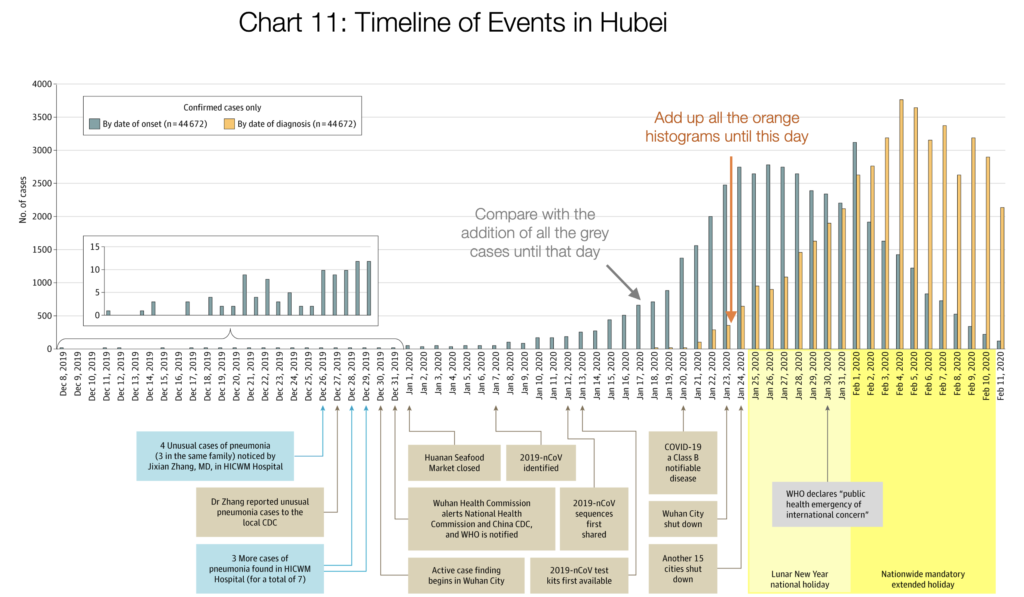
The grey bars show the true daily coronavirus cases. The Chinese CDC found these by asking patients during the diagnostic when their symptoms started.

Crucially, these true cases weren’t known at the time. We can only figure them out looking backwards: The authorities don’t know that somebody just started having symptoms. They know when somebody goes to the doctor and gets diagnosed.

What this means is that the orange bars show you what authorities knew, and the grey ones what was really happening.

On January 21st, the number of new diagnosed cases (orange) is exploding: there are around 100 new cases. In reality, there were 1,500 new cases that day, growing exponentially. But the authorities didn’t know that. What they knew was that suddenly there were 100 new cases of this new illness.

Two days later, authorities shut down Wuhan. At that point, the number of diagnosed daily new cases was ~400. Note that number: they made a decision to close the city with just 400 new cases in a day. In reality, there were 2,500 new cases that day, but they didn’t know that.

I wouldn’t be exaggerating when I say this article will be one of the most important pieces written about this episode, and will be referenced a decade later.

This article is what the widespread availability of the Internet has made possible.

Even twenty years ago, even in the early days of the indie Internet, there just wasn’t enough of an audience. And go back just a little bit in time and this wouldn’t even have been possible. The writer wouldn’t be able to get the data from around the world – certainly not this fast. He wouldn’t have been able to publish it. And he couldn’t have gotten the reach he did. Consequently, he would not have been able to have the impact he inevitable will. 

There’s been much written about democratisation of information because of the Internet. This is a prime example and it is not a small thing.

Categories
Uncategorized

The state of crypto


This blog post takes apart the current state of the crypto space:

Almost always it’s a last-ditched attempt to fleece retail punters out of millions of dollars, selling a utility token that will never be used for the utility outlined in the abundance of whitepapers that have been written. These utility tokens are also extremely volatile assets. Most will lose the majority of their value. There are now thousands of projects with thousands of different tokens, with surprisingly few focussed on building products people will actually use…

– Almost All Crypto Projects Are Complete Bullshit and Will Fail

It’s not a good look. But I have witnessed to much of what the writer says: I have seen the cooky business models. Projects petering out without even a try. The insane promises of coins ‘mooning’. The brigading on Telegram groups. The fawning and bickering on Twitter. News as PR. 

Two years ago in the midst of the initial coin offering craze, I did a talk (YouTube) about the right fit for decentralisation in a business or product. An attempt to bring some sense of rationality. Some of the presentations at that very event were clearly ideas that were taken seriously only because they had a ‘crypto token’ associated with it. They were not successful. That talk is as relevant now as then.

Categories
Uncategorized

Generalists or Renaissance Men

From this short blog post that made it to Hacker News:

And I do all those things pretty poorly, if you compare the result of each individual thing I might do with the outcome of a specialist.

But as a generalist I have an advantage over a specialist: I will never say “this is not something I do”.

On Being a Generalist

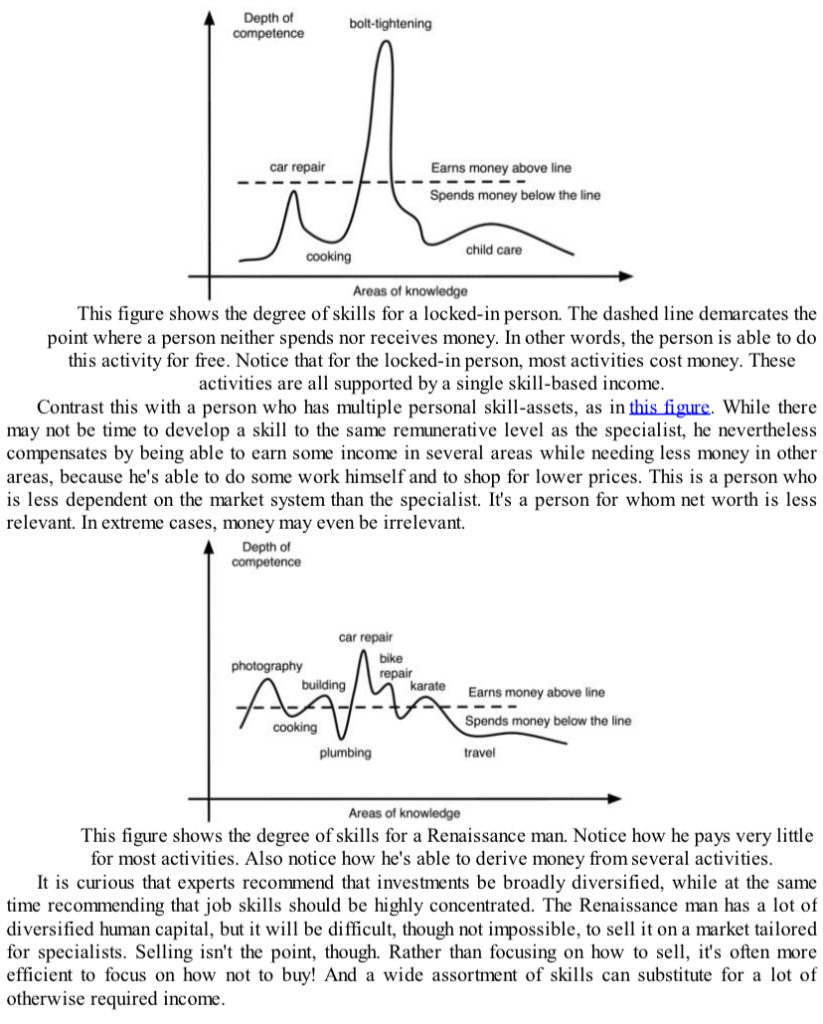
I’m reminded of Jacob Lund Fisker’s Early Retirement Extreme, which is destined to be a classic for the ages. It describes the Renaissance Man, who has adequate levels of competence across a wide range of everyday skills, and therefore needs to call upon a specialist only in rare, edge-of-probability-curve cases, even though he or she may not be the best in a particular specialisation. He describes it with these elegant charts

Categories
Uncategorized

Ad-blocking history

From AdGuard, a brief history of ad-blocking. In the article:

A little story to illustrate how powerful and influential a filter maintainer can be. In one of the countries there’s a filter list that’s clearly far more popular than any other local filter. And the maintainer of this filter list has a very peculiar way to deal with websites that show what this developer considers to be bad, shady or malicious ads. Instead of blocking such ads, the developer simply blocks the entire website. And then they send an email to the website owner with an ultimatum: “I blocked your website. You better take down these and these ads if you want to be unblocked”. 

Are ad blockers doomed or have we already won? A history lesson

Extortion for good.

I would love for this to be a whole series of articles, or a well-made documentary. I would pay well to read/see it.

Also: When on the go, I run a DNS sink based adblocker on the iPhone and iPad, which created a VPN for device-wide blocking. I explain this to people who ask me about the VPN icon in the status bar of my screenshots. To which some have commented that they actually like the ads they see, and wish there were more aggressive data collection for better personalisation. It is more than just the odd person who feels this.

Categories
Uncategorized

The hedge fund approach

The hedge fund billionaire D E Shaw has “applied his fund’s risk-averse, quantitative approach to nearly every aspect of his life”, including his children’s college admissions, deploying “a remarkably elaborate and expensive pattern of philanthropy to seven of the most renowned universities in the country.”

… the Shaw Family Endowment Fund donated $1 million annually to Harvard, Yale, Princeton, and Stanford and at least $500,000 each to Columbia and Brown. The pattern persisted through 2017, the most recent year for which public filings are available, with a bump in giving to Columbia to $1 million a year in 2016 and 2017. The foundation, which lists Kobliner as president and Shaw as treasurer and secretary, has also contributed $200,000 annually to the Massachusetts Institute of Technology since 2013.

… investing in multiple colleges is a classic asymmetric bet — one with minimal risk and massive potential upside.

The Wall Street Billionaire and the Ultimate College Hedge

The article as a whole is a look into Shaw’s family staff’s hiring and working, and worth a one-time read. 

Ps: both of Shaw’s college-going kids got into Yale, one of the colleges in the donations list. 

Categories
Uncategorized

American political campaigns move to the highest-priority inbox

On US political campaigns using text message spam to influence voters:

P2P texting has become much more integrated with other communications channels like direct mail and online promotions, increasing its reach and effectiveness. For instance, I recently responded to a Trump Facebook ad, then filled out a short survey at a Trump site. The next day, I got a text from the campaign asking for a donation. Even though I’m neither a Republican nor a Trump supporter, the campaign had my cell number and was able to match my online identity and/or my email address to it.

A campaign typically starts with a list of cellphone numbers taken from a voter file it leases from the party. The voter file contains voter-provided phone numbers, email addresses, and demographic information on everybody with a recent voting history. My cell number wasn’t likely in the GOP voter file, but the Trump campaign gets millions of additional phone numbers by purchasing them from commercial data vendors like Axciom or i360. Whatever their source, the cell numbers can be queued up and placed into text messages in the P2P texting app, along with some boilerplate text that the sender can customize with their own words. Then they just hit Send and move on to the next phone number.

Inside the 2020 campaign messaging war that’s pelting our phones with texts

Phone text messaging, unlike email, has had little to no innovation in terms of the user experience. Apple’s, Google’s and major phone manufacturers’ ‘SMS’ apps are rudimentary at best. There is zero spam protection. Android at least lets you change your default messaging, and there exist alternatives that support spam filtering and block lists. iOS doesn’t even let you do that. There is no spam filtering, and blocking only works for regular phone numbers – it doesn’t work at all for the most common spam: from SMS shortcodes. You can uninstall email On your phone but you can’t turn off SMS.

Categories
Uncategorized

Sophistication on a budget

From this short USA Today obituary on Trader Joe’s eponymous founder:

The stores were unique in other ways. His mother-in-law and father-in-law had been academics who enjoyed dining on fresh seafood and quality, yet affordable wines. Trader Joe’s would cater to those with similar, sophisticated tastes who were also on a budget… Trader Joe’s became known for a selective array of premium foods available at low prices. 

– Trader Joe’s founder Joe Coulombe, who started one of America’s favorite grocery stores, dies at 89

The book Class by Paul Fussell, which I finished (re)reading a few days ago, makes the point right up front that good taste has little to do with wealth, and while they may be correlated, they are definitely not causal.

The common misconception means quality is almost always sharply correlated with price, with good quality often out of the reach of most, regardless of what it acutally costs to produce and distribute.

This leaves a large market of exactly the sort Trader Joe’s – and Apple – have focused on.

Categories
Uncategorized

Information asymmetry

From A New York Times article about the data company Clearview:

… his daughter, Andrea, walked in. She was on a date with a man Mr. Catsimatidis didn’t recognize… Mr. Catsimatidis then uploaded the picture to a facial recognition app, Clearview AI, on his phone. The start-up behind the app has a database of billions of photos, scraped from sites such as Facebook, Twitter and LinkedIn. Within seconds, Mr. Catsimatidis was viewing a collection of photos of the mystery man, along with the web addresses where they appeared: His daughter’s date was a venture capitalist from San Francisco.

– Before Clearview Became a Police Tool, It Was a Secret Plaything of the Rich

In the Industrial Age, we had asymmetry of production as the divide between the haves and the haves-not. In the Financial Age, it was asymmetry of raw capital. In the Internet Age it’s going to be asymmetry of information. You can have little money, no physical assets. But you can punch way, way above your weight with access – legal or illegal – to the right data.

Categories
Uncategorized

The passport of the 21st century

In an interview with the cofounder of the encrypted email service ProtonMail:

…because what is email fundamentally? Email, I would argue is actually the most meaningful passport of the 21st century. In the 20th century, your identity was tied with your passport. That was who you were. That was how you verified to the world who you were. That was how you accessed all the services that the world could offer you. Today, everything’s moving online, and every online service that you sign up for is actually linked to your email. It’s your online passport, and the idea of using your corporate email account doesn’t actually work because that would be like say, your employer is your identity. It’s not true. So that’s why for that reason, you know, that’s not really an option for most people… so Gmail isn’t just, let’s say controlling your data. They’re also controlling your identity in some ways. And you don’t realize that when you set up for it. But that’s what is happening. And that’s why we feel it’s very important to have an independent identity.

This is true even if you don’t actually use email to communicate much. All your friends might be on Facebook or Instagram or Twitter or Reddit or even Facebook Messenger or iMessage or Slack – they are all tied to email-based identities.

PS: in countries like India, that passport is mostly your mobile number.