Categories
Uncategorized

Burnout as a workplace injury

This blog post about burnout contrasts how we deal with mental health versus physical health issues:

As far as I can tell, 100% of the google results for “burnout” or “recognizing burnout” boil down to victim-blaming; they’re all about you, and your symptoms, and how to recognize when you’re burning out… the burden of recovery is entirely on the person burning out.

If this was advice about a broken leg or anaphylaxis we’d see it for the trash it is, but because it’s about mental health somehow we don’t call it out… Bee stings are just part of life; maybe you should take the time to rethink your breathing strategy.

As the blog post further points out, even the American Medical Association identifies burnout as a structural problem and mitigating it requires structural solutions. Burnout is a problem with the workplace, not with the individual. In fact, in this article I have bookmarked in whole a long time ago,

It’s a common misconception that the culprit behind burnout is simply working too long or too hard… [a]t its core, burnout emerges when the demands of a job outstrip a person’s ability to cope with the stress. Over the past 20 years, Maslach and her collaborators have developed a comprehensive model identifying six key components of the workplace environment that contribute to burnout: workload, control, reward, community, fairness, and values. Burnout emerges when one or more of these six areas is chronically mismatched between an individual and his job. 

Ultimately, the writer of the original blog post says, we need to completely change the way we think about burnout.

If “mental health” is just “health” – and I guarantee it is – then burnout is an avoidable workplace injury, and I don’t believe in unavoidable mental-health injuries any more than I believe in unavoidable forklift accidents. 
Categories
Uncategorized

Flickering consciousness

Apparently, consciousness – as defined by deliberate focus – is somewhat fragmented:

The reason why we experience reality as a movie when it’s only a collection of pictures can be at least partially explained by our rhythms of attention. About four times every second, the brain stops taking snapshots of individual points of focus — like your friend on the corner in Times Square — and collects background information about the environment. Without you knowing it, the brain absorbs the sound of the crowd, the feeling of the freezing December air — which it later uses to stitch together a narrative of the complete Times Square Experience.

This reminded me of U G Krishnamurti’s philosophy of ‘natural state’ – although what he said is not exactly what the article above describes. He described himself as living (after a realisation he calls the ‘calamity’) in this manner:

“… he claimed to be functioning permanently in what he called “the natural state”: A state of spontaneous, purely physical, sensory existence, characterised by discontinuity – though not absence – of thought.”

It has always seemed to me that after that event in his life he became very aware about the constant lack of awareness, or wakefulness, in what we call human consciousness. Only very infrequently are humans aware that they are observing the world around them. Most of the time the brain is on auto-pilot, rapidly alternating between focus and distraction.

Categories
Uncategorized

Human conventions and edge cases

This article on Scientific American on how human conventions fall apart at edge cases, such as the meaninglessness of time zones and days/nights at the North Pole:

At the North Pole, 24 time zones collide at a single point, rendering them meaningless. It’s simultaneously all of Earth’s time zones and none of them. There are no boundaries of any kind in this abyss, in part because there is no land and no people. The sun rises and sets just once per year, so “time of day” is irrelevant as well.

They could see the smiling faces of their colleagues just feet away—but they were two time zones apart.

The ship operates like a windup toy, disconnected from the spinning of the planet, which normally dictates time. “Time” is just an operational ritual, intended to create the illusion of regularity.

As people push boundaries scientifically, physically, virtually, more conventions will fray, and more will need to be layered on top: at a point in history people created the concept of dividing their day into 24 hours. Atop that, time zones became necessary with the advent of railroads.

With space travel, we’ve reached the next level – the International Space Station typically orbits the earth 16 times a day, leading to sunrises and sunsets approximately every 45 minutes, so the layered convention is to anchor clocks to GMT. If and when people begin colonies on Mars or other planets, we’ll need even more layers to translate between two planetary day/time systems.

Categories
Uncategorized

Altruism as the native governance model of the internet

This story on NBC news about the fast-growing subreddit focused on news and information about the coronavirus pandemic.

Every day, Boggs and the other moderators work through a queue of thousands of comments and posts that have been flagged for review. They coordinate via the messaging platform Discord to ensure they aren’t duplicating work or to settle any disagreements. Some spend time developing tools to automate or improve their workflow, inviting high-profile scientists and doctors to participate in “Ask Me Anything” Q&A sessions and recruiting more moderators.

How Reddit’s coronavirus community became a destination

This is what moderators of most active communities do – not just this one, not even just Reddit. But this process when applied to this specific global event has created an incredible user-generated, user-moderate, user-friendly resource.

It’s like Wikipedia, but temporal – when this pandemic dies down, interest among contributors will die down too. The moderators will move on with their lives. In fact it’ll be the Wikipedia page for the pandemic that will be the longest-lived.

Some of the best things on the internet have been driven by altruism. Technology projects – Tor, Linux, Apache, GNU, Calibre, Blender, Mozilla Firefox, Pi-hole, WordPress. Knowledge projects like Wikipedia, Reddit and the ad blocking community. Standards like HTTP, TCP/IP, XMPP. They have either been ground-up communities from the beginning or contributions from large corporations. Projects run in this manner also tend to be long-lasting, sustainable.

And perhaps altruism is the governance model for the Internet [1]. The analog of democracy in the Real World. Just like in meatspace there exists a continuum of governance models across countries, so will there be different ways to run projects in bitworld. There will be variations – some very significant – even among altruism-governed projects. Wikipedia is end-to-end community-driven and supported by donations. Reddit is owned by Conde Nast and is ad-supported.

The model itself doesn’t make a project good or bad. But altruism projects are more natural to the internet, more at home in it, are a better fit for it, and eventually will be stronger and longer-lived than their other counterparts.

[1] However much these are driven by a shared sense of community, it isn’t communism.

Categories
Uncategorized

Conscious news consumption

The internet and smartphones have meant that there’s a lot more demand for what is a finite amount of attention. For news, which monetises attention, this in turn means a race to capture as much of it as possible. The most obvious symptom of that is clickbait online, but more broadly, topics that shock and outrage receive coverage disproportionate to their impact on society.

At some point – we are probably past it – this behaviour becomes self-fulfilling, and personalities that are the most skilled at shocking and causing outrage end up being the ones most imbued with power.

By this time, 2020, mainstream publications across print, TV and the internet have for years prioritised the wrong topics. One straightforward way to restore balance is to consciously pick one’s sources of information and news. To start with, think independently about the issues that one think matter now and in the future.

Over the next few months I’m going to recalibrate my news sources to focus on more such issues. My list so far is

  • Health and medicine research
  • Physical health/wellness
  • Mental health
  • Public health and diseases
  • Personal finance
  • Education
  • Lifestyle design
  • Environment and climate
  • Privacy and data ownership
  • Edge tech
    • Brain machine interface
    • AI
    • Quantum
    • Renewable energy
    • EVs
    • Life extension
    • CRISPR
    • Drones and remote tech
    • Decentralised ledgers

My guess is that preventing one’s attention from being dominated by short-term topics, events and personalities that are inevitably conflict-oriented, instead driving it towards those that are forward looking and constructive will improve one’s general mood, optimism and mental health as well.

Categories
Uncategorized

Headache log

In March 2019, I was prescribed a 6-month course of pills for a migraine problem that had begun to significantly affect the quality of my life. For the previous 6 months, I had had a migraine 9 days out of every two weeks. 5 of them were severe enough to warrant winding up a working day, driving home and somehow sleeping it off – essentially, half of my working days. I had gone through an identical, though shorter regimen in 2012.

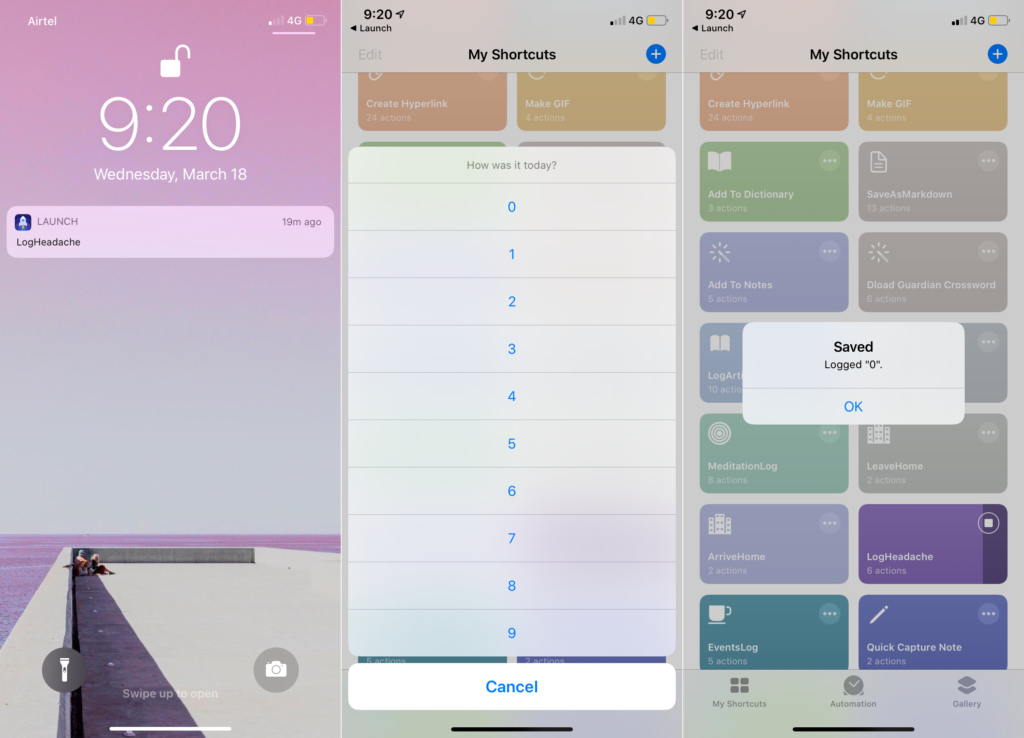
This time I wanted to see how fast the course would act and how long-lasting its effect would be. So I created an exceedingly simple iOS Shortcut that took input from me on my pain level on a scale of 1 to 10 and log it to a pipe-separated plaintext file in iCloud Drive. I automated that with Launch Center Pro (before iOS 13 introduced Shortcuts automation) to notify me at 9pm each night. This is tonight:

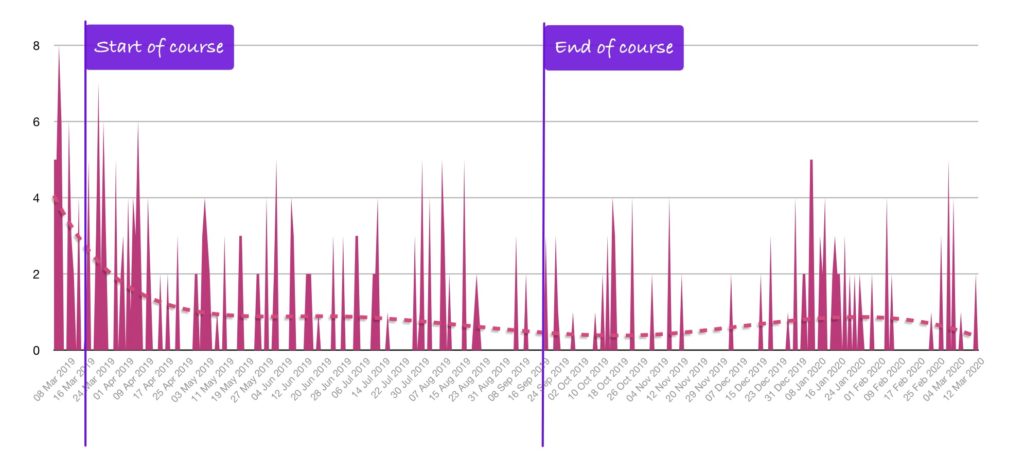
It’s been a little over a year since I began tracking data. Unfortunately, there isn’t a lot of baseline data because I began tracking pain levels just a week or so before starting the pills. But here it is, visualised:

Data begins 8th March 2019. I began the regimen on 14th March 2019. I ended it in mid-September, although I don’t remember the exact date.

You can see how both the intensity and frequency reduces significantly in the first month itself, and then settles down to a much less severe level. January 2020 was a weird, bad month but it didn’t hold a candle to the January a year ago. I can live with this level of chronic pain pretty easily.

The regimen was simple – two pills a day tapering down to one a day. The Shortcut and scheduling is trivial. The data is also unidimensional – doesn’t capture potential migraine triggers – food, light, sound, stress. But the data exists. Is in an open format. And can be charted. And that by itself gave me a sense of control during and after the course.

I plan to continue charting the data and make it richer by capturing more contextual data – triggers being the first. Maybe we’ll revisit this post a year, three years later. And maybe this long-term data set will be useful for treating the next bout of severe migraines even better.

Categories
Uncategorized

Managing energy, managing time – plus “How I Work”

In a remarkable 2006 feature that I have gone back to again and again over the years, the then-CEO of Proctor and Gamble talked about How I Work. I have quoted nearly the entirety of what he says:

I’ve learned how to manage my energy. I used to just focus on managing my time. I’d be up in the morning between 5 and 5:30. I’d work out and be at my desk by 6:30 or 7, drive hard until about 7 P.M., then go home, take a break with my wife, Margaret, and be back at it later that evening. I was just grinding through the day.

During my first year in this job, I worked every Saturday and every Sunday morning. Now I work really hard for an hour or an hour and a half. Then I take a break. I walk around and chit-chat with people. It can take five or 15 minutes to recharge. It’s kind of like the interval training that an athlete does.

I learned this in a program called the Corporate Athlete that we put on for P&G managers. I did the two-day program, where I also learned to change the way I eat. I used to eat virtually nothing for breakfast. Now I have a V-8 juice, half a bagel, and a cup of yogurt. And I eat five or six times a day. It’s about managing your glycemic level. You don’t want to boom and bust.

The other piece of the Corporate Athlete program is spiritual — things you can do to calm the mind. I’ve tried to teach myself to meditate. When I travel, which is 60 percent of the time, I find that meditating for five, ten, or 15 minutes in a hotel room at night can be as good as a workout. Generally, I think I know myself so much better than I used to. And that has helped me stay calm and cool under fire.

A key to staying calm is minimizing the information onslaught. I can’t remember the last time I wrote a memo. I write little handwritten notes on my AGL paper, and I send notes, a paragraph or less, on my BlackBerry. I prefer conversations. That’s one reason my office and our entire executive floor is open. The CEO office is not typically a warm and welcoming place, but people feel they can come in and talk in mine. We have goofy-looking pink and chartreuse chairs with chrome frames and upholstered backs and seats.

The full series is here. It features Marissa Mayer, then at Google, Carlos Ghosn, then yet to have his reputation ruined, Bill Gross, then yet to be forced out of Pimco, John McCain, then yet far away from running for President and Hank Paulson, then at Goldman Sachs, shortly before becoming Secretary of the Treasury and subsequently having to deal with the financial crisis.

Bonus: the next month, Fortune published a more detailed How I Work with Bill Gates, then no longer Microsoft’s CEO but still its chairman. We will almost certainly examine it in more detail in a future post some time.

Categories
Uncategorized

Write

“The most we can do is to write – intelligently, creatively, critically, evocatively – about what it is like living in the world at this time.”

Oliver Sacks, 2015
Categories
Uncategorized

On the tricky matter of the soul

This short essay on Aeon magazine:

In using the term ‘soul’… we don’t have to think of ourselves as ghostly immaterial substances. We can think of ‘soul’ as referring, instead, to a set of attributes ­­– of cognition, feeling and reflective awareness – that might depend on the biological processes that underpin them, and yet enable us to enter a world of meaning and value that transcends our biological nature…

… if we were content to structure our lives wholly within a fixed and unquestioned set of parameters, we would cease to be truly human. There is something within us that is always reaching forward, that refuses to rest content with the utilitarian routines of our daily existence, and yearns for something not yet achieved that will bring healing and completion…

… we yearn to rise above the waste and futility that can so easily drag us down and, in the transformative human experiences and practices we call ‘spiritual’, we glimpse something of transcendent value and importance that draws us forward. In responding to this call, we aim to realise our true selves, the selves we were meant to be. This is what the search for the soul amounts to

Categories
Uncategorized

The brain’s “Rinse Cycle” observed

This article on the website of the US National Institute of Health:

… [sleep] triggers rhythmic waves of blood and cerebrospinal fluid (CSF) that appear to function much like a washing machine’s rinse cycle, which may help to clear the brain of toxic waste on a regular basis.

In an fMRI machine, 

First, you see a wave of blood flow (red, yellow) that’s closely tied to an underlying slow-wave of electrical activity (not visible). As the blood recedes, CSF (blue) increases and then drops back again. Then, the cycle—lasting about 20 seconds—starts over again.

Fascinating that such a mechanical cycle exists. And that we can actually see it.

This brings me back to a fantastic longform National Geographic article in Aug 2018 about sleep, which had alluded to evidence about the same mechanism. 

Also: “Why We Sleep” by Matthew Walker, one of the books I read last year.