Categories
Uncategorized

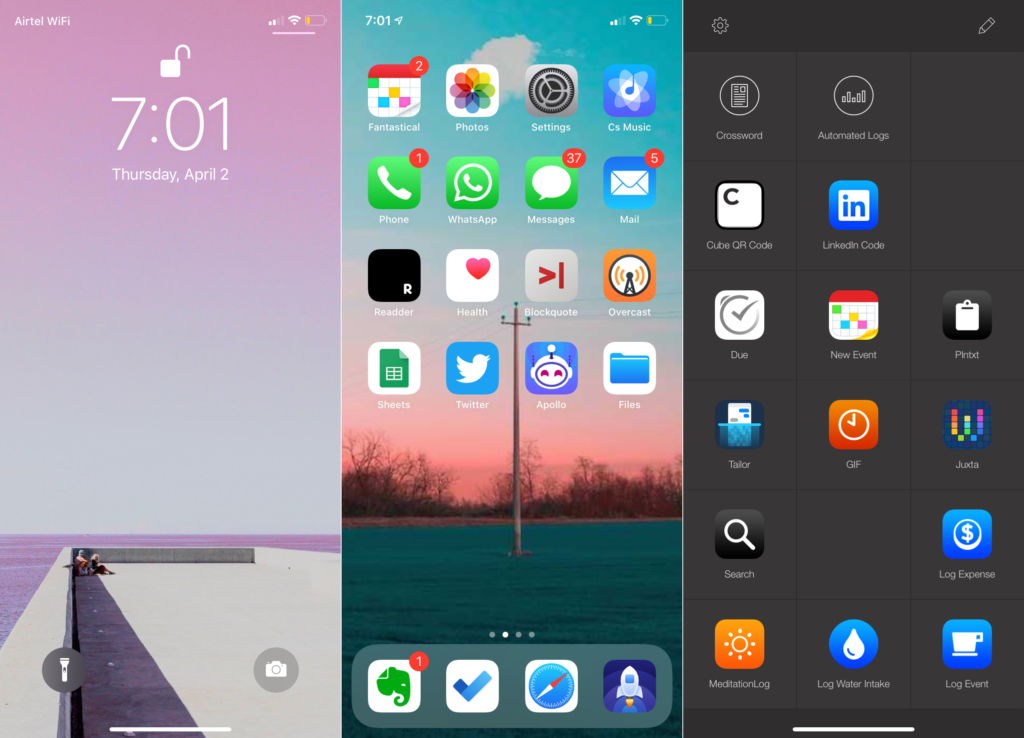
iPhone home screen, April 2020

CS Music: formerly Cesium: iOS’s music app used to be really good. No more. Hence.

Overcast: iOS’ podcasts app used to be the best. Again, no more

Readder: Main, fun Reddit account

Apollo: Account with fewer, more focused subscriptions

Blockquote: plaintext editor with great iCloud Drive support

Files: files app with great iCloud Drive support

Sheets: personal and work spreadsheets. Many populated by IFTTT recipes

Health: tracking water intake (populated by an iOS Shortcut), meditation (“Mindful Minutes”, also populated by Shortcut), heart rate (populated by Soul Solver via a Fitbit).

Evernote: research material for projects

Microsoft Todo: main todo app. Does lists better than iOS Reminders

Launch Centre Pro: Launches apps and Shortcuts manually but based on time and geofencing. I use it multiple times every day and almost feels part of the OS.

Categories
Uncategorized

Questions about the open Internet

Cloudflare has an interesting microsite that emphasizes how the open nature of the Internet has made it the global connective layer we are plugged into during this period of global isolation. Worth a read. 

The stage was set for an always-on, always-connected future. A demanding world where every user would choose how they use the network. And the network was almost ready. In the meantime, home and office computer users were forced to dial into private services like AOL, Prodigy and CompuServe. These closed worlds contrasted sharply with the open Internet growing quietly in the background.

The Internet we know today was dreamt in the 1960s, debugged in the 1970s and built in the 1980s. Thirty years of work to create a reliable, flexible, inexpensive, global network.

As 1990 dawned it was ready for all of us. Thirty more years later, in 2020, it binds us together.

In the next few years, during the next global crisis, we will debate issues like net neutrality, like data ownership, like censorship, because there will be issues of not just the economy but also of life and death riding on policy around these issues. 

Case in point: during the 2018 California fires, Verizon famously throttled the fire departments’ speeds because they were out of data. There is an argument that they should have been compelled to provide the best possible bandwidth to an emergency service, against the principles of neutrality. 

Similarly, you could make the case that bandwidth on Zoom (or Skype or other video collaboration services) be reserved first for governments, medical and healthcare personnnel, other essential services and then other (possibly paying) businesses. Again, against the principles of neutrality.

Censorship examples are easier to find and make. The last twenty years was using terrorism as the bogeyman, the next couple of years will likely be using that of a public health crisis. India has a problem of misinformation spread by people over Whatsapp. During the current global pandemic, it’s easy to spread panic via rumors and easy to risk health by touting suprious cures. There is a case to be made for censoring content on these private messaging platforms. 

We don’t have the answers, but we will need to confront these questions in the years right ahead.

Categories
Uncategorized

E-commerce fulfilment as infrastructure

This important article in the Indian publication Medianama on the pandemic bringing to the fore the importance of the Internet, and how it should be treated on par with other infrastructure, like say electricity.

It recognises that Internet service and e-commerce have been listed as essential services for the national lockdown, and in fact uses this to argue that this should be formalised in “broader legal and institutional frameworks”

It talks about delivery of government services:

The present situation also threatens to exacerbate India’s ‘digital divide’, denying access to public goods to those without internet access. The delivery of government services, in particular, is increasingly dependent on internet connectivity at the household level. The Aadhaar project relies to a large extent on internet connectivity at the Point-of-Sale level, which routinely fails. 

And the hardships faced by healthcare workers in Kashmir during the restriction of Internet access in the area.

The article also refers to e-commerce delivery workers. This is what interests me the most. Against all odds, a massive country with a messy transportation system, a severe lack of urban planning and universal addressing, and a sharp urban-rural divide has built a nation-wide delivery network via its e-commerce firms and their fulfilment partners.

If viewed and operated as infrastructure, even if owned and managed privately, this network can be used to deliver all manner of essential goods accurately, and even collect payment. It can even be used to transport personnel, say medical personnel, especially for the last mile. And not just during a pandemic or similar state of national emergency. India could rethink healthcare, education and financial inclusion with such an infrastructure. India Post Bank and Paytm Payments Bank already tech and a widespread delivery network to offer their banking and investment services across the country. But it could make entirely new things possible – such as a medical trial, which involves delivery and collection with rigorous tracking, at scale for specific categories of people, say ethnicities.

Never letting a crisis go waste is a cliche, but re-framing some assets as infrastructure could truly make this happen.

Categories
Uncategorized

Language and the perception of time

First up, how we speak about it.

Because time is so abstract, the only way to talk about it is by using the terminology from another, more concrete domain of experience, namely that of space. For example, in Swedish, the word for future is framtid which literally means “front time”. Visualising the future as in front of us (and the past as behind us) is also very common in English. We look forward to the good times ahead and to leaving the past behind us.

Languages around the world have different spatial terms:

But for speakers of Aymara (spoken in Peru), looking ahead means looking at the past. The word for future (qhipuru) means “behind time” – so the spatial axis is reversed: the future is behind, the past is ahead. The logic in Aymara appears to be this: we can’t look into the future just like we can’t see behind us. The past is already known to us, we can see it just like anything else that appears in our field of vision, in front of us.

Mandarin Chinese employs a vertical time axis alongside a horizontal one. The word xià (down) is used to talk about future events, so when referring to “next week” a Mandarin Chinese speaker would literally say “down week”. The word shàng (up) is used to talk about the past – so “last week” becomes “up one week”. This affects the way observers perceive the spatial unfolding of the ageing process.

…they alter the way the same individual experiences the passage of time depending on the language context they are operating in. For example, Swedish and English speakers prefer to mark the duration of events by referring to physical distances – a short break, a long party. But Greek and Spanish speakers tend to mark time by referring to physical quantities – a small break, a big party. Speakers of English and Swedish see time as a horizontal line, as distance travelled. But Spanish and Greek speakers see it as quantity, as volume taking up space.

What’s interesting is when people can speak two languages that use different ways of referring to time.

But Spanish-Swedish bilinguals are flexible. When prompted with the Swedish word for duration (tid), they estimated time using line length. They were unaffected by container volume. When prompted with the Spanish word for duration (duración), they estimated time based on container volume. They were unaffected by line length. It seems that by learning a new language, you suddenly become attuned to perceptual dimensions that you weren’t aware of before.

The Indian languages I can speak all use volume to indicate time. For instance you’d say “bahut waqt” in Hindustani which transliterates to “a lot of time” unlike the English “a long time”. I learnt both languages around the same time. Perhaps as a result of this, having thought about it, I don’t have a visual perception of time, either linear or volumetric. But I have realised I’d prefer the term “a lot of time” when speaking in English to “a long time”.

Also interestingly, the words for tomorrow and yesterday in Hindustani are the same: “kal”. In Gujarati the word is also the same but always qualified: “gai kale” for yesterday and “āvati kale” for tomorrow, transliterates to ‘previous day’ and ‘next day’.

Categories
Uncategorized

The genius of ‘Asterix’s translators

The magnificent illustrator of the Asterix books, Uderzo of ‘Goscinny and Uderzo’ died this week. You could enjoy several reads to spot every detail and mischief in the artwork.

The text was art in its own right with outrageous puns, irony and satire. Once I learnt as a child that the original had been in French I marvelled at how natural and clever the English seemed to be. It turns out the translators were every bit as gifted as Goscinny.

This blog post describes three examples in detail. It’s impossible to quote extracts: it is a delightful, delightful read.

Categories
Uncategorized

Chandrayaan 2 cameras

ISRO’s Chandrayaan 2 moon orbiter is taking the highest-resolution photos yet of the moon’s surface:

Chandrayaan 2 orbiter has an optical camera called the Orbiter High-Resolution Camera (OHRC) that captures detailed images of the moon. OHRC can image at a best resolution of 0.25 meters/pixel, beating NASA Lunar Reconnaissance Orbiter’s (LRO) best of 0.5 meters/pixel.

Back in October, we already saw OHRC flex its muscles by sending images including clearly visible boulders less than 1 meter in size. And now OHRC has demonstrated imaging an area not directly illuminated by sunlight. It captured an image of a crater floor in shadow by seeing the dim light falling on it that has been reflected from the crater rim.

Moving ahead, this capability will be used to image insides of craters on the lunar poles, where sunlight never reaches. Mapping the terrain of polar craters is important because future lunar habitats are believed to be stationed near them, transporting water and other resources from inside them.

In addition to the high-resolution camera,

The Terrain Mapping Camera (TMC 2) onboard Chandrayaan 2 is a stereo imager, meaning it can capture 3-D images. It does that by imaging the same site from three different angles, akin to NASA’s LRO, from which a 3-D image is constructed.

And it’s already yielding results

Chandrayaan 2’s orbiter is in the process of adequately quantifying just how much water ice is trapped beneath the permanently dark crater floors on the moon’s poles. Current estimates based on past observations suggest that the moon’s poles host more than 600 billion kg of water ice, equivalent to at least 240,000 Olympic-sized swimming pools.

Categories
Uncategorized

PARA

The productivity consultant Tiago Forte has a method of organising digital information that I have used for a while personally and find very useful. It’s described in great detail on this page on his firm’s website, built his interview to Evernote describes it succinctly:

I have this method I’ve developed called PARA, which stands for projects, areas, resources, and archives… PARA is 4 categories, and that’s kind of the starting point. You divide your work into projects, which I’m using here the GTD definition, a series of tasks linked to an outcome.

Areas of responsibility: Some standard or area of your life that’s an ongoing concern; that you want to maintain on an ongoing basis.

Resources: Basically, interests or topics. Things like website design. For me, it’s not a particular project — not even really an area because that’s not my work — but it’s something I’m interested in that I’d like to keep track of.

And then Archives, which is anything from the previous three categories that’s no longer active, because you want to avoid clogging up your actionable categories. As soon as something is not top of mind, not front and center, you want to move it to the archives, but still keep it in case you want to go and find something there.

– Tiago Forte’s Approach to Productivity

It’s practically, and as he describes, is a framework replicable across your toolset: your task manager (say Microsoft Todo), your notes capture system (say Apple Notes) and your research + organisation system (say Evernote).

Categories
Uncategorized

3D printing intellectual property

This article about an ordinary citizen with a 3D printer:

Christian Fracassi came to the aid of an overwhelmed Brescia hospital that ran out of breathing tubes for an intensive care machine on Saturday.  Doctors raised the alarm after their regular supplier said they could not produce the valves on time – forcing them to come up with an alternative solution… word soon reached Fracassi, a pharmaceutical company boss in possession of the coveted [3D printer] machine. He immediately brought his device to the hospital and, in just a few hours, redesigned and then produced the missing piece.

In an ideal world, this would be a story about humanity and humankind’s wonderful technological advances. But it is also a story about another uniquely human quality:

… even though the original manufacturer was unable to supply the part, it refused to share the relevant 3D file with Fracassi to help him print the valve. It even went so far as to threaten him for patent infringement if he tried to do so on his own. Since lives were at stake, he went ahead anyway, creating the 3D file from scratch… Fracassi doesn’t dare share his 3D file with other hospitals, despite their desperate need for these valves

… the official list price for a single valve is 10,000 euros — about $11,000. This is a perfect example of how granting an intellectual monopoly in the form of a patent allows almost arbitrarily high prices to be charged, and quite legally. 

This reminds me so much of E O Wilson’s quote that “the real problem of humanity is the following: we have paleolithic emotions; medieval institutions; and god-like technology.”

This is also a reminder that we’ve yet to find a balance between rewarding deep research and making the fruits of research available widely and affordably.

Categories
Uncategorized

My giant goes with me wherever I go

“Traveling is a fool’s paradise. Our first journeys discover to us the indifference of places. At home I dream that at Naples, at Rome, I can be intoxicated with beauty, and lose my sadness. I pack my trunk, embrace my friends, embark on the sea, and at last wake up in Naples, and there beside me is the stern fact, the sad self, unrelenting, identical, that I fled from. I seek the Vatican, and the palaces. I affect to be intoxicated with sights and suggestions, but I am not intoxicated. My giant goes with me wherever I go.”

– Ralph Waldo Emerson, Self-Reliance
Categories
Uncategorized

Building slack into the economy

The ongoing pandemic has brought to the fore discussions in the US around universal basic income. As more economies are being put into suspended animation by governments putting entire countries or regions into lockdown, it’s becoming clear that people need some sort of sustenance during their temporary retrenchment to help with their dues and expenses.

In India, this week has seen an exodus of migrants from cities back to their home towns and villages because daily wage jobs have been put on hold as cities lock down. The second-order consequences are serious: while people have moved back to avoid rent and high expenses in cities (than in their home towns), the move puts pressure on resources in these towns, both economic and social. Even once this crisis abates, there will be disruption – not all these migrants will be able to return to the same jobs and the same living quarters as before.

There is a strong case now to build slack into the system in the form of basic income.

The modern economy operates at criticality. For nearly two hundred years now we’ve benefitted – mostly – from lower prices, faster availability, increased quality and greater variety by ekeing out efficiencies in the economy. For example fewer companies pay out dividends now because the wisdom is to re-invest surplus capital in growth or just buy back stock than pay that capital out.

As long as the infrastructure, the underlying conditions are stable, this works. But like with any well designed critical system, there have to be redundancies built in, and perhaps part of that is having a country pay out a dividend to its citizens in addition to investing in (GDP) growth.