
Categories
Uncategorized

21st Century Media part 5 – Supporting it; conclusion

The entity will be reader-funded, whether via pay-per-news or subscriptions. The questions are: Will people pay? And Will it be easy?

A large customer-funded information business outside of the financial news domain has not yet been built. Even within finance, the Financial Times only makes 55% of its revenue from subscriptions and news-stand sales and is therefore still an ad-supported company. There are a few independent paid news sites: The Information is the best-known but extremely niche. Paid email newsletters have been around for years – Substack is the most recent one getting traction – but they are far from mass adoption. This means 21st Century Media will be a pioneer. 

I am confident that people across income and interest segments will pay for something truly useful: ten years ago, I led the team that created a paid ‘iTunes store for SMS subscriptions’ under the MyToday brand, that included a variety of news, entertainment and sports ‘channels’ delivered via SMS. MyToday was the first application of a ‘digital services operator’ that the internet entrepreneur Rajesh Jain had conceived of. In an age before smartphones, cheap data and reliable payment gateways, we created a combination of online and offline payment methods for subscriptions priced aslow as INR 10 a month (then ~USD 0.2). The most motivated of our customers made sure their money reached us. Along with online payments we even received money orders, even cash, sent via post to our Bombay office. Scaling this was a problem and the board eventually shut it down, but there are many lessons to learn in 2020.

So intent is not an issue. In addition today, things have changed. Micropayments are now possible, at least in India and many other mobile-first societies with prepaid digital wallets and payment systems like UPI. In the West, with its credit-card-heavy systems, pay-per-view is a challenge and perhaps 21st Century Media will offer only subscriptions. 

In the intermediate future, transaction costs for small-ticket-size cryptocurrency transfers will become possible. The Brave project with its combination of ad-blocking browser and payments token BAT is an early example of what could be. With payments in cryptocurrency, customer payments are natively written to a (public) blockchain. 

We end as we began.

We live in an era of abundance of information and a glut of means to consume it. We also live in an era of great economic, political, environmental and social change brought on by technology, creating issues that are hard to understand but important to deal with. There have never been more demands made of our attention. In this era, news is critically important to provide data, help us convert it to information and add to our knowledge and judgement so we can not just respond to change but also thrive. 

We have seen how the ecosystem of news in its current form cannot live up to these challenges – its interests are simply not aligned with its readers and viewers. Therefore, transforming news is not a matter of people or money or technology – it is one of new incentives and new systems. We need an entirely different news entity, born in technology and supported by its readers. This series has given us an idea of what 21st Century Media can and should look like.

(ends)
Categories
Uncategorized

21st Century Media part 4 – what it looks like

21st Century Media is an entity that bears fiduciary responsibility for our attention and that is directly supported by readers. At success, its scale will be akin to existing media empires, but it will truly be a reader-fed, reader-supported, reader-consumed resource.

However the media is delivered – whether as TV-like video streams or a web-page-oriented site – it will be organised by issues, not by event. Each issue will have a history and will be updated as events occur, setting those events in context – context and perspective being what today’s news lacks.

It will not be neutral, and it will also not be ‘both-sides‘. Both sides implies that there are only two interpretations of an issue, internally homogenous, framed either as for or against, an adversarial view of everything that has catalysed the polarised world we live in. Reality is messy. It is a continuum of positions with pros and cons, and 21st Century Media will highlight and present that.

It need not start with producing original writing.  Great content is already being written. Text, video, even audio via podcasts. But search engines and other discovery and editorial mechanisms are not incentivised to surface this. 21st Century Media will aggregate and present the best writing and conversations from across the Internet.

The algorithms for surfacing the ‘right’ content are dependent on first defining what this content is, and for that we need humans to train them, like the human curators in Neal Stephenson’s science-tech-fiction book Fall. 21st Century Media needs to get a head-start over the sort of polluted internet Stephenson imagines

“[A] Few people were rich enough to literally employ a person whose sole job was to filter incoming and outgoing information.”_

“Direct, unfiltered exposure to said flumes—the torrent of porn, propaganda, and death threats, 99.9 percent of which were algorithmically generated and never actually seen by human eyes—was relegated to a combination of AIs and Third World eyeball farms, which was to say huge warehouses in hot places where people sat on benches or milled around gazing at stuff that the AIs had been unable to classify. They were the informational equivalent of the wretches who clambered around mountainous garbage dumps in Delhi or Manila looking for rags. Anything that made it past them—any rag that they pulled out of the garbage pile—began working its way up the editorial hierarchy and, in rare cases, actually got looked at by the kinds of editors—or more likely their junior associates — who worked for people like Sophia. Consequently, Sophia almost never had to look at outright garbage.”

Human editor aggregation and filtering will be augmented with reader submissions. Readers – more a community – will be rewarded for these submissions. The rewards resemble Bitcoin’s Proof of Work, except that the work is not computing power but their judgement. Specifically they will be a share of profits from micropayments for that content. 

Perverse incentives to submit clickbait content do not exist because everything goes through a filter: first human, then eventually human + algo. The 1% rule of the Internet makes this very likely to be financially viable: “…in a collaborative website such as a wiki, 90% of the participants of a community only consume content, 9% of the participants change or update content, and 1% of the participants add content.” – there are nearly two orders of magnitude more people paying than being paid. In fact, this will be done at a scale that approaches Wikipedia more than any news organization.

21st Century Media will nail trust by placing reader recommendations, publishing, edits and subscription payments on a public blockchain. The smart contract and its integration with whatever CMS is used will be publicly auditable. While recommendations and payments will be pseudonymous, publishing and edits will be identifiable. This will be critically important when the team and the reader base scales.

All this brings us, finally, to supporting and sustaining 21st Century Media (part 5).

Categories
Uncategorized

21st Century Media part 3 – Rewarding entertainment, not information

When the incentives of the news ecosystem participants are to hoard your attention, they distort news itself. Here’s how:

There is disproportionate attention to politics, not policy making – see the front page of any physical or online newspaper. In general, there is not enough focus on the stuff that really matters. This directly affects what people think is important: as Steven Pinker argues in the Guardian (yes, itself a newspaper):

The nature of news is likely to distort people’s view of the world because of a mental bug that the psychologists Amos Tversky and Daniel Kahneman called the Availability heuristic: people estimate the probability of an event or the frequency of a kind of thing by the ease with which instances come to mind…

Plane crashes always make the news, but car crashes, which kill far more people, almost never do. Not surprisingly, many people have a fear of flying, but almost no one has a fear of driving. People rank tornadoes (which kill about 50 Americans a year) as a more common cause of death than asthma (which kills more than 4,000 Americans a year), presumably because tornadoes make for better television…

Similarly, there is disproportionate coverage of what’s wrong and less on what’s being done to fix it – this is required to produce the sort of adversarial content that keeps readers and viewers hooked. Again, Pinker:

Consumers of negative news, not surprisingly, become glum: a recent literature review cited “misperception of risk, anxiety, lower mood levels, learned helplessness, contempt and hostility towards others, desensitization, and in some cases, … complete avoidance of the news.” And they become fatalistic, saying things like “Why should I vote? It’s not gonna help,” or “I could donate money, but there’s just gonna be another kid who’s starving next week.”

News is also driven entirely by events (witness the continuous ‘Breaking News’ on TV and large-font headlines on websites). There is little issue-based coverage. As Rob Wijnberg of the slow-news site Unbreaking News argues, this prevents us from understanding true causality because we no longer view our world actively as a set of systems, merely as as passive objects of a set of events that ‘happen’ to us.

… news also makes us blind to the influential that is not exceptional at all. That’s why we often don’t hear about major developments until something highly improbable happens (events the Lebanese-American philosopher Nassim Taleb dubbed “black swans”).

The 2008 financial crisis, for example, didn’t become huge news until the Lehman Brothers investment bank filed for bankruptcy — a highly unusual event. But the lead up to this event — banks that kept piling risk on top of risk, little by little, day by day — never made it to the front page because of the fundamental mismatch between what was happening (gradual risk increase) and the way news commonly signals what is happening (event-driven sensationalism).

Therefore, in the relentless rolling news-cycle, context is lost:

Almost everything that’s news must be something that has just now taken place. But the most recent thing isn’t by definition the most influential one. Everything in the world has a history. And that history determines in large part why something happens. Because the news usually keeps its eye trained on today, it blinds us to the longer term, both past and future.

As entertainment, news is now delivered to us in premasticated,easy-to-digest chunks, no thinking or reasoning required. Matt Taibbi, in his letter to his audience about going independent, cites this as one of things wrong with journalism:

…journalists in the Trump era are trained to narrativize everything, with the consequence that we’ve drifted away from complex issues and toward saleable, simplistic, sports-like controversies. Heading into the Covid-19 disaster, we argued about Bernie Bros, Lev Parnas, Russian Facebook ads, and a host of other things that don’t seem all that important now… The media business as constructed is expert at mass-generating binary streams of hot takes and talking points, and selling ads to a public engaged by them.

Starved of critical reasoning, readers and viewers of news act how Taibbi described in his book Insane Clown President:

“Trained for decades to be little more than good consumers, we had become a nation of reality shoppers, mixing and matching news items to fit our own self-created identities. We rejoiced in the idea that reality was not an absolute but a choice, something we select to fit our own conception not of the world but of ourselves”

All of these – negative, politics-centric, event-driven, context-less hot-takes – reward bad actors. As we have written previously,

The most obvious symptom of that is clickbait online, but more broadly, topics that shock and outrage receive coverage disproportionate to their impact on society.

At some point – we are probably past it – this behaviour becomes self-fulfilling, and personalities that are the most skilled at shocking and causing outrage end up being the ones most imbued with power.

To state the obvious, the epitome of this is the presidency of Donald Trump and how it utterly dominates coverage online and the TV and serves his ends. This has a profound effect on society (Rob Wijnberg)

…our news addiction — is to make us afraid of other people, skeptical of the future, and cynical about our own ability to affect it. Day in, day out, the news confirms our most stubborn prejudices and our greatest fears. It makes us pessimistic and suspicious. It even makes us unhappy.

and is harmful to democracy itself (Pinker)

…they become fatalistic, saying things like “Why should I vote? It’s not gonna help,” or “I could donate money, but there’s just gonna be another kid who’s starving next week.”

An important note: we are not even focused in this series on the impact of the large-scale or pirate ownership of most news media and the influence of advertising on editorial, although these are equally important problems. This article from the non-profit American media watchdog FAIR is a good summary of the matter.

It’s abundantly clear how broken the existing news ecosystem is. It’s time to visualise what an alternative one could look like in the 21st Century (part 4).

Categories
Uncategorized

21st Century Media part 2 – Attention and its discontents

Our attention is finite – fundamentally, it’s a function of time. In an age of abundance of data, attention is capital. The most successful companies of our time look to accumulate and grow as much of it as possible: Google’s search and many other services, Facebook (with Instagram), Twitter, Spotify and of course TV news channels. Their business model is to resell our attention at a price to entities we have little to no control over.

These vast entities, most publicly listed companies, are Attention Merchants: we hand our attention daily to these entities. They aggregate and lend it out to advertisers for a price. We collect a fraction of the returns. Not as cash but as the product that is built with the cash. 

The problem is that it’s a closed loop – the product itself collects more attention and data. It’s pretty clear then that the primary incentive is not to make the product more useful for us but to capture every little bit of marginal attention. For example, Twitter’s Q4 FY19 investor fact sheet depicts people who use its service as faceless heads labelled ‘monetizable DAUs’, the primary company metric. This is not to single out Twitter – examine any quarterly result of any of these companies. The market rewards every quarterly increase in attention and its monetisation.

When that product has to do with information, with news, as nearly all of these do, the impact of this misalignment of interests is very real. 

For instance, rather than algorithms highlighting a finite number of tweets (or Facebook or Instagram posts…) that are relevant to me, all social media is now designed as an infinite river or stream of posts with an easy ‘pull to refresh’ (its inventor has regretted how addictive it has become). The algorithm may sort by both recency and relevance, but it is always infinite – the objective being to keep you on the site/app as long as possible. Other news and other content sites achieve this with ‘you may also be interested in’ widgets or outright loading other news stories as you approach the end of an article, again simulating a river. This means more consumption, less thinking.

The second-order consequence of this is the way online content is written. We have written about what happens when the audience for online writing is an algorithm instead of a human being:

This comment on Hacker News

I would add new ways of searching in Internet. If I searched for food recipes in the 2000s I would find independent blogs with some real local/family taste. Now I have a hundreds of results from click bait sites with the same commoditized recipes and the ugly blog with a good recipe deep in the long tail. We can say that we need improvements in the long tail when the tail deserves to move up (or to the left in a xy chart).

Internet search is a driver for the world economy, a tiny improvement would improve the life of entrepreneurs and their ecosystem beyond elite circles.

I had then written: Discoverability is going to become an increasingly large problem. Leaving aside content locks inside social media services, over and above what the commenter says, Google optimises for recency, page performance, mobile-friendliness. You can no longer filter search results by date range. Organic results are also pushed down the page by structured search results: top stories, news carousels, related search results, travel cards and more, all of which are dominated by publishers that support AMP.

Taken together, this ends up being biased against independent, casual, non-optimised but potentially interesting publishing, not to mention the loss of increasing amounts of old content that exists on the web but with no way to discover them any more.

This state of affairs creates a pervasive environment for distorted news. (part 3)

Categories
Uncategorized

21st Century Media part 1 – The new news

We need a new way of doing news.

Broadly, the current business model of production, distribution, discovery and consumption of news is built on hoarding attention to the detriment of education. This creates perverse incentives across the ecosystem to focus on a narrow range of short-term topics presented as entertainment. This is compounded by the fact that news organisations often align themselves to the world-view of their financier or benefactor.

But news also informs our world-view. Who we trust. How we vote. Who we make friends with. Where we move to. Where we spend and invest. This is especially true in a world that is going through as much change as quickly as today. It is far, far too important to be presented as a never-ending series of big fights. 

When you tease the problem apart, it becomes clear that it is not a question of one or two bad players, nor is it a conspiracy – those would be easy to tackle. The ecosystem itself is not incentivised to serve us – the reader, the viewer. 

At the same time it has never been more possible to set up, run and sustain an alternative way of informing the public. Technology has, to use a cliche, levelled the playing field. Most of the elements that make up 21st Century Media already exist. Now they need to be brought together for, and supported directly by, the reader.

Before we see what that looks like, we need to understand the problem better (part 2).

Categories
Uncategorized

Path to the future

“Most of us kind of agree on the thrust of history. The key is to understand how we get there… The transition strategies are more important than understanding what the outcome state will be.”

Sean Parker in his profile Agent of Disruption, 2011

Categories
Uncategorized

This could be the start of independent, direct-to-reader journalism

We have discussed the problems with news before. And we have discussed the power of building an audience in the  constantly-online age. 

The confluence of these two can be summed up thus: attention is the capital of the 21st century. Media today – whether TV or on the internet – while always incentivised to hijack that attention for money, has now reached a point where it is either the direct or proximate cause of polarisation of society and its attendant problems by simplifying and packaging ‘takes’ on issues. 

This is especially unfortunate because we’re living in a time where disruption, no longer just a buzzword on a startup VC pitch deck, is changing industries, jobs and norms across the board and across countries. With the potential for great benefits it brings with questions of ethics and morality we must confront, and prospect of inequality we must resolve. 

I’d like to believe that today the first major step has been taken towards the way 21st century media should be.  

The journalist Matt Taibbi, writer of the excellent books Griftopia, The Divide and Insane Clown President among others, has gone direct: he is moving to a reader-paid email newsletter on the publishing platform Substack.

I am excited.

Not just by the move, but by his post justifying why. He gets it.

Both the new economics:

Compensation in news media traditionally involves a reporter working for a corporation or a wealthy patron, who ostensibly paid staff with revenue from advertising and subscriptions. This used to be necessary because delivering content was expensive and required additional labor: design, printing, distribution, marketing, etc. 

Distribution is instant now, design can be automated, and there are no printing costs. The logical endgame is cutting out middle steps and having journalists work directly for readers. 

and the more important imperatives:

The media business as constructed is expert at mass-generating binary streams of hot takes and talking points, and selling ads to a public engaged by them. It’s great business: cable profits have soared. But it’s a lousy system for getting to the bottom of difficult subjects, and boy do we have a lot of those to deal with

There have been independent political bloggers before, most notably Andrew Sullivan of the Daily Dish, which was also paid-subscriber model. But that was seven years and a lifetime ago. I hope this is what launches the new new media.


Categories
Uncategorized

Not all digital natives are equal

This 2019 study (PDF) of citizens’ data literacy in the UK by the University of Liverpool, Glasgow University and others has one curious conclusion: a profile they call ‘social and media users’

On the surface they resemble what you would typically call digital natives: young, who spend large amounts of time online and share lots of content. 

But they are different in that they are significantly less aware of the source and impact of the information they receive and share. They are also likely to be less educated than other profiles. According to the report:

‘Social and media users’ have almost as limited an awareness of the use of data by platforms as Limited users. At the same time they have the least concern about data sharing and the least critical position on the data sharing practices of platforms. 

Ironically, they also still do not trust content they find in any media – but they are more likely than other groups to trust content shared by friends. Given that this group (17% of users) consists mainly of young people, with lower educational attainment from lower income households, we are concerned that they will remain disadvantaged in their data literacy into later life. 

This result – along with similar ones elsewhere in the literature – undermines the idea of the “digital native”. 

Other details about this profile that stood out to me:

  • 95% reported to make no effort to view news website which are different political perspectives than their own
  • Just 30% looked online to verify information during a conversation with friends or family
  • Only 8% encouraged or showed others how to fact-check things online, for example by conducting other searches
  • And in a dichotomy, 85% indicate that it is not acceptable to track their online behaviour over time but 50% believe that there is no point in changing privacy settings because companies will be able to get around these settings anyway

These are a passive group that is ripe to be influenced with misinformation online, such as the campaign run on Facebook during Brexit. Their consume-and-share behaviour puts not just people like them at risk but other groups too.

Categories
Uncategorized

iPad Pro positioning

A friend asked yesterday whether most people even know of the iPad Pro’s and iPadOS’ capabilities, leave alone care. So. A short thread on what I think Apple’s thinking is regarding the iPad Pro buyer segment:

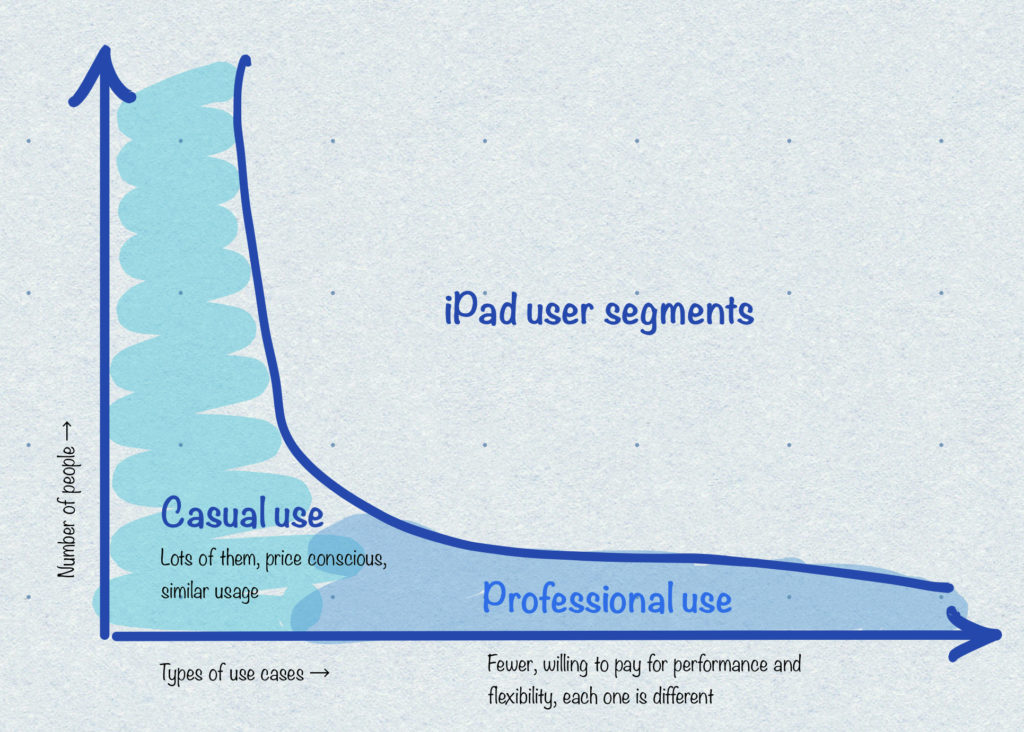
The iPad Pro is specifically targeted at that narrow segment of people who already know, or educate themselves, on what the device’s capabilities are. Most others don’t care – and for them, there exists the regular iPad.

Now the regular iPad gets some of iPadOS’s software capabilities for free, such as pointer support. But in terms of raw performance and hardware, it lags. It’s unlikely to get multiple cameras, LIDAR, Smart Connector, the speaker system, even ProMotion.

But that keeps prices down, and that’s key. The causal buyer will look at price first and features second (they are already sold on the core iPad proposition). The vanilla iPad is a killer everyperson tablet at its price.

The professional, however, is going to want a device with whole range of features and capabilities because their iPad use cases form the long tail. And for that power and functionality, they are willing to pay lots more:

The question I think Apple wants you to ask yourself is Do I *rely* on my iPad for work? For one buyer segment, the first time they ask themselves that is when they will realise they have outgrown – instantly – their regular iPad. 

Apple’s ‘What’s a computer’ ad campaign earlier and ‘Your next computer is not a computer’ campaign now is to get that segment to ask themselves that question:

So. The non-Pro versions are what the vast majority will buy. But because it has more gee-whiz, the Pro is what will get the most press. And that press creates a halo effect around Apple, deepening that sense of desirability. 

End note: Apple has had a long history of regular and pro variants of its hardware lines. You could even say it went all the way back to the Mac (simple, closed) and the Apple II (complex, extensible). The iBook and the PowerBook. The MacBook and the MacBook Pro. Today the iMac and the iMac Pro.

The iPhone and iPhone Pro difference, though, I think is somewhat facile, merely branding. In fact the regular iPhone (and previously the iPhone XR) are arguably better for heavy everyday ‘pro’ use – not only do they have nearly everything the Pro phones have, they have longer battery life because it doesn’t have to drive the more power-hungry OLED screen. I wonder if that hurts the Pro branding for other product lines where it it more meaningful.

Categories
Uncategorized

Mac OS as an iOS app – and other remote machines

In Federico Viticci’s excellent long-form blog post about the iPad Pro as a modular computer is this section about accessing his Mac (a Mac Mini):

With my Mac mini running in the background, I can open Screens on the iPad Pro, which instantly logs me into macOS with my credentials. Here’s why this setup is incredible: Screens for iPad supports full-screen output on external displays (more in the next section), which means I can interact with a full-screen macOS UI on the UltraFine display that is actually being transmitted from an iPad app over USB-C. In the latest version of Screens for iPad, I can use the Magic Trackpad to click-and-drag macOS windows, right-click to open contextual menus, and otherwise use the native macOS pointer from my iPad without even seeing the iPadOS pointer on my external display. It’s a mind-bending setup, but it works beautifully – you’d be forgiven if you looked at the photo below and thought I was using macOS and the iPad Pro next to each other. In reality, that’s just my iPad Pro running Screens in external display mode along with a Magic Trackpad 2… Effectively, this is macOS as an app.

– Modular Computer: iPad Pro as a Tablet, Laptop, and Desktop Workstation

This is fantastic. And a great way of putting it. The iPad Pro’s performance makes it possible to interact with a remote machine – graphically. And the software support both within the Screens app and now within iOS 13 make it possible to emulate Mac OS gestures via inputs connected to the iPad Pro.

My needs don’t require a full-fledged Mac OS desktop, but I do require a UNIX setup occasionally. In that case I use the excellent Termius app to SSH into my Raspberry Pi that I have physically attached to my router and mainly runs Pi-hole.

Termius has a built-in SFTP client, but I’m not sure I want to run an FTP server on the Pi. So I use Resilio Sync to transfer any files to/from the iPad. This works for the most part – Resilio Sync on the iPad even has a file provider so it shows up as a destination in Files and file browsers views, but the app needs to be open to actually sync. I can live with it, but it’s suboptimal, especially when transferring large files.