Categories
Uncategorized

A renewed interest in text

A longform exploration of new startups for a new online audience built around new interpretations and packaging of an old, in fact the oldest information format: text. Here is part of the introduction:

The text renaissance is an actual renaissance. It’s a story of history-inspired renewal in a very fundamental way: exciting recent developments are due in part to a new generation of young product visionaries circling back to the early history of digital text, rediscovering old, abandoned ideas, and reimagining the bleeding edge in terms of the unexplored adjacent possible of the 80s and 90s.

This will take you at least thirty minutes to consume well, and longer to digest.

I am thrilled of course by the renewed interest in and innovation around text for its inherent archivability, portability and exportability – given my support of open data formats and data ownership.

Although the writer does not explore memexes, I’m intrigued by new services like Notion that are text-oriented but not limited to text. Should they also count as part of the renaissance.

Categories
Uncategorized

Twitter bookmarking with Charm

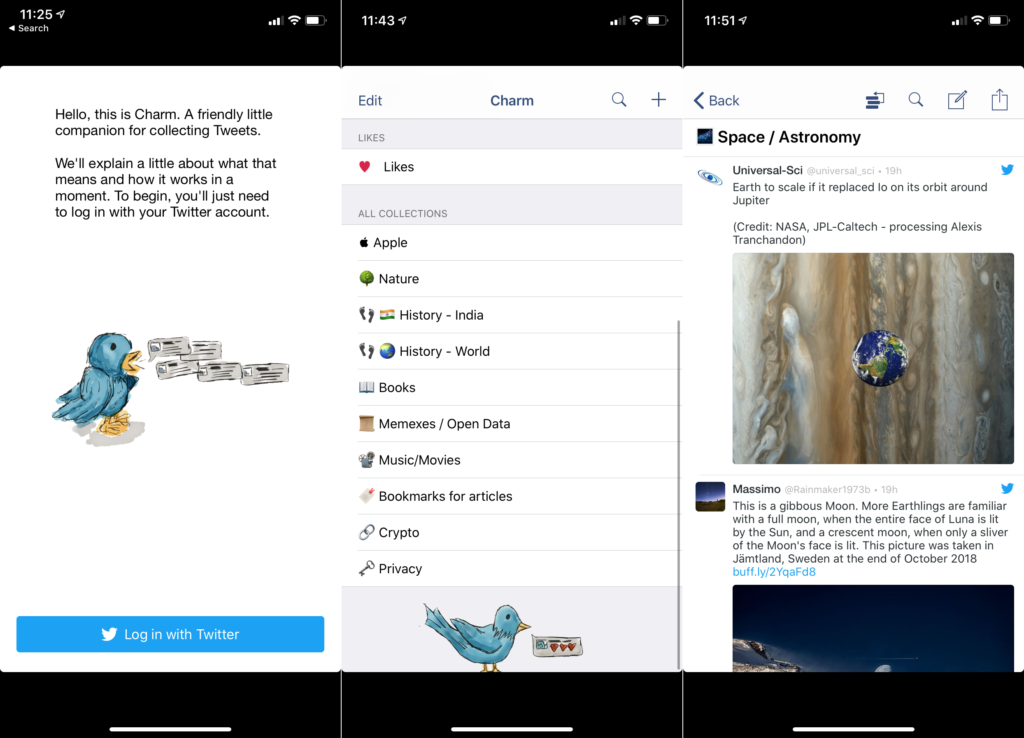
I came across the Twitter Collections iOS app Charm a couple of weeks ago. Think of Collections as multiple Bookmarks lists, so Charm is a great way of bookmarking tweets for different interest areas/themes.

Charm hasn’t been updated since 2016. The creator used to work at Twitter, but made clear that it was a hobby. So the app hasn’t been optimised for post-iPhone-X resolutions, and the iPad display is a stretched-out iPhone app.

But it works. It was well-designed when it was created. It has charming artwork, extensive support for Collections including rearranging tweets. I love it.

More than anything, the creator has not implemented their own authentication, user management, storage, encryption – it’s all built around Twitter. You log in using Twitter, you create, save Collections straight to Twitter. There are no custom extensions to Collections. And Apple hosts and manages the app itself. Ben the creator can move on, even outright abandon the project but Charm will run as long as Twitter supports Collections and Apple supports the iTunes App Store. This is similar to yesterday’s app Nomie that relies on Blockstack’s authentication and storage.

Categories
Uncategorized

A real consumer app that uses blockchain-based authentication and storage

I came across the personal goals and streaks tracker Nomie, which runs as a progressive web app in your browser.

Most notably, instead of rolling its own authentication service or implementing a social login, it authenticates via the decentralised service Blockstack. Similarly, while you can store your data locally, if you are syncing it across devices, the app implements Blockstack’s distributed storage system they term Gaia. 

Blockstack was familiar because of their 2019 security token offering, the first of its kind not restricted to accredited investors because they received a Reg A+ exemption from the SEC. But this is the first time I came across a service that actually used it. The website has a gallery of applications that use its auth and storage service.

I am trying to understand Blockstack’s approach to authentication and storage better. While authentication is no longer handled by the app developer, it is also not completely outsourced to another centralised party in the way a Google or Twitter login is. According to the documentation, Blockstack authentication happens entirely client-side:

The identity address private key is derived from the user’s keychain phrase and is the private key of the Blockstack ID that the user chooses to use to sign in to the app. It is a secret owned by the user and never leaves the user’s instance of the Blockstack Browser.

This private key signs the authentication response token for an app to indicate that the user approves sign in to that app.

While user data is stored off the blockchain on what Blockstack calls a decentralised storage system named Gaia, which is an abstraction layer above traditional ‘cloud’ storage services:

Transactional metadata is stored on the Blockstack blockchain and user application data is stored in Gaia storage. Storing data off of the blockchain ensures that Blockstack applications can provide users with high performance and high availability for data reads and writes without introducing central trust parties.

I understand the principles well but not the actual implementation, and will publish follow-on posts as this improves. In general I am uncomfortable with the fact that Blockstack does introduce its own identity, and implements its own blockchain instead of using existing large ones. However, 

… the Stacks blockchain stores only identity data. Data created by the actions of an identity is stored in a Gaia Storage System. Each user has profile data. When a user interacts with a decentralized dApp that application stores application data on behalf of the user. Because Gaia stores user and application data off the blockchain, a Blockstack DApp is typically more performant than DApps created on other blockchains.

Broadly, this is a great example of how decentralised ledger technology, or DLT, makes trustless systems possible. The application developer is free to focus on the core value proposition instead of bothering with housekeeping. At the same time, neither the application developer nor a third-party identity or storage provider have access to your identity or data. While it is up to the application developer to ensure that the data is in an open, published format, this blockchain-based approach does appear to leave ownership of the data with the end user.

Entities like Blockstack are important to the development of the ecosystem. Whatever their downsides, they’re making it easier for app developers to plug DLT in their services than it is today.

Categories
Uncategorized

Perverse incentives

From Michael Lewis’ 1991 collection of columns ‘The Money Culture’, about the then-recent Financial Services Act in the UK:

I recently spoke with a man widely regarded as one of the most astute and scrupulous investors in London. He manages nearly GBP 2 billion, some of which belongs to him. The Act essentially assumes that he is inclined to front run his clients — buy shares with his own money, then nudge the price with his clients’ money. The Act therefore requires him to execute orders for his clients before he does anything for himself. He hasn’t time for this. Often the markets are crazy, and he has not more than 30 seconds to buy or sell at a price. What he has always done is execute orders simulataneously, and give his clients the best price. He will copy with the Act by simply excluding his clients from whatever quick decsision he is making. Clients will effectively not get the full benefit of his wisdom. If I were a client I would be screaming for less protection.

– What the British can learn from American History
Categories
Uncategorized

Productivity in isolation

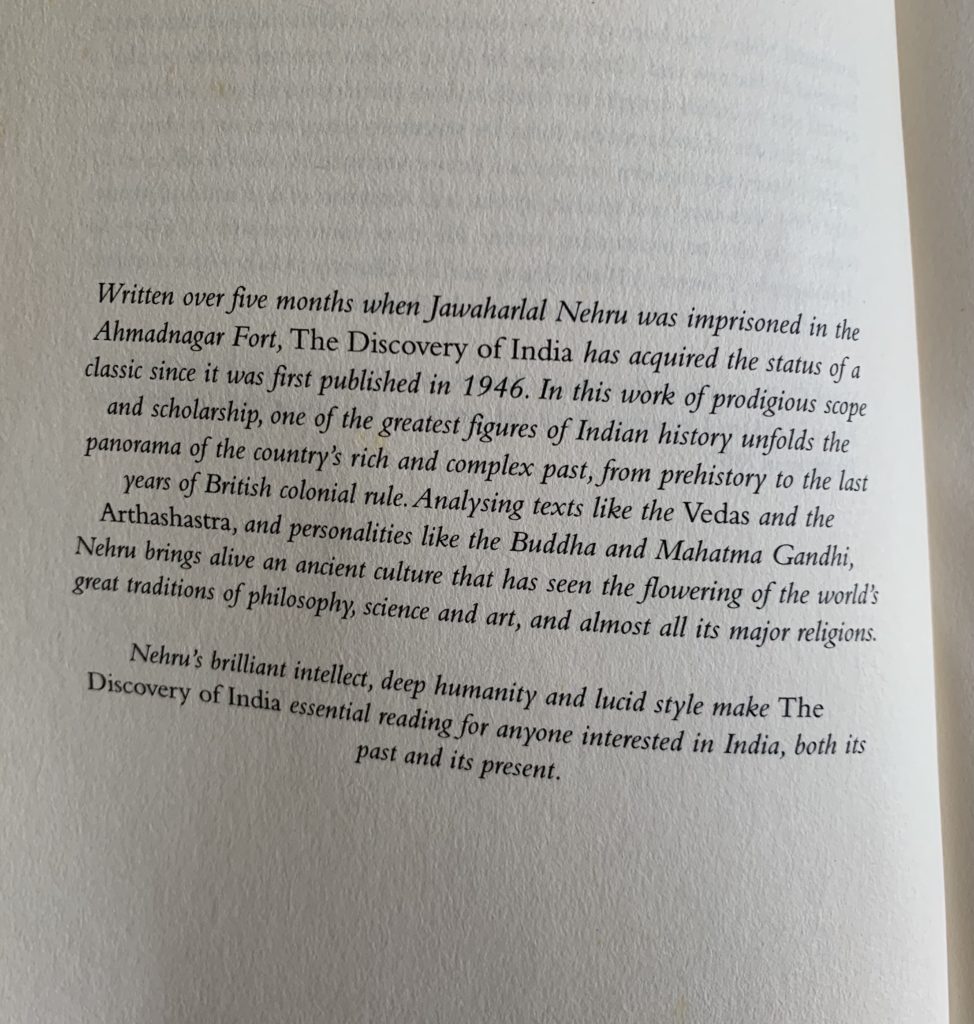
While there are several articles online about Newton and Shakespeare having been splendidly productive while in forced isolation, let’s not forget that Nehru wrote The Discovery of India while in jail during the Quit India movement.

PS: this was Nehru’s ninth, longest and final jail term, from August 1942 to June 1945. Over his life, he was in jail for over 3,250 days.

Categories
Uncategorized

Deliberation

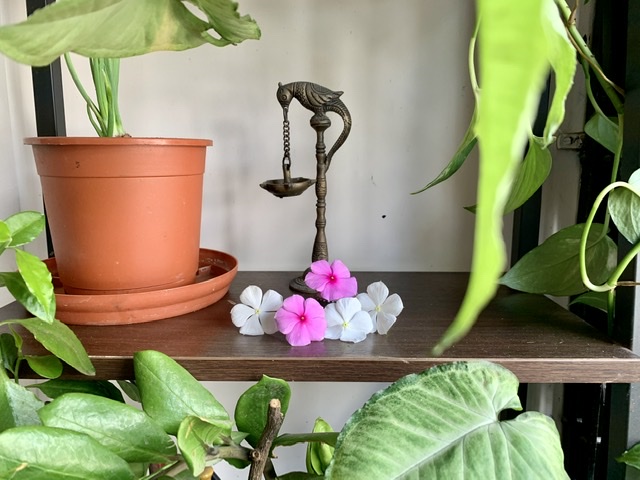
Some time ago I had a simple realisation. I have maintained plants at home for over a dozen years. I enjoy the days I spend taking on planned gardening tasks, often losing track of time

But it’s the daily maintenance – watering, rotating, trimming, spraying – that takes up most of my time. I scheduled this during my mornings, multitasking while getting ready for the work day. 

I resented mildly having to keep track of plants that needed more or less frequent watering, at having to slide my windows to reach plants in the corner. I resented those plants that had ant or big infestations no natter how early I caught it. Because I was distracted and hurried, I poured water from a tumbler into my pots instead of sprinkling it, causing the characteristic depression you see around stems. 

One day, having to spend time spraying bug repellent on a plant it dawned upon me how I had turned something I loved, a hobby, into a daily irritant and a mild annoyance. 

I quickly asked myself if tending to my plants was something I liked doing, or if it was the end result, healthy balcony gardens, that I was interested in. If it was the latter, I’d be better off delegating daily maintenance to someone. But I did like the process. More than the outcome, in fact. 

I also happened to read about the extraordinary ecologist and model Summer Rayne Oakes who has hundreds of plants in her apartment.

Watering the plants takes “about a half an hour every day, which I view as more of a meditative experience,” Oakes says. “And then once a week I probably spend a good hour, hour and a half doing composting, clipping back, that kind of stuff.”

That gave me some perspective. I don’t have as many plants, but they are a significant number. I should expect to spend more than a couple of minutes every two days with a bucket. 

Since then I have made adjustments to my morning schedule so spend a lot more time with the plants than earlier. I probably do more regular work on ridding them off bugs, but it makes me feel better than resentful. Doing this consciously has changed not just the plants’ health but my relationship with them. The garden is exactly the same but it is now a small source of joy and curiosity, instead of of irritation and anxiety. 

This change probably sounds trite. But it’s helped me be more deliberate about a few other everyday things I took for granted or did on autopilot.

Categories
Uncategorized

Tangible, intangible and in-the-middle – Part 2

At the same time, people younger than me baulk at having to manage their own stuff. As a mobile-first generation, their PCs/Macs are an afterthought. They see regular television and radio as old-world (broadcast) streaming services, and Prime/Hotstar/Alt-Balaji/Netflix as the logical next stage. they have never had to store anything, never had to back it up. They lament a TV show or music album no longer being available because a service chose to not renew a licenss, but they move on quickly because they know it’ll just show up sooner or later on another service. Impermanence is not a bug, it’s just part of the experience. 

My world of downloaded and organized libraries built up incrementally over decades seems not just an anachronism, but a different branch of evolution altogether. 

For many, having one’s media stored primarily in a format one isn’t comfortable with also affects the way one uses that media. I know a few older people who have all the music they like on their phones. They have streaming service subscriptions. But because it’s no longer on cassettes or CDs – in fact, their houses no longer have players for them – they just listen to music less. I know others who were gifted a Kindle with access to an unlimited range of books, including titles they grew up with that they said they’d longed to read. From what I know, the Kindle experience just didn’t take.

It’s unfortunate – they have more music to listen to, more books to read, more flexibly than ever, yet their lives are somewhat less rich because of this.

Of course isn’t always true. Many people have successfully made this mental shift in media, understanding deeply that the safely and longetivity of the stuff they own is always a matter of tradeoffs. I too have subscribed to a couple of streaming services – for me they’re a great way to discover new and old shows and movies, and a low-friction way of trying out new genres. If I like them, I can always buy and store them!

(ends)

Categories
Uncategorized

Tangible, intangible and in-the-middle – Part 1

Ownership of one’s personal data is a topic close to my heart, and data perservation/integrity are an important aspect of it.

I think there is a strong correlation between the generation one is born in and what medium one is most comfortable with for primary storage of one’s data.

Take one’s music, or movies, or photographs. In 2020, someone who is in their fifties or older is more likely than someone younger to think their data is most safe in physical form – for music and movies, as audio cassettes or VHS tapes or CDs/DVDs. For photographs, as physical albums. 

They are also less likely to read e-books, even on an e-ink Kindle. Anecdotally for me, people who are older don’t contrast e-books and physical books the way some younger people who have preferences do. They don’t talk about the feel of books, their smell, their heft, the uniquness of type or cover, their non-distractive nature. No, they just seem to be unable to consider an e-book a book. It seems to be a conceptual barrier.

All of this is usually instinctive – it’s not that they don’t like technology per se. It’s merely familiarity with the media that they stored and managed their first music, movies and photos in.

Personally, while I had my own audio cassettes, my first camera was a digital one – the good-for-its-time 5MP Sony W1. My first movies were CDs that I ripped to my hard drive. So I’m natively comfortable with my media being digital, that isn’t true of streaming services. 

I like to have my music in my iTunes folder, with all of the playlists I’ve made and ratings, ID3 tags and album art I’ve added over nearly twenty years (it was near-impossible to fetch meta information for Hindi and Marathi film music from the 50s to the 80s back then). I’m much more comfortble with my photos in iPhoto (now Photos), similarly organized into albums, on my Mac. Because open formats are important to me, I am concerned about the single daabase that is my iPhoto Library. And finally, I continue to store my movies and TV shows as files on my hard drive, although it has gotten very hard and increasingly expensive to buy movies/TV shows – even iTunes is now skewed heavily towards Apple+ and streaming.

Categories
Uncategorized

Coffee: filter based brewing methods healthier than unfiltered

From a large-scale study:

The new study followed over half a million healthy Norwegian men and women between the ages of 20 and 79 over a 20-year period…

Turns out if you’re a male over 60,

“…drinking boiled or pressed unfiltered coffee raised the risk of death…  due to elevated cardiovascular mortality”.

These are methods like espresso, the Moka pot or French press or Turkish coffee or South Indian filter coffee.

As for filtered coffee, it is

“…linked to a 15% reduced risk of death from any cause, a 12% decreased risk of death from cardiovascular disease in men and a 20% lowered risk of death from heart disease in women when compared to drinking no coffee”

These are methods like the aeropress or Chemex or V60.

I especially like that the article quotes this bit:

“The finding that those drinking the filtered beverage did a little better than those not drinking coffee at all could not be explained by any other variable such as age, gender or lifestyle habits. So we think this observation is true” 

As an aeropress person, this pleases me.

Categories
Uncategorized

How do you build a censorship-resistant site? Part 2

(Part 1)

When the information you publish starts causing serious damage, there will be pressure on your domain provider to delist your domain and on your hosting provider to take down your content. Things start getting quite inconvenient, and you start making tradeoffs. You can move your domain and hosting to providers in countries that are not on the best of terms with the countries that want your content to be removed. Wikileaks has hosted itself on a Russian provider in the past. If you’re a Westerner, this may make for uncomfortable bedfellows.

You can potentially fragment your content, especially if it’s text, and distribute it across notes on pastebin. Then there’s no one target. The problem again is discovery. If you have just a single piece or a small set of documents that could work. But if you want to run a publication, that will be a problem. You could run a channel on, say, Telegram to distribute your posts/episodes. With sufficient outrage, though, Telegram may shut your public channel down. But the lines appear to be if the stuff you’re publishing is child pornography, organising terrorism or fomenting an armed uprising

At this point, your only path is to get off the web altogether.

And get on the Tor network, aka the Dark Web. This will likely involve hosting your own web server, off a home computer or a Raspberry Pi. You’ll get an Onion network address, bypass the DNS infrastructure altogether. This means that your site is more or less untouchable (though not 100%) but significantly – massively, in fact – less accessible. It’s only reachable through the Tor web browser. And the distribution probem still remains – because you’re no longer on the regular web, you don’t have a regular domain name. You do have an address – that ends in .onion – but people still need to know it. For broad-based distribution of whatever it is you’re still publishing, you’re going to rely mostly on your visitors on Tor pasting and sharing it via mainstream-web chat and email. 

This is where you’ve ended up. Good luck.

(ends)