Categories
Uncategorized

Infinite reach, micro-brands and linear commerce – Part 3

(Part 2)

The Internet has also enabled

“the democratization of logistics and manufacturing, propelled by emerging digital shopping channels, has sparked a Cambrian explosion of DTC companies”

– The Pivot to Owned Commerce, David Perell

This means the barrier to entry to start a commerce business has dramatically dropped. Therefore if you have an audience that’s interested in something, you have the ability to shape that into a very specific desire and fulfil it.

The publishers of today are the commerce companies of tomorrow. Publishers with organic reach can launch and test products without paid media. Intimate customer touch-points remove the need for focus groups. With shopping experiences that are native and true to the brands DNA, they can scale fast, with relatively low investment. They can A/B test every ad, evaluate customers with engagement data, and use real-time data to iterate and improve creative. By diversifying their revenue streams, they’ll decrease business risk and increase their revenue multiples… Content and commerce are converging. Publishers who appeal to owned audiences will win the upcoming pivot to owned commerce.  

You cannot do this cynically, though:

Casper launched Van Winkle, the brand’s standalone online publication, in 2015, but quickly shut it down after struggling to deal with the site’s independence from the brand.

If you need a company, you seek it out or opt-into communication from it. “Need companies” are the email newsletters you subscribe to, the creators you talk about with friends, the podcasts you listen to weekly, and the writers who’ve blown your mind so many times that you’ll never miss a word again. They have extremely loyal audiences… “Feed companies” are the opposite. They’re undifferentiated. They try to be everything to everyone. But in reality, there’s nothing to no-one. Most feed-discovered content is interchangeable.

(Part 4 – companies that take their audience relationship to the next level)
Categories
Uncategorized

Walk and talk

“Turning my Zoom meetings into walking phone calls. Less Zoom fatigue, more steps!” – @shl

Came across this tweet quoted in my RSS feeds. Given that I’ve also been doing this – and light stretching – the last couple of months, I’m wondering how many of us are now having walking meetings without knowing about it.

No matter how informal the meeting, sitting in front of a computer/propped-up phone is not the same as sitting in a chair/couch in an in-person meeting. If we are going to be doing remote-first work for a while longer, the desk for anything more than an hour of conference calls is not an option. With walking you’re getting improved breathing and improved circulation. You pay better attention and stave off fatigue.

Some folks are getting a lot of walking done.

There are downsides, even with audio-only.

“It is frustrating for me, I hate hearing ‘I don’t know, will have to look up when I’m back at my screen’ or ‘oh, I can’t read anything you’re sharing with the meeting cause I’m on my phone on the move’” – @goldie_

Someone else in the thread remarks how walking is fine until you have to take notes, but another reply says they take notes on their phone.

I think it’s great that we’re figuring this out. We’re creating new normals that are Internet-native.

Categories
Uncategorized

Goals, habits and a disagreement

While reading in the context of yesterday’s post I came across this post on the Farnam Street blog making the case that habits, not goals, are the key to making a difference.

According to the writer, the problem with goals include that they have an end point after which people usually regress, they rely on willpower and self-discipline, even that they lead to recklessness once made public – as yesterday’s post did. In contrast habits are ‘easy to complete’, are ‘for life’, ‘can compound’ and can even ‘overshoot your goals’.

The argument is one-sided, creates a false dichotomy and advocates against a powerful tool in your arsenal towards habit formation.

A goal, set correctly, puts you on course to forming a habit. If you carelessly design a goal such that executing on it causes a major disruption to your life, it doesn’t matter if it’s in the pursuit of a habit or not.

But executing on a well thought out goal – with regular check-ins– provides a great framework for making choices and changes so that the end habit becomes sustainable.

I want to create a habit to get adequate amounts of water daily, as we saw yesterday. The goal of hitting a 250-day streak is very useful in identifying challenges or opportunities to set that habit because you’re checking in every day. The logging of water to Apple Health via the iOS Shortcut tracks the streak goal but it is in the service of identifying and removing friction in water consumption. Without it it’d be really hard to make sure I’m having enough.

The problem with the writer’s take is the following. If the pursuit of a goal is a drain on one’s willpower and causes one to be reckless, it’s a symptom of a poor relationship with oneself. If you have a healthy nurturing relationship with yourself, a goal becomes something exciting, a project to look forward to. Execution difficulties become problems to challenge yourself with. Setbacks become learning opportunities, achievements become heartfelt celebrations – all because it’s you making yourself better.

Categories
Uncategorized

Water habit and walking the talk

We have seen my tracking the tackling of my migraine problem. Recently I’ve had a recurrence of a particular variant whose trigger I have narrowed down to inadequate water intake.

The idea now is to make water consumption a habit.

  1. The consensus around enough water seems to be 2.5L a day for men in tropical climates. Although I spend most of time indoors, Bombay is humid. So I have set my daily consumption target to 3L.
  2. The consensus around building a habit is now 66 days on average but up to 254 days. Everything I can find online seems to reference a 2009 study that states

The time it took participants to reach 95% of their asymptote of automaticity ranged from 18 to 254 days; indicating considerable variation in how long it takes people to reach their limit of automaticity and highlighting that it can take a very long time.

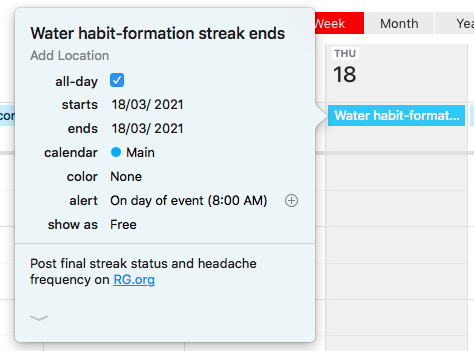
So I have set myself a target of 250 straight days of this level of water consumption, that is until 18 March 2021. The study abstract also says “missing one opportunity to perform the behaviour did not materially affect the habit formation process” so I won’t obsess over a perfect streak.

  1. To track water consumption, I’m going to simply use the shortcut I wrote in February 2020. It’s easy to launch from Launch Center Pro and logs to Apple Health, so I can look up my day’s consumption quickly. I have already logged ~5000 expenses for over 3 years via a similar LCP Shortcut, so the logging habit is already ingrained.
  2. Finally, to measure if water consumption has a material effect on that variant of the headache, I have modified my headache log script also log the variant in addition to the pain-level. Unfortunately we don’t have a baseline frequency of the occurrence of this variant. We will report in briefly every month.

This is part of what I wrote last week about walking the talk, as I write about how people are using the Internet to achieve exponential results in their lives.

Categories
Uncategorized

Customer support excellence

In 2015 I was gifted a Fitbit Charge HR. Just over two years into (on-and-off) use, the battery began to run out overnight – that is, it would last less than twenty-four hours as opposed to 5+ days when new.

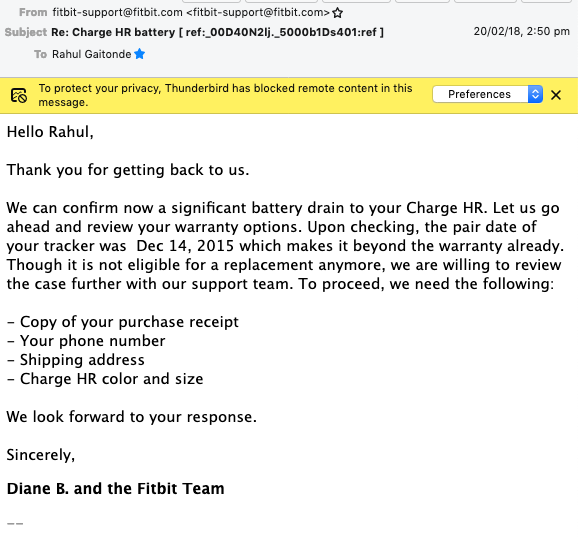
I read online that that’s typically how long the battery lasts on Fitbit devices, but I wrote to Asia-Pacific customer support anyway – Fitbit had (has?) next to no presence in India. The company put me through to tech support over email, who had me use the device overnight and then sync, and verified that there was a problem:

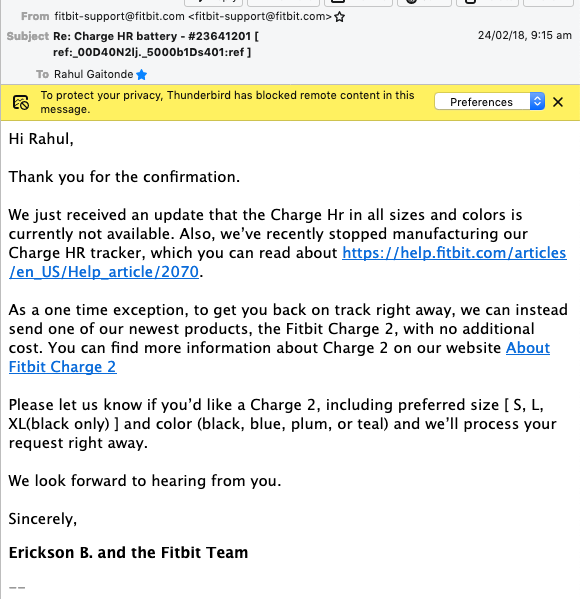
So Fitbit agreed to “review the case” even though the device was out of warranty. Over a short exchange they first agreed to replace the device as an “exception” and then, having found there were none in stock, offered me an updated model:

They also hand-held me through the shipping process and set expectations regarding customs. Since then I’ve used that Charge 2 – which is longer than I had the original.

I’ve had some good, even great customer support experiences from a few other companies in India and in the US. What is notable about this interaction was one – that it took place entirely remotely, and two – it involved multiple calls to treat this as an exception to make sure I was happy.

If only I’d use it more consistently.

Categories
Data Custody Decentralisation and Neutrality Uncategorized

The Library of Congress and online archival – Part 1

This past weekend I read about the US Library of Congress’ online archival system, partly out of simple fascination with the scale at which they operate, and partly to learn from it, to create my own offline archive of web pages and websites that are important to me.

The Library of Congress’ site describes the process:

The Library’s goal is to create an archival copy—essentially a snapshot—of how the site appeared at a particular point in time. The Library attempts to archive as much of the site as possible, including html pages, images, flash, PDFs, and audio and video files to provide context for future researchers. The Library (and its agents) use special software to download copies of web content and preserve it in a standard format. The crawling tools start with a “seed URL” – for instance, a homepage – and the crawler follows the links it finds, preserving content as it goes. Library staff also add scoping instructions for the crawler to follow links to that organization’s host on related domains, such as third party sites and social media platforms, based on permissions policies.

The Library of Congress uses open source and custom-developed software to manage different stages of the overall workflow. The Library has developed and implemented an in-house workflow tool called Digiboard, which enables staff to select websites for archiving, manage and track required permissions and notices, perform quality review processes, among other tasks. To perform the web harvesting activity which downloads the content, we primarily use the Heritrix archival web crawler External. For replay of archived content, the Library has deployed a version of OpenWayback External to allow researchers to view the archives. Additionally, the program uses Library-wide digital library services to transfer, manage, and store digital content. Institutions and others interested in learning more about Digiboard and other tools the Library user can contact the Web Archiving team for more information. The Library is continually evaluating available open-source tools that might be helpful for preserving web content.

It’s extremely encouraging that it explicitly specifies open-source tools. The most interesting part to me is the data format it uses:

Web archives are created and stored in the Web ARChive (WARC) and (for some older collections) the Internet Archive ARC container file formats.

I am now digging into the tools available to save, search and view articles in this format.

(Part 2 – A little more on why this is important to me)

Categories
Uncategorized

Appeal to bias

From the book Range: Why Generalists Triumph in a Specialized World:

“In a study during the run-up to the Brexit vote, a small majority of both Remainers and Brexiters were able to correctly interpret made-up statistics about the efficacy of a rash-curing skin cream, but when voters were given the same exact data presented as if it indicated that immigration either increased or decreased crime, hordes of Brits suddenly became innumerate and misinterpreted statistics that disagreed with their political beliefs. Kahan found the same phenomenon in the United States using skin cream and gun control. Kahan also documented a personality feature that fought back against that propensity: science curiosity. Not science knowledge, science curiosity.”

In an age where we are inundated by information and skim instead of digest, there is every incentive for publishers to present information selectively and in a way that appeals to our biases and reinforces them. More than ever before we must be skeptical of everything we read AND be open to new ideas. At the same time.

Categories
Uncategorized

Anachronistic but beautiful

Every now and again I break out some old hardware and software. For old times’ sake.

Well designed hardware lasts. Well designed software should too, but no software is an island, and therefore things break, often much too soon.

Well designed software, though, running on well designed standards runs years after its first release.

And just like good hardware wears well, old good software seems anachronistic but beautiful.

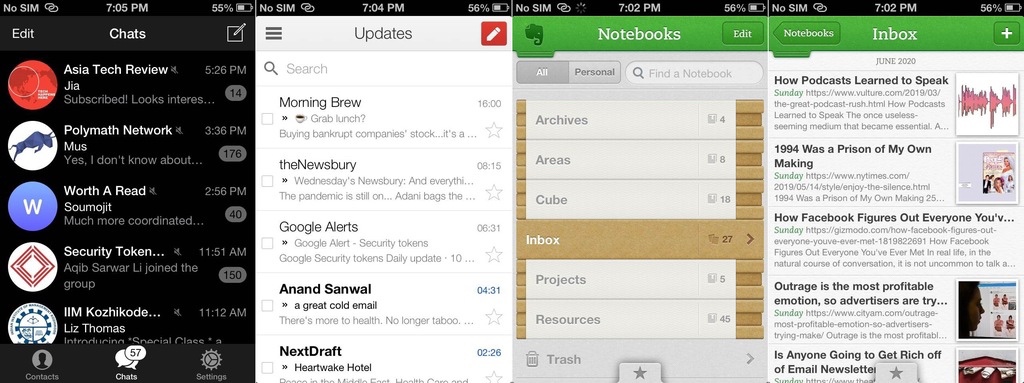
So. In 2020, here are Evernote, Gmail and Telegram running like new on iOS 6, released in 2012, running on an iPhone 4, released in 2010.

Categories
Uncategorized

Mega-trends and Big Questions – Part 4 – Wellness when Always-On

(Part 3)

How Wellness when Always-On relates to other Mega-trends and Big Questions:

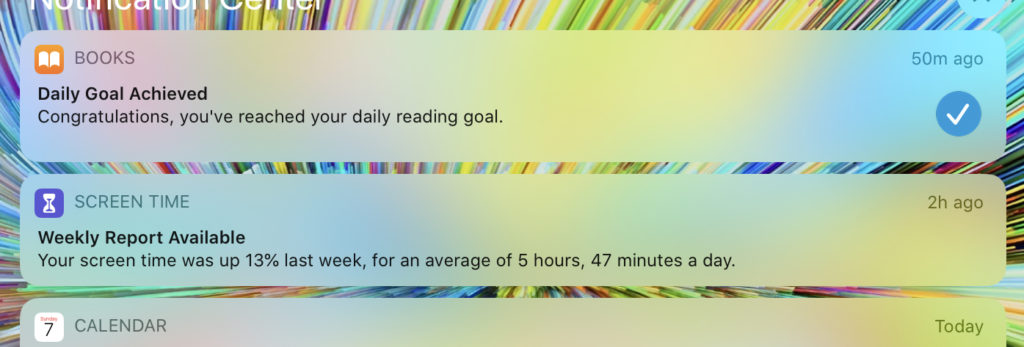
Because The Next Computer is likely to be iPad and other mobile-first devices, they will have native support for social media apps, which have turned notifications into a dark art for holding people’s attention. Apple’s solution to this has been Screen Time, which chiefly measures the time you spent on your phone, along with a list of your most-used apps. With iOS 13 Apple now also nudges you whether you really want notifications from an app – perhaps by tracking if you haven’t responded to past notifications. Over and above this, apps like Moment not only measure phone pickups and screen and app usage, but also have coaching programmes to help you kick your phone (or tablet) addiction. Regardless, none of this is a substitute for you being conscious about your computer usage, and apps being actively designed to get and hold your attention.

Conscious Discovery and Curation is extremely important to wellness. Not only because of its sheer abundance, but also because the incentives are stacked towards making it as outrage-worthy and negative as possible. It is now difficult to find mainstream news institutions, whether in print, on TV or online, that do not optimise for attention in this manner. But there are encouraging signs of individuals who recognise this, who have opinions on what is important and what is not, and while finding them is hard, following them is not. 

The Internet has made it possible for people to build an Audience directly and get their message out, independent of mediating institutions. Even so, it goes both ways: we have recently have seen one notable example of such an individual disintermediating his institution, and another placing an institution in between. The About page of the email newsletter services startup Substack links to more examples of independent publishers.

Speaking of which, email newsletters and podcasts are making a comeback from over ten years ago because of a sense of fatigue with the constant emotional manipulation and lowest-common-denominator algorithms of social media. These are part of the Dark Forest of the Internet, private, in that they are not typically not available as publicly indexable web pages. As conversation shifts away from the noise and hostility of Twitter and the envy-stoking of Facebook, it is shifting towards closed groups on messaging apps like Telegram in order to maintain a sense of sanity and focus. (Telegram has for many years been the medium of choice for cryptocurrency projects, but it’s expanded to several interest groups, including becoming a test-prep platformin India.)

So there we have it. Wellness when Always-on requires being aware of the distractions of our Next Computer, how we Discover and consume new content and the Dark Forests we retreat into, even as we build direct relationships with people who know that that Audience is their Capital.

In an age where our attention is the most valuable commodity of all, with entrenched systems and institutions that cultivate, hijack, farm, package, sell and resell it, paying that very attention, being conscious, is more important than ever before.

(Part 5 – TBD)

Categories
Uncategorized

Jump E-Bikes and Shareholder vs Stakeholders

Yesterday’s post about Uber’s decision to scrap, en masse, tens of thousands of perfectly functional electric bikes due to, according to them, potential liability issues reminded me of the debate between shareholder and stakeholder responsibility of corporations. 

Stakeholders are a broader set of people, which include employees, the communities in which the company’s offices operate, the environment, among others. Shareholders are therefore a subset of stakeholders.

This 2019 survey published by the Stanford Business School shows, though, that

Only 12 percent of the CEOs and CFOs of S&P 1500 companies believe that addressing stakeholder interests is a short-term cost that leads to long-term value… 

Common consensus is that U.S. companies are not investing in areas like sustainability, the environment, their employee base, or communities because they do not want to incur the costs today that are necessary for long-term success in these areas. However, the companies themselves do not see it this way. Most do not believe that a tradeoff exists between short- and long-term outcomes. Instead, their viewpoints tend to fall into one of two buckets: either they believe addressing stakeholder concerns is costly to the company in the short run and will continue to be costly in the future, or they believe that addressing these concerns is immediately beneficial to the company and will remain so into the future—a so-called ‘free lunch.’”

No wonder that Uber didn’t much care for, or go the extra mile for ensuring its bikes ended up with the hands of people, neighbourhoods, communities that could have really used them.