Categories
Uncategorized

How newness enters the world

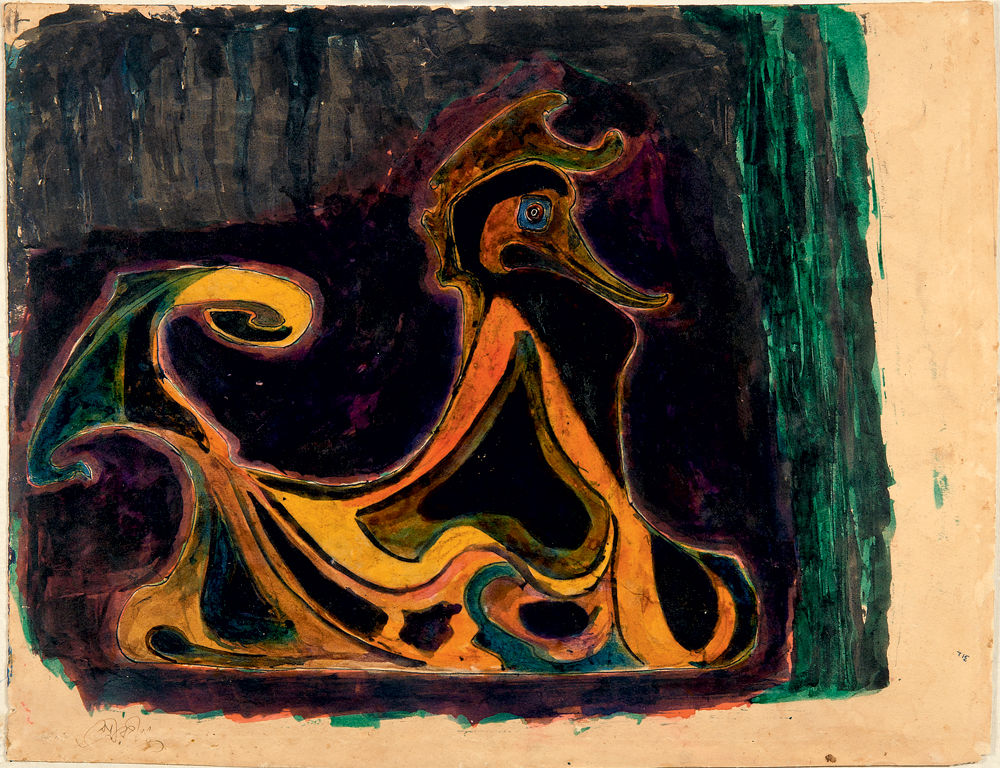
The Victoria and Albert Museum in London has this to say of Rabindranath Tagore’s paintings.

[they were] unplanned and shaped by accidents and intuitive decisions but often seem to carry memories of ‘primitive’ art objects he should have seen in books and museums.

Something of this spilled into his early paintings. Many of them represent animals, but they are seldom of the real ones we know of; more often they represent what he has described as ‘a probable animal that had unaccountably missed its chance of existence’ or ‘a bird that only can soar in our dreams’.
I am most interested in artists that imagine and express something that does not yet exist in the world:

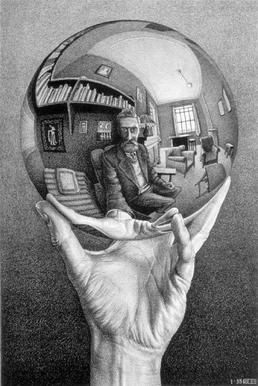
New perspectives, like that of M C Escher’s Hand With Reflecting Sphere
Or new worlds that deal with new issues, like Neal Stephenson’s books Anathem, REAMDE and (although I read it much too late to have the impact it could have had), Snow Crash.

Or fevered visualisations of otherworldly concepts like Bosch’s Garden of Earthly Delights, and – in principle – Tagore’s early paintings.

Finally, I’m reminded of Salman Rushdie’s answer to what his book The Satanic Verses was about:

[it] celebrates hybridity, impurity, intermingling, the transformation that comes of new and unexpected combinations of human beings, cultures, ideas, politics, movies, songs. It rejoices in mongrelization and fears the absolutism of the Pure. Mélange, hotchpotch, a bit of this and bit of that is how newness enters the world.

I read this years ago (the answer is from 1991) and it made an instant impact on me.
Categories
Uncategorized

Information noise, real-world noise

I live in a noisy neighbourhood with road traffic and trains honking. It’s bad enough, made worse by my tinnitus and associated noise sensitivity. And recently major road maintenance and a nearby apartment renovation project had made it near-unbearable for months. I resorted to a combination of earplugs, noise-cancelling headphones and piping white noise though them. It didn’t shut out everything but it made me functional.

The immediate noise spike has passed, but I’m now dealing with a new double whammy: a serious crisis within the family and the second coronavirus wave outside. As I spend a lot of time simply waiting (the crisis has sapped my ability to think, consult, advise, even write meaningfully), I spend a lot more time scrolling through news websites, reddit and twitter – hours on end. Relatives I’m staying with watch local news that operates in perennial breaking news mode, sensationalising the simple and optimising for outrage.

Twitter’s algorithms themselves undermine my experience – my deliberately curated follower list and keyword filters amount to nought as I’m suggested topics I have no interest in or am actively trying to avoid, and alerted to actions by people related to the people I follow – people who discuss the very subjects I’m keeping away from. Reddit is full of outrage from the United States. I can no longer rely on news, whether TV or online, for perspective. The constant optimization for eyeballs and clicks is beyond disheartening (right now: oxygen tank leak kills 22 followed a few dozen pixels below by katrina kaif tests negative for covid).

All in all, I will have to apply the same damping techniques to information noise that I did to real-world noise: specifically, training myself to run off reddit, twitter and news websites. Limit how often I read though my whatsapp groups. Catch up on my reading on the kindle. It’s only been twenty four hours. I hope it helps.

Categories
Uncategorized

Humans are the mold growing on technology

A lament about the concentration of the internet in the hands of a few mega corporations that will last well beyond your lifetime and mine. About their often malign influence, their lack of consideration for us as individuals and our utter lack of influence over them:

Sometimes it feels like the paradigm has inverted. Technology was the mold growing across human systems. Software was eating the world. Now it feels like humans are the mold growing on technology.

By and large the writer is right. Participating in today online-offline urban society means accepting monopolies (Facebook, Gmail) or duopolies (Amazon/Flipkart, iOS/Android, Uber/Ola, Zomato/Swiggy, MakeMyTrip/Cleartrip).

In theory, you can resist. You can think carefully about data custody and use open source software wherever possible. You can minimise software and data lock in, for instance by avoiding smart devices that require an internet connection to work or unlock features. You can support local businesses.

But being largely free of the influence of tech giants? That requires a major change in the way you live. Even homesteading isn’t going to be a solution.

Categories
Wellness when Always-On

Even casual online abuse diminishes everyone’s experience

The writer, performer and actor Stephen Fry in 2016, on leaving Twitter:

But I would contend that just one turd in a reservoir is enough to persuade one not to drink from it. 99.9% of the water may be excrement free, but that doesn’t help. With Twitter, for me at least, the tipping point has been reached and the pollution of the service is now just too much.

– Too many people have peed in the pool

I think the average experience on Twitter is worse than Fry describes. If you’re speaking with your neighbours on the street outside your apartment and someone cycling by yells an obscenity at the group, it diminishes everyone’s experience. That’s the real world example of a single abusive or divisive tweet in an online interaction.

Even if all you do is browse Twitter, scrolling through arguments and trolls is the online analog of walking past an ugly altercation or scuffle – it mars the outing at best and makes you feel unsafe at worse.

As we live out more of our realities online, even casual online abuse should be unacceptable. Instead, both we and social media companies have normalised it.

Categories
Uncategorized

Feeling secure

Tynan, a blogger I have followed for years:

The biggest thing I learned is that people will like you for who you are. This sounds obvious and simple, but for years I just figured that there were one or two “very likeable” archetypes, and I wasn’t one of them. Media and pop culture set this trap and it’s an easy one for anyone to fall into.

What I found was very nearly the opposite. Someone acting cool is not scarce or interesting. Someone being genuine and authentic and presenting themselves through the clearest lens possible is extremely rare. These people are so rare that when you meet them you immediately like and respect them, even if you don’t have much in common with them or even want to be friends with them

This is a lot easier if you know who you are, know what you believe in, know what you stand for, and know what your values are. Imagine that you know all of those things and you know that you are doing a reasonably good job living by them and are striving to get better. If someone thinks negatively of you, you can know for sure that they just don’t know you well enough to know the truth. You have the proof that you are living up to the standards you have set for yourself.

– How to Be Secure

Some of this occurs naturally with most of us as our life ahead of us recedes, piling up year after year behind us: as the possibilities of what we can do with our lives shrink, we unconsciously end up making peace with the person we have become.

We can also be proactive – we can be deliberate about how, with who and in what we spend our time. Not only does it slow down the passage of time, it brings each of us face to face with the person we’ve become, and presents us opportunity after opportunity to adjust course. This turns passive acceptance into active shaping.

As you become aware of yourself as a person – your likes, dislikes, successes, failures, warts and virtues – you feel more secure. This is the essence of Tynan’s post. I also think being deliberate about how you spend your time helps you discover and shape yourself, accelerating your journey to self-assuredness.

Categories
Uncategorized

Turning down the volume

In the conclusion of the excellent book “How Not To Die” by Dr. Michael Greger:

The overconsumption of sugar-sweetened foods has often been compared to drug addiction. Until very recently, this parallel was based more on anecdotal evidence than on solid scientific grounds. But now we have PET scans, imaging technology that allows doctors to measure brain activity in real time. It all started with a study that showed decreased dopamine sensitivity in obese individuals. The more the individual being studied weighed, the less responsive to dopamine he or she appeared to be. We see the same reduction in sensitivity in cocaine addicts and alcoholics. The brain gets so overstimulated that it ends up trying to turn down the volume.

This reminded me strongly of the post from a few days ago

where I described my take on why Starbucks, at least in India, made over-extracted, burnt espresso. I think it’s because the coffee had to be identifiable among the cream, flavouring and sweeteners in their drinks.

It’s the same principle at work with processed food. A friend who has experimented with several types of diets once told me his ‘palate’ changed when he moved to ‘clean eating’ (whatever that meant in his specific context), so that simply regular savoury Indian fast food seemed overwhelming.

Categories
Uncategorized

“No love, however brief, is wasted”

“I’m almost 50, and here is the best thing I have learned so far: every strange thing you’ve ever been into, every failed hobby or forgotten instrument, everything you have ever learned will come back to you, will serve you when you need it. No love, however brief, is wasted.”

Louise Miller, Twitter.

As my internal model of the world evolves, I find this to be increasingly true.

Introspection and time form links between loves near and far. The more these nodes, the richer my model gets, the clearer the patterns that form, the more obvious the truths that emerge, the more visceral their understanding becomes, and the fewer the conflicts I experience.

Categories
Uncategorized

The Remembering Algorithms in our lives are not our friends

This writer called off her wedding, but finds it hard to escape being constantly reminded of the relationship. On This Day photo reminders, anniversary emails, recommended topics to follow – all features that were previously welcome have now made her online world an emotional minefield.

When engineers build ad retargeting platforms, they build something that will continually funnel more content for the things you’ve indicated you’re interested in. On average, that’s the correct thing to do… [b]ut these systems don’t factor in when life has been interrupted. Pinterest doesn’t know when the wedding never happens, or when the baby isn’t born. It doesn’t know you no longer need the nursery. Pinterest doesn’t even know if the vacation you created a collage for has ended. It’s not interested in your temporal experience.

So much of our software has become more than a tool. Because the majority of popular software is either ad-driven directly or indirectly, many features now serve both the software provider and you. Re-surfacing old photos as ‘memories’ is meant to have you, the user, use the app by responding to the notificaton, a notification whose timing has been chosen to maximise the probability of you tapping it.

This is no longer a simple photo organiser that you use. Both you and the software’s maker are using each other.

This is deeply uncomfortable for me, not just on principle but also because in mere weeks or months I will face an event that’s will turn many past events into painful memories, and I don’t know how I’m going to deal with it.

Categories
Uncategorized

Change is inevitable but you can stay conscious of it

Olga Khazan says you can be a different person after the pandemic: https://www.nytimes.com/2021/04/06/opinion/covid-personality-change.html

After all, the person who emerges from quarantine doesn’t have to be the same old you. Scientists say that people can change their personalities well into adulthood. And what better time for transformation than now, when no one has seen you for a year, and might have forgotten what you were like in the first place?

… now, it appears the idea that our personalities are immutable is also not quite true. Researchers have found that adults can change the five traits that make up personality — extroversion, openness to experience, emotional stability, agreeableness and conscientiousness — within just a few months.

Like almost everyone around you, you have lost, gained, stressed, adapted. Some change in personality is going to be inevitable, I think. You may not even have the power or drive to be deliberate about it or influence it. The only question then is how conscious you will be of this change. So that over time, in less trying circumstances, you can mould it forward or backward.

(Via Jason Kottke https://kottke.org/21/04/you-can-be-a-different-person-after-the-pandemic)

Categories
Uncategorized

On meditation and the recent articles about problems with mindfulness – Part 2

(Part 1)

None of this is to defend or criticize meditation. Nor do I have easy solutions – or any solutions – to mitigate the risks that the articles vividly describe. These are my observations of the difficulties I’ve faced in my own years of practice. More of us need to understand that not only meditation a hard journey but also that breakthroughs are vastly more powerful than we expect.

The academic I K Taimni, in the preface to his masterful exposition of the Yoga Sutras of Patanjali, had this to say about people embarking on the practice of Yoga:

[the pursuit of the Yogic ideal] can be undertaken only on understanding fully the nature of human life and the misery and suffering which are inherent in it and the further realization that the only way to end this misery and suffering permanently is to find the Truth which is enshrined within ourselves, by the only method which is available, namely, Yogic discipline.

It is also true that the attainment of this objective is a long-term affair and the aspirant should be prepared to spend a number of lives—as many lives as may be required—in its wholehearted and single-minded pursuit. No one can know in the beginning his potentialities and how much time will be needed. He can hope for the best but must be prepared for the worst.

It cannot be, as he says, “undertaken as a mere hobby or to find an escape from the stress and strain of ordinary life.”

(ends)